


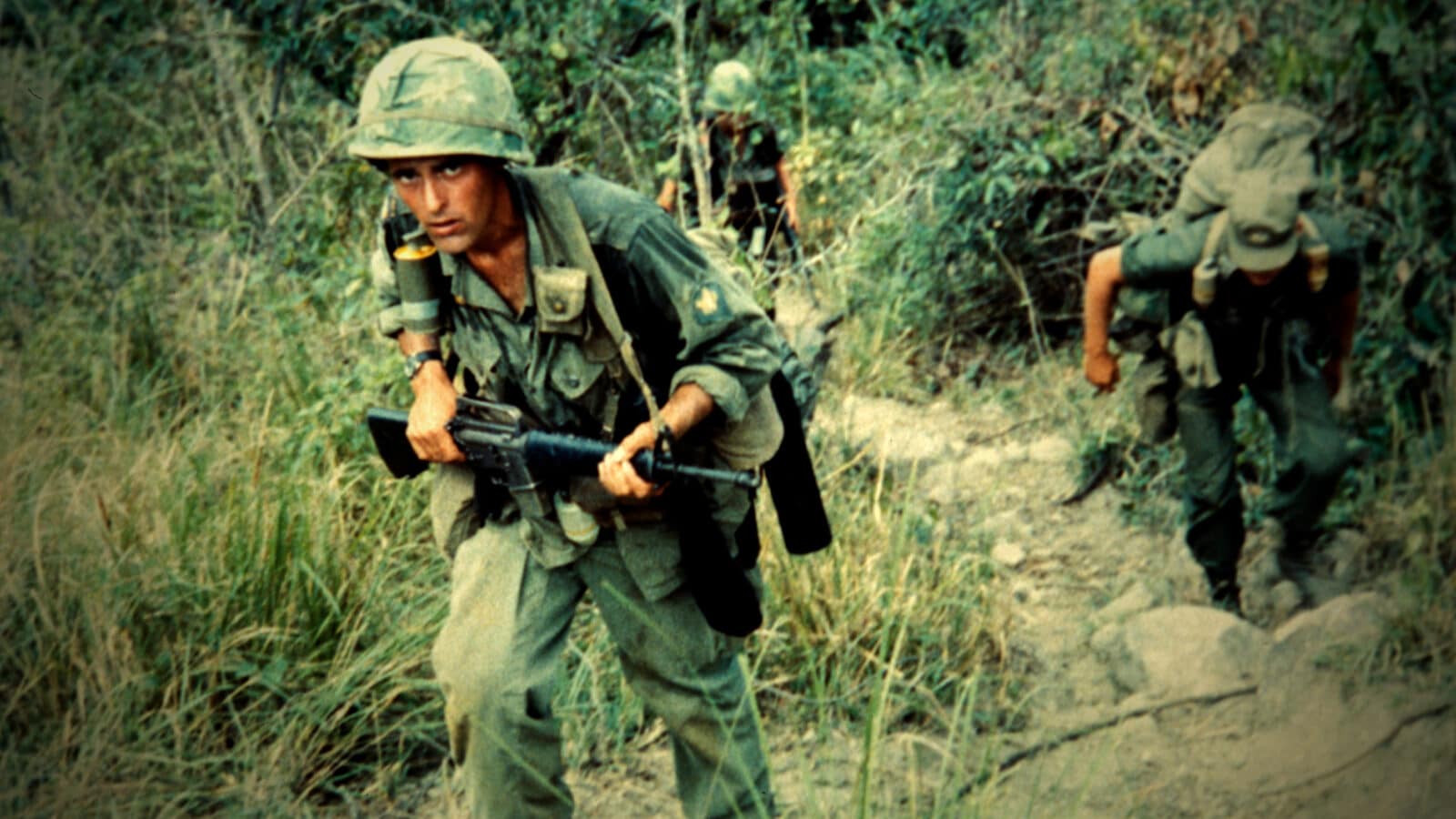
“Practically every one of our dead was found with his rifle torn down next to him where he had been trying to fix it.” — Excerpt from a letter written by Marine in 1966 to his family after a firefight in Vietnam.
Parts of this Marine’s letter was read by Rep. James J. Howard (D-N.J.) to the House. At first, there were reports circulating in the military that the newly developed M16 rifle jammed frequently in combat. We could send astronauts off into space, but our government couldn’t field a reliable service rifle? In May 1967, those reports were made public. It took a Congressional Committee to right the M16 rifle program.
Background
Advisors were initially sent to Vietnam as early as 1955, and then in 1965 the U.S. was all in and officially committed combat troops to Vietnam in 1965. M14 rifles were originally issued to troops bound for Vietnam, but the rifle was deemed too long, heavy, had too much recoil and was uncontrollable if fired in full-auto.

Conversely, the Viet Cong AK-47 was proving to be highly capable. In the dense jungle environment, a lighter, more maneuverable weapon like it was needed. A new caliber was also being developed that would offer lighter recoil and theoretically equal or greater power than the 7.62 NATO.

The result was a high-velocity .22-caliber round that could penetrate a steel helmet at 500 yards, offered less recoil, and allowed soldiers to carry more ammo. The .223 Remington cartridge was the new military round and was officially adopted in 1964 and named “Cartridge, 5.56mm ball, M193”. By 1965, the M16 rifle was being fielded in Vietnam, replacing the much larger M14.
Powder Snafu
The spec for the 5.56 cartridge was for IMR 4475 stick powder, but the producer of the powder could not manufacture it in the quantities requested by the military. A ball powder was the solution, and that seemingly small change was a major factor in M16’s jamming in the jungle. The public was already unhappy with a war in a country most never knew existed before. But I’m getting ahead of the story.
Congress Investigates
The U.S. House of Representatives created a subcommittee in May of 1967 to focus on reports of malfunctions of the M16 experienced by both U.S. Army and Marine Corps personnel. The “Armed Services Special Subcommittee on the M16 Rifle Program” was the official title, and they investigated the controversy with the M16 rifle in Vietnam.

Hearings were held between May 15 and August 22 of that year, and a number of field investigations were conducted at military facilities in both the U.S. and in South Vietnam. To quote the Subcommittee findings, management of the Army rifle program was “unbelievable” and should be “thoroughly reviewed.”
What’s In The Report
Richard H. Ichord (D-Mo.) was the chairman of the subcommittee, and the report generated by the three member committee on the failures of M16 is generally known as the Ichord Report. The report noted key issues with the M16:
- The 5.56mm cartridge used in the M16 was tested and approved with the use of extruded powder, which was switched to ball powder, producing more fouling, which quickly jammed the M16.
- The lack of a forward assist on the M16 caused the rifle to become inoperable when the bolt failed to go fully forward.
- The M16 lacked a chrome-plated chamber, which allowed corrosion problems and contributed to case-extraction failures.
- No cleaning kits, nor instructions on how to clean the M16, were given to troops.

The change in powder, lack of cleaning equipment and training, and the lack of a chrome-plated chamber in the rifle created a perfect storm that led to jamming of the action of the rifle. Subcommittee members learned that some troops who did have access to cleaning rods taped the rod to their rifle in the event a cartridge case stuck. To clear the jam, the cleaning rod was inserted into the barrel to knock out the spent cartridge case. Other changes were recommended including changing the barrel rifling twist rate and adding of a buffer to slow the rate of fire.

Live The Armory Life. The latest content straight to your inbox plus an automatic entry to each of our monthly gun giveaways!
The military published the graphic manual, “The M-16A1 Rifle: Operation and Preventative Maintenance”. These instructions along with cleaning kits were issued to troops as a result of the Ichord Report.
The End Results
The Subcommittee also found conflicts of interest between a commanding general of the Army Weapons Command throughout negotiations for the Army’s procurement of the M16. The general retired and was hired by the original M16 manufacturer, which the Subcommittee called unethical. The change to the new powder “was not supported or justified by test data,” wrote the Subcommittee.

The findings of the report were incorporated into what would become the M16A1, which had significantly fewer reliability problems and led to the respected M16-, M4 Carbine- and AR-15-pattern rifles we know of today. It would appear it took an act of Congress to get the M16 rifle back on track.
Editor’s Note: Be sure to check out The Armory Life Forum, where you can comment about our daily articles, as well as just talk guns and gear. Click the “Go To Forum Thread” link below to jump in!