


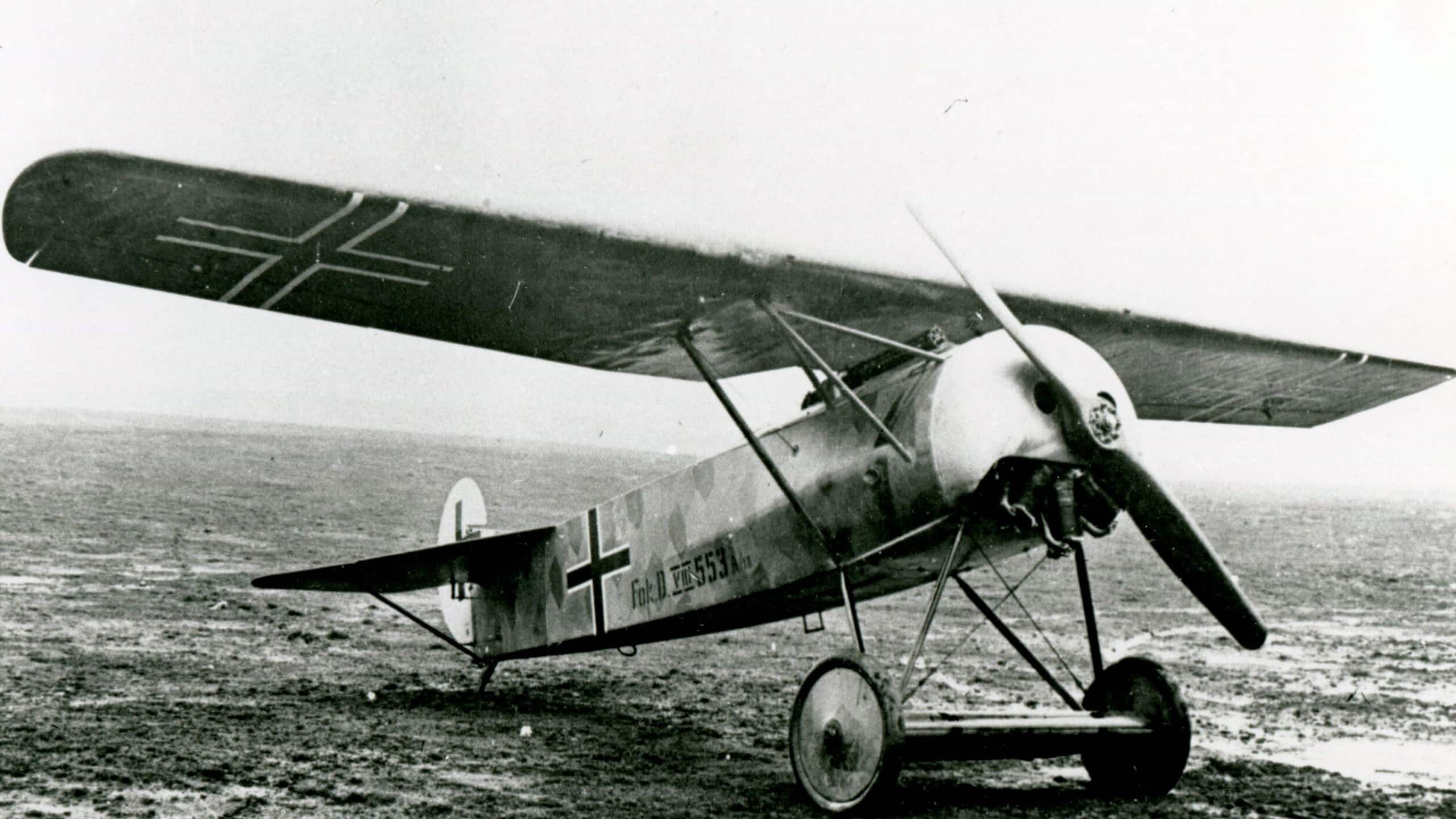
In the summer of 1918, a new fighter ascended in the German Air Combat Forces, or Luftstreitkräfte, boasting a level of performance that would outpace any of Anthony Fokkers’ famous designs. The Fokker E.V parasol monoplane, eventually known as the Fokker D.VIII, demonstrated tremendous combat potential during Germany’s Second Fighter competition of May-June, and multiple frontline pilots lauded the E.V’s outstanding maneuverability. But in a bizarre twist of aviation fate, the new Fokker was grounded by the end of August. The “Flying Razor” had become a blade that cut both ways, and its reputation forever clouded in controversy.
The German Fligertruppe’s “Fokker E.V” nomenclature denotes the fifth production monoplane (“Eindekker”) produced by Anthony Fokker, the famous Dutch aircraft designer. As for parasol wing construction, it had been employed before, but primarily on low-performance types used early in the Great War. By 1918, priorities in the air war had changed, and in this case, the E.V represented a different approach to aircraft production. Fokker and designer Reinhold Platz committed themselves to a simple, clean, and efficient single-wing design, with a focus on cost-effective manufacturing. Development of the E.V culminated in a unique-looking, plywood covered aircraft with a cantilevered wing.

In the first Fighter Competition, held in the first weeks of 1918, the earlier Fokker V.17 prototype featured a cantilevered wing, and it became the fastest aircraft tested that January. Even though the V.17 was rejected for several reasons, Idflieg officials directed Fokker to produce other monoplane designs for the second competition in May, where the E.V was the clear winner.
Minimalist Practicality Takes Wing
The E.V used a new cantilever wing made from plywood. The fuselage and the tail used a simple and cost-effective steel tube framework that was covered with fabric. Consequently, the materials of the E.V’s construction were readily available in Germany — which was an increasingly important consideration.
Fokker had hoped to combine the parasol design with a powerful new engine, either the 45 hp Oberursel Ur.III or the 160 hp Goebel Goe.III, but neither powerplant was available in the numbers required. Consequently, the E.V prototype (the V28) used an engine that was considered functionally obsolete — the 110 hp Oberursel Ur.II.

Interestingly, the E.V’s Ur.II rotary engine provided just 10 more horsepower than the UR.I engines that powered the Fokker Eindekker fighters of mid-1915. The UR.II engine was also used on the Fokker Dr.I Triplane, which was exceptionally maneuverable but quite slow. Coupled with the E.V’s sleek design and light weight, the elderly UR.II engine still gave the E.V a top speed of 127 mph and a strong rate of climb (1,600 feet per minute), superior to the latest Allied fighters of 1918.
In 1918’s Second Fighter Competition, a group of test and combat pilots put multiple manufacturers’ prototypes through their paces, including strong candidates from Junkers (the single wing, all-metal D.I) and Pfalz (the D.XII biplane). Fokker’s cantilever wing design delivered impressive results, and the V.28 won the competition.
The aircraft was immediately ordered into production and was designated Fokker E.V. The test pilots reported that the new Fokker provided a fast take-off and a quick climb to altitude for interception missions. The E.V was easy to fly, maneuverable, and quick on the controls. Its dive capability was strong enough to get away from trouble, and the pilot’s view was highly praised. Expectations were high.

But before the end of August, all Fokker E.V aircraft were grounded. Three pilots had been killed as their E.Vs suffered catastrophic wing failures. On August 24th, the “Sturz-Kommission”, led by Lt. von Mallinckrodt, began an investigation.
Wing Failures and the Blame Game
The first E.V aircraft were sent to Jasta 6, based at Bernes, France in the Somme region. Jasta 6 was part of Jagdgeschwader Nr 1, the famed Richthofen’s Flying Circus, and six arrived by August 7th. It seems that the E.V’s swift progress from official acceptance to factory production to squadron service did not raise alarm. Meanwhile, E.Vs were also delivered in small amounts to Jastas 1, 19, 24, and 36 during the first two weeks of August.

Lieutenant Emil Rolff of Jasta 6 scored the first confirmed victory in the type on August 17th, downing a Sopwith Camel of the British 203 Squadron. Rolff was killed two days later when the wing of his E.V collapsed, and his plane plummeted down from 300 meters. This was the second fatal accident in three days, as on August 16th, Ernst Riedel of Jasta 19 was killed when his E.V’s wing fragmented during a familiarization flight.
In addition to the dramatic wing failures, the Fokker E.V also suffered from a lack of proper lubricating oil for use in its rotary engine. Castor oil was the preferred lubricant for rotary engines, and while it was plentiful in Allied air forces, Germany had little of it. Instead, German rotary engines tried to make do with “ersatz” oil — forcing pilots to nervously baby their rotary powerplant to keep the engine from seizing.
As the Sturz-Kommission team began their inspection, Anthony Fokker immediately claimed that the wing failures were the fault of Idflieg’s modifications to the E.V’s original design — declaring that the changes over-strengthened the rear main spar. Fokker said this caused the parasol wing to twist and break apart.

However, when several aircraft were disassembled at Adlershof, the nature of the problems were not found in the design, but rather in Fokker’s workmanship and the poor quality of the materials used. One investigative report stated:
“The workmanship was at once seen to be deplorable, and defective timber had been used for the spars. The wing of another machine, No. 110/18, showed the same deficiencies. Fokker E.V No. 127/18 was even worse, as water had collected inside the wing, and the wood was rotting. When the plywood skin was cut, a stream of fetid water flowed out, indicating that the glue was disintegrating.”
Fokker had sub-contracted construction of the E.V wings to the Gebrüder-Perzina factory, and the work had not only been rushed, but the quality control was also almost nonexistent. Inferior quality wood had been used, the spar assemblies were weak, and water damage eroded the connection of glued parts.

A new wing was constructed with strengthened spars, and a varnish-coated interior, and this was tested on September 7th. Additional tests proved that the wing design was quite safe, provided it was properly constructed. With the manufacturing team at Gebrüder-Perzina fully informed, and quality control measures implemented, Fokker was authorized to resume production on the E.V.
It is worth noting that Anthony Fokker had been warned before. In October 1916, as his M.21 prototype for the Fokker D.III was evaluated, Idflieg inspectors found evidence of shoddy construction and poor workmanship. When a D.III was disassembled, the wing structure barely passed the tests, while the fuselage and tail were found far below specifications. Idflieg formally reprimanded Fokker for “substandard construction practices”. Production of the Fokker D.III was allowed to continue (210 were built), but the aircraft was barred from frontline service and was used in home defense and training units until late 1917.

Live The Armory Life. The latest content straight to your inbox plus an automatic entry to each of our monthly gun giveaways!
The investigation of the E.V wing failures was a far more serious matter than what is often described. Idflieg officials sent a letter to Fokker and informed him that they held him personally responsible. There was also a recommendation for criminal charges to be brought against Fokker, but these never materialized. The German military had much greater challenges to resolve at that point, and Anthony Fokker and his aircraft designs were going to be needed.
Deliveries of the parasol wing fighter resumed in October. By the time the aircraft reached frontline Jasta 11 on October 24th, it had a new name: The Fokker D.VIII. Idflieg had dropped all earlier fighter prefixes (“E” and “Dr”) and replaced them with “D”.

There is little information available about the D.VIII’s service during the last weeks of the war. Clearly, the fighter made a significant impression on friend and foe alike, but its actual contributions to the air war were small — only 84 were accepted for service before the Armistice. Concerns about wing failure seem to have been mostly overcome in Germany, but news of the early problems apparently surfaced among the Allies who received D.VIIIs as part of their war reparations in early 1919. The French, British, Italians, and Japanese did little with their D.VIIIs before scrapping them. However, one of the best accounts of flying the D.VIII comes from a U.S. Army Air Service report, detailing a test flight conducted at McCook Field (Dayton, Ohio) during May 1921. Lieutenant Leigh Wade described flying the D.VIII:
“The airplane has a tendency to turn to the right in taxiing, takes off very quickly, climbs very rapidly, and is very maneuverable. It is easy to fly, and the controls are sensitive. It is tail heavy, but so light on the controls that it is not tiresome to fly. The visibility is very good. The machine guns are so placed that in the event of a crash; the pilot would undoubtedly be injured by being thrown against the same. The airplane lands very slowly with a slight tendency to drop the right wing, and to turn to the right on the ground. The controls for the engine are very inconveniently located, because the throttle for the gas is on the left side of the fuselage, and the throttle for the air is on the left side of the control stick.”
Smuggled into Holland
Since the terms of the Treaty of Versailles prohibited Germany from producing military aircraft, this limited Anthony Fokker to making only civil aircraft. To maintain his business, Fokker smuggled many “salvaged” aircraft out of Germany into his native Holland.

Among this large total (up to 150), twenty were D.VIIIs. In Dutch service, these aircraft were finally fitted with the powerful engines Fokker originally envisioned, and they served throughout the 1920s. Fokker got away with questionable behavior yet again.
In Action over Poland
Shortly after the Armistice, the newly created Polish armed forces secured a total of 17 E.V/D.VIII from former German territory. Seven of these were flyable, and the remainder were used for parts. Lieutenant Stefan Stec recorded the Polish Air Force’s first aerial victory (April 29, 1919) by shooting down a Nieuport 21 fighter on the Polish/Ukrainian border in the early days of the Polish-Soviet War.

Further aerial combat was over Poland was limited, but as the war progressed, Polish E.V/D.VIII fighters flew many strafing and reconnaissance missions. One E.V remained in Polish service until 1924.
The Blue Max
In the closing scene of the 1966 film “The Blue Max” (20th Century Fox), the main character, German pilot Lt. Bruno Stachel (George Peppard), demonstrates a parasol-wing monoplane fighter inspired by the Fokker E.V. Described as a “death trap” by a previous test pilot, the monoplane (a modified Morane 230 trainer) comes apart in midair, leading to a fatal crash that concludes the film.

Nearly fifty years after its disastrous debut, the Flying Razor’s early reputation as a pilot killer lived on, even in the movies.
Fokker E.V/D.VIII Specifications
- Length: 19 ft 3 in
- Wingspan: 27 ft 4 in
- Height: 8 ft 6 in
- Wing area: 115 sq ft
- Empty weight: 893 lbs
- Gross weight: 1,334 lbs
- Powerplant: 1 × Oberursel UR.II 9-cyl. air-cooled rotary piston engine, 110 hp
Performance
- Maximum speed: 127 mph
- Endurance: 1.5 hours
- Service ceiling: 20,000 ft
- Rate of climb: 1,600 ft per minute
- Time to altitude: 3,300 ft in 2 minutes
Armament
Editor’s Note: Be sure to check out The Armory Life Forum, where you can comment about our daily articles, as well as just talk guns and gear. Click the “Go To Forum Thread” link below to jump in!