


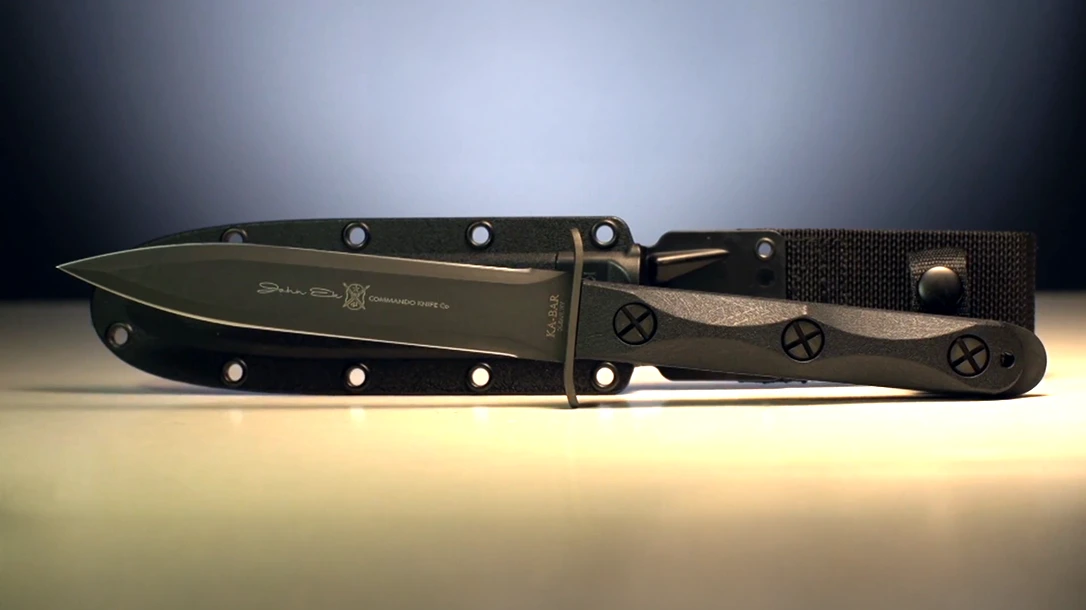
Inspiration comes in various forms when it comes to article endeavors. An early press release for my latest Jack Carr book purchase, CRY HAVOC, featured various 1960s-era items. Along with a Colt Commando rifle (CAR-15/XM177), a tomahawk, and other paraphernalia, there was a dagger that caught my attention. I had to find out more about this blade and have one. What I was looking at was an Ek Model 4 Commando Dagger, and KaBar had what I needed. This had my mind off and running. I admit to having a “knife problem.”
The KaBar Ek Model 4 Commando Dagger
The Ek Commando Knife Company’s history dates back to 1939. John Ek established the company in Hamden, Connecticut, with several stops along the way, before Kabar assumed production in 2014. The Ek Model 4 originates from an era when the world was ablaze with hard men performing demanding tasks that could involve close-range blade work. Its contemporaries were the Fairbairn–Sykes and the V-42 daggers.
The original Ek blades were made of 1/8-inch-thick Nickel-Chrome-Moly Steel. They were full tang, and the two handle pieces are secured with hot-poured lead rivets. This design makes for an extremely strong knife.
Advertisement — Continue Reading Below
Mr. Ek preferred wood for his knife handles, as leather could deteriorate and metal would be uncomfortable in hot or cold climates. The majority of the handles were made from Rock Maple, but some Oak was also used.
The lead rivets put the balance of the knife firmly in the hand. These traits carry over to today, with some changes in materials and methods to achieve the overall goal.
Advertisement — Continue Reading Below
The KaBar Ek Model 4 Details
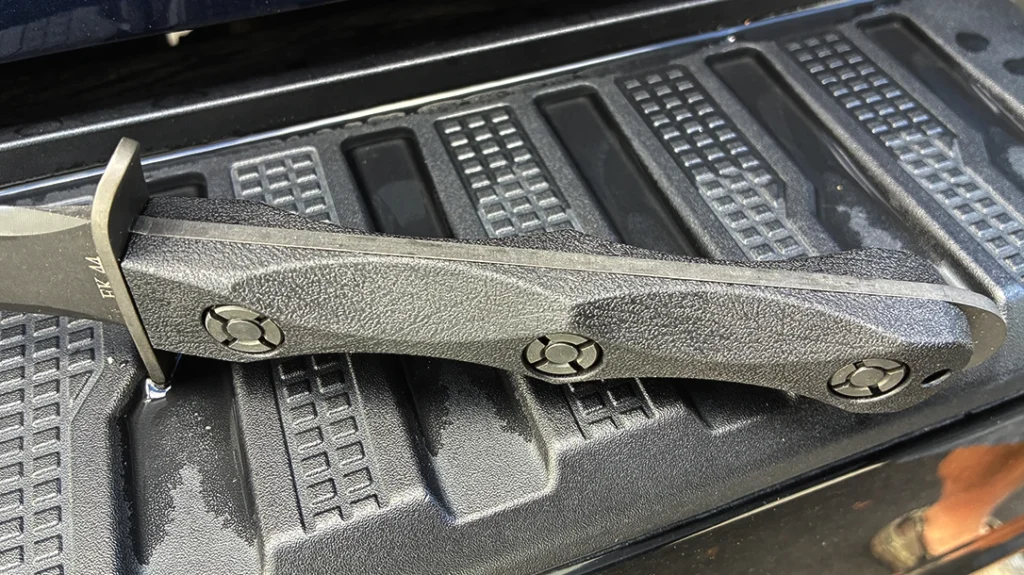
The current Kabar Ek Model 4 is US-made from 1095 Cro-Van with a parkerized finish. Textured and scalloped glass-filled nylon handles using X-head fasteners pay homage to original Ek methods, once the hot-poured lead rivets were phased out.
The grip’s scallop grooves, four on each of two grip panels, provide such a good grip that John Ek believed that a crossguard was not necessary to prevent the hand from sliding onto the blade. His first blade designs did not feature a crossguard for that reason.
Advertisement — Continue Reading Below
Rockwell hardness is 56-58, offering both edge retention and ease of sharpening. Overall length is 12.6 inches, with the double-edged spear-point blade measuring 6.625 inches. Weight is 11 ounces, with the balance point focused in the hand—important for a fighting knife. You do not want a blade that is front-loaded with the weight shifted forward, “pulling” it out of your hand.
Another nod to the Ek-legacy is the “S-style” blade guard of 12-gauge carbon steel. A US-made Celcon sheath with a retaining strap, self-locking function, and multiple tie-down points arrives with the Kabar Ek Model 4.
The Ek Model 4 design has maintained a loyal following in the knife world, with numerous collaborations and limited editions. Spartan Blades and Elishewitz both offer their renditions of the Ek Commando knife as excellent examples. KaBar keeping the Ek Commando knife “alive” is much appreciated.
Advertisement — Continue Reading Below
Daggers—One Mission
The dagger dates to the very earliest part of human history. Daggers were initially fashioned out of stone and bone, and then every other advancement in material technology that humanity progressed through—bronze and iron–up to our modern-day steels. They served as ceremonial objects and status symbols for many societies’ elites, dating back to antiquity. Two daggers were found in King Tut’s tomb.
The dagger is primarily a stabbing weapon. Its blade profile leaves no doubt of its motif. The dagger is, and always has been, a close-range fighting weapon, not a general-purpose tool. This was especially true of early dagger specimens made of materials such as flint, obsidian, bone, ivory, etc. Such daggers had a flimsy point, limiting any utility as a prying tool. The desire to keep the all-important dagger tip pristine is understandable.
Over the last hundred-odd years, the dagger’s design has solidified into a recognizable pattern: tapered point, a central spine, dual cutting edges honed to razor-sharpness. Most daggers feature a crossguard to keep the hand from riding forward onto the blade. Sharpened full-length twin edges enable the user to make broad slashes using either a forehand or backhand arm movement.
Advertisement — Continue Reading Below
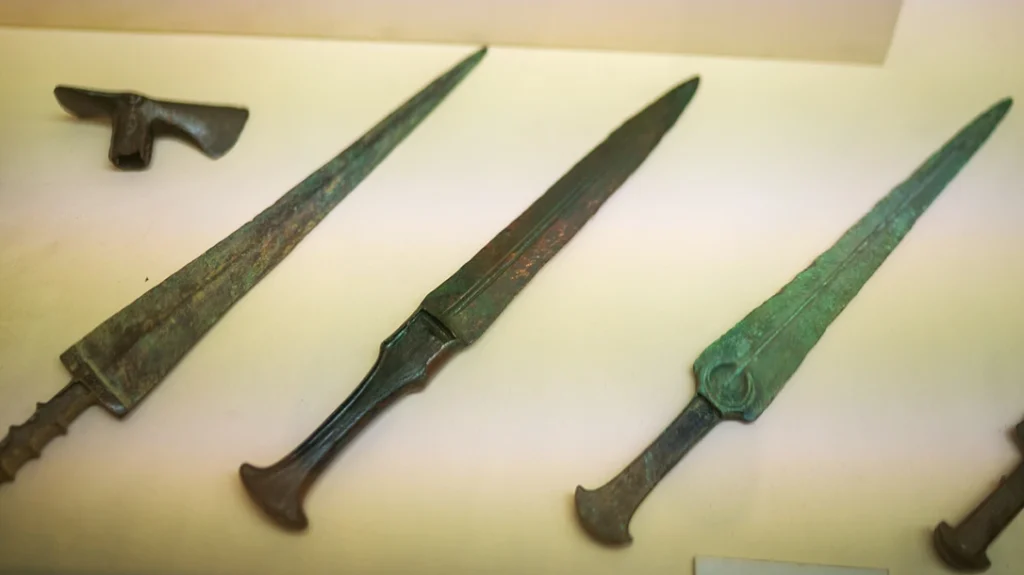
Make no mistake, the dagger is primarily made to thrust and puncture an adversary. However, its deadly versatility distinguishes the modern dagger from more specialized thrusting knives, such as the stiletto, which often lack sharpened edges and rely solely on their points.
The thought process behind the daggers is to end an engagement with one violent, well-placed thrust. When used correctly, the dagger is the knife world’s “sucker punch,” coming from nowhere and deciding the matter quickly and silently. There is purity in the dagger’s simplicity. No artistic flourishes or clever knife drills are needed. Just aggression and knowledge of human anatomy.
Advertisement — Continue Reading Below
Background of the Ek Commando Dagger
Any dagger model that has appeared during or since WWII is inevitably compared to the Fairbairn–Sykes (FS) model. The FS set the bar for modern dagger design. It is a double-edged fighting knife with a foil grip developed by William Ewart Fairbairn and Eric Anthony Sykes.
The sharpened double edges arose from the belief that a clean-cut artery will bleed out quicker than a ragged/torn artery. They based the FS dagger on lessons learned while advising the chaotic Shanghai Municipal Police in China before WWII erupted.
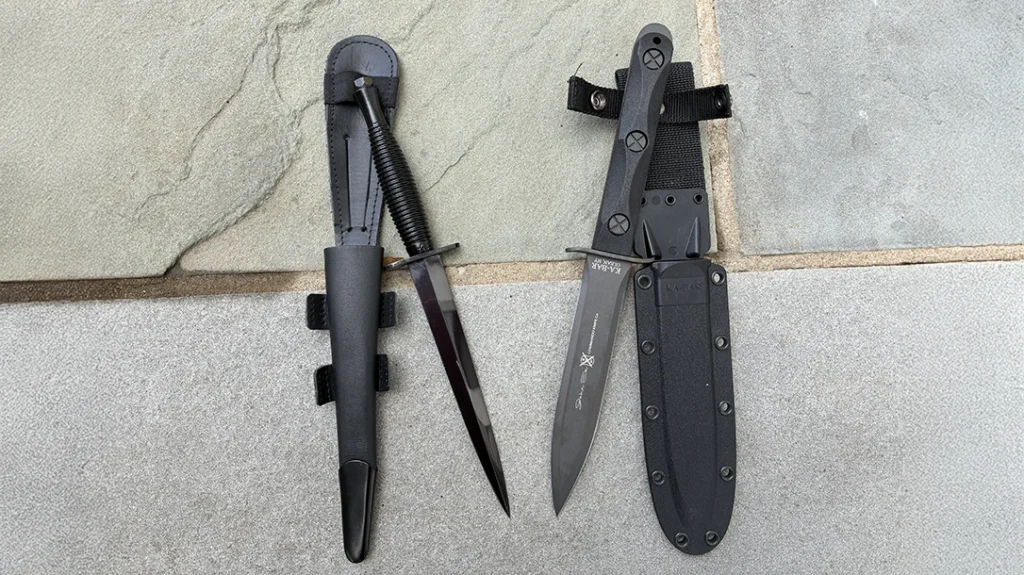
The FS dagger was made famous by the WWII British Commandos and Airborne Forces. Its blade length was chosen to penetrate the body deeply, even after passing through thicker winter clothing. Initial production of the FS had a blade length of 6.5 inches, with later patterns extending it to 7.5 inches.
US elite forces such as OSS, Rangers, Airborne, and Marines quickly desired similar profile blades. The V-42 fighting knife, associated with the First Special Service Force (Devil’s Brigade), and the Ek Commando knife are two of the most noteworthy examples.
The Ek Commando knife was not a standard-issued piece of equipment. However, the WWII War Production Board viewed the Ek knives favorably, as evidenced by granting permission for Ek to obtain raw materials for production. One of the most important materials was the steel: a high-quality Nickel-Chrome-Molybdenum, oil-hardening steel that was a critical war material.
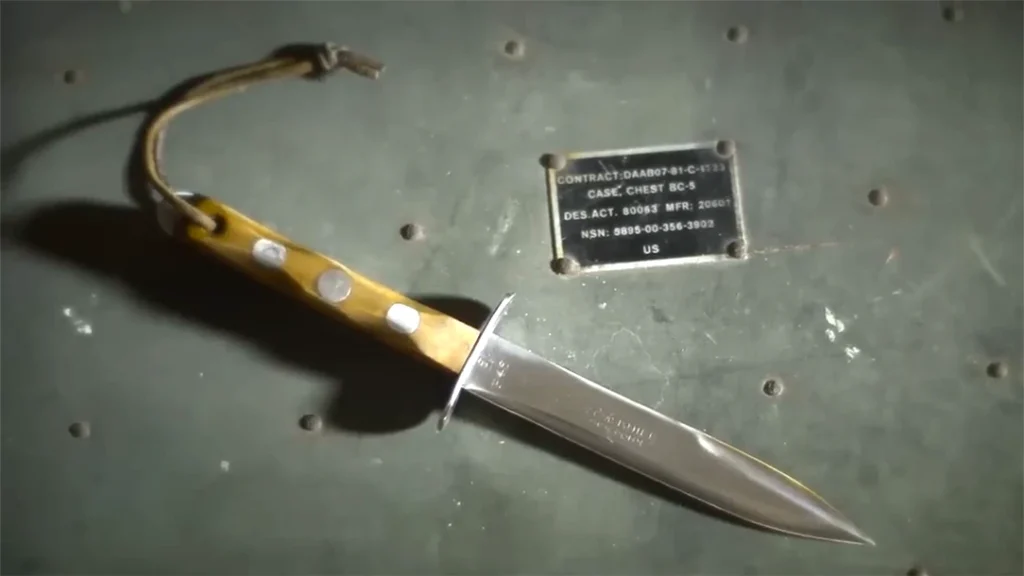
The lead for the handle rivets was recovered from used bullets and wheel weights. The hardwood Rock Maple came from bed-slat scraps and furniture. By August 1944, troop demand for Ek knives had grown to the point that three shifts worked around the clock, seven days a week, producing 10 different models to meet demand. Remember, these Ek blades were private purchases by our personnel.
US-Design Tweak
Dagger naysayers focus on the thin, fragile point as found on the FS as being too easily broken. The FS dagger is certainly svelte, ideal for finding its way between a sentry’s ribs or neck vertebrae. However, the Ek Commando is almost brutish, featuring a reinforced spear point that is thicker and wider than the classic FS.
The Ek Commando’s grip design gives tactile feedback in terms of which way its blade is orientated, even in absolute darkness or when having to react instantaneously. Correspondingly, it is fitted with a steel guard. It can act as a guard from an opponent’s blade, but this is not its true function.
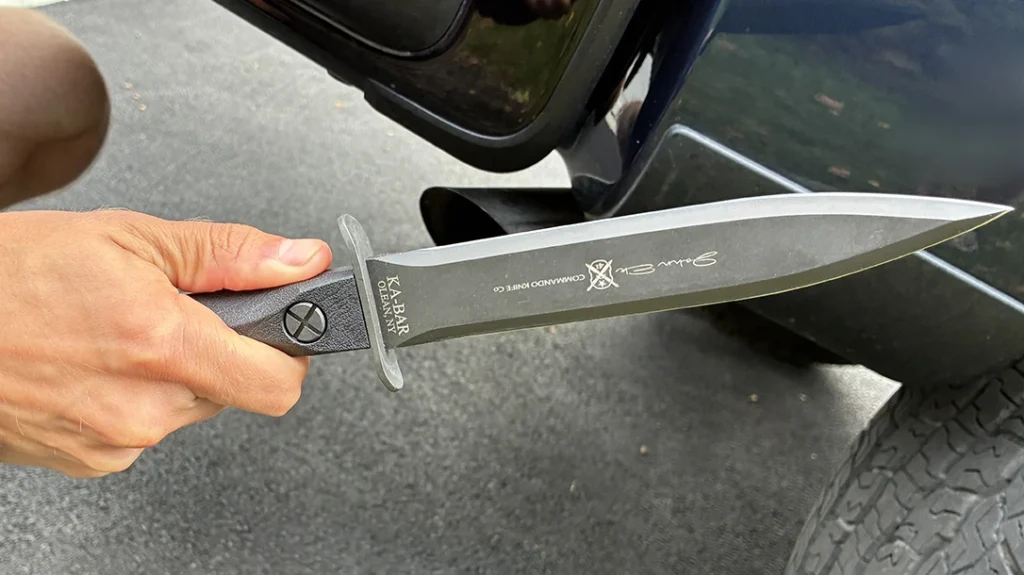
The Ek’s guard helps balance the weapon and protects the hand from slipping forward when thrusting into a target. A solid, semi-tapered metal pommel delivers striking power on a reverse thrust or as a pry bar, keeping the blade tip intact and enhancing blade-to-handle balance.
The Ek Commando’s center of gravity is located behind the guard, in the handle. This was another function of the Ek poured lead rivets. Extra weight towards the hilt, which made the knife balance far better than most.
Summarizing Fairbairn about dagger balance, “… the blade should not be so heavy that it drags the hilt from your fingers in a loose grip. The blade should readily go where the hand goes.”
“Porkman”
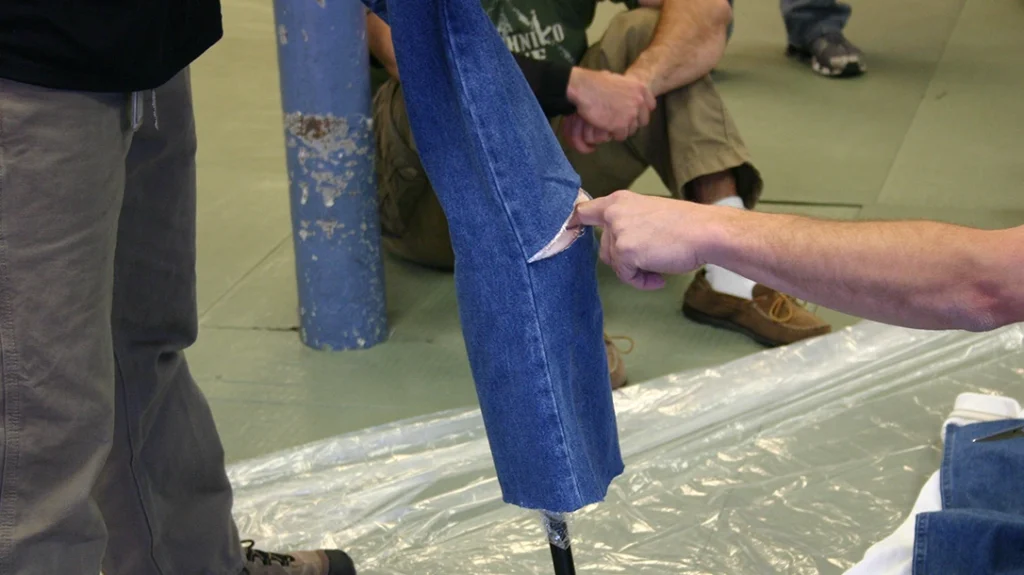
One of my standard knife evaluations involves a “porkman” to test both slashing and thrusting effectiveness. I became aware of “porkman” during a Michael Janich course I attended several years ago. Janich did a demonstration involving a pork roast butterflied around a broom handle, wrapped in plastic, and covered in multiple layers of clothing. The “porkman” offers an evaluator a means to test a blade’s effectiveness in a medium simulating an adversary’s clothed limb.
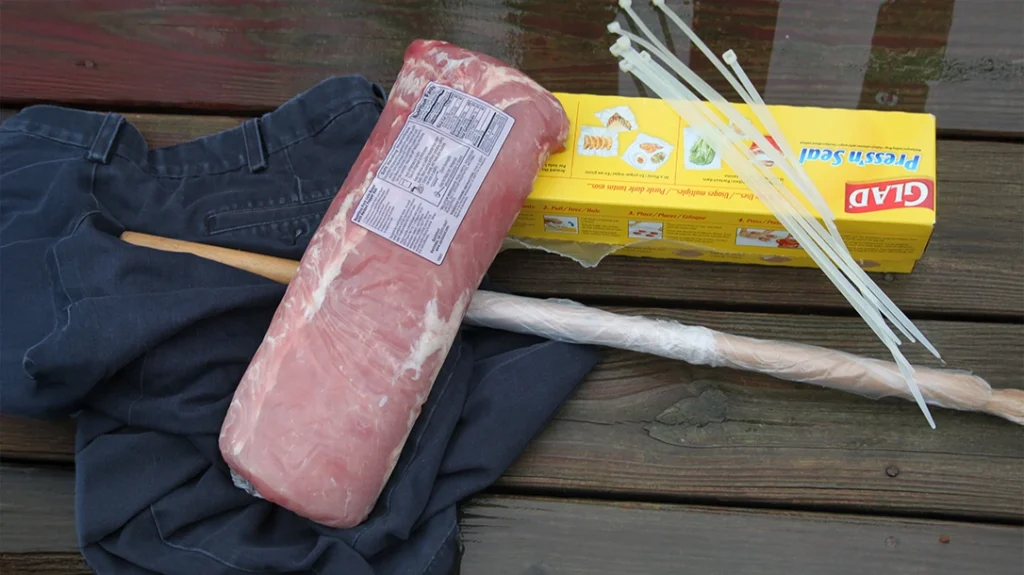
After starting slowly to get a feel for manipulating the Kabar Model 4, the Ek Commando penetrated easily into the “porkman” down to the guard. Thrusting with the Ek’s 6.6-inch blade made short work of the “porkman.” No real resistance was encountered when penetrating the layers of denim/plastic and meat. I tried multiple grip styles—forward hammer, saber, icepick. Each with the same result.
I also couldn’t resist trying out some slashes with the Model 4 Commando. With the “porkman” held firm, the Ek Commando had no problem slicing down to the broom handle core. Even a flick of the wrist with the Ek Model 4 produced what would be labeled a serious wound.
The KaBar Ek Model 4 In Hand
The Ek’s handle and double-edged dagger blade profile facilitate multiple grip types, such as conventional/forward, saber grip, or ice-pick/reverse grip. More and more reverse edge methods are being recognized for efficiency and effectiveness. Reverse edge methods are typically more instinctive and natural in use compared to other knife methodologies.
Each knife grip style has advantages and disadvantages. Holding the knife in one of the forward grips allows for greater finesse and longer reach, while a reverse grip allows for greater power. With the Kabar Ek Model 4 Commando, a user does not have to worry about edge-in or edge-out orientation, unlike a single-edge weapon.
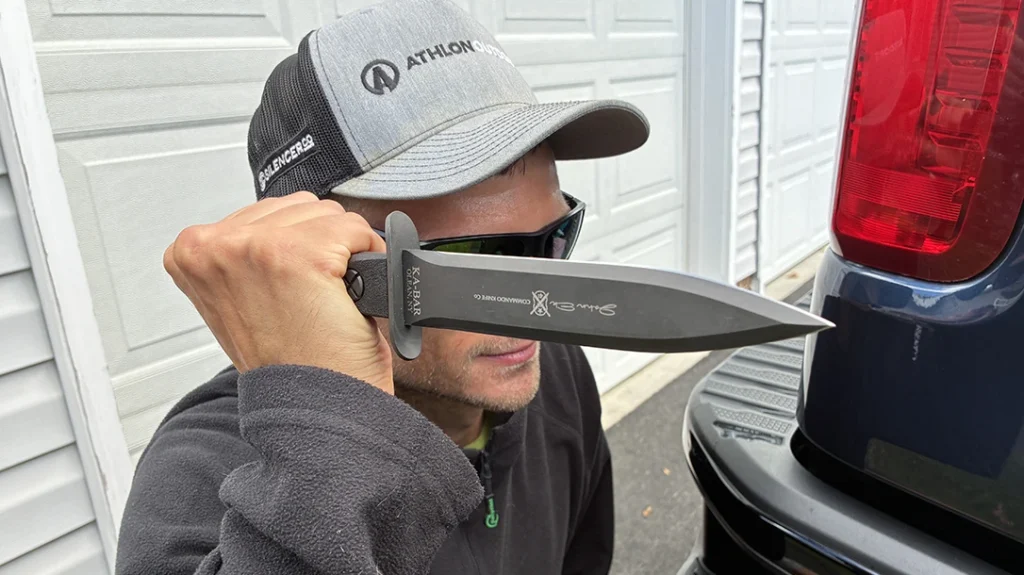
The Ek Model 4 was designed to penetrate objects such as flesh. Testing has shown that the force required to penetrate tissue is directly related to the sharpness/fineness of the tip. The sharp tip leading to the straight double edges enables the Ek Commando to penetrate deeply and quickly. It also allows the knife to be removed easily, rather than binding up in the target, thus facilitating rapid multiple strikes.
Does the Ek Commando Dagger Still Have a Place?
Some will question the veracity of the Ek Model 4, given its dedicated focus on edged CQB. However, others will appreciate the simple design methodology rooted in thousands of years of evolution.
Choosing a knife is probably even more of a personal decision than a firearm. A dagger such as the Ek Model 4 Commando can be viewed in the same way as a combat shotgun: a no-nonsense weapon supremely effective in the realm of close-range encounters. This is why the Ek Model 4 has been on the web gear or chest rig of our troops in every conflict since World War II.
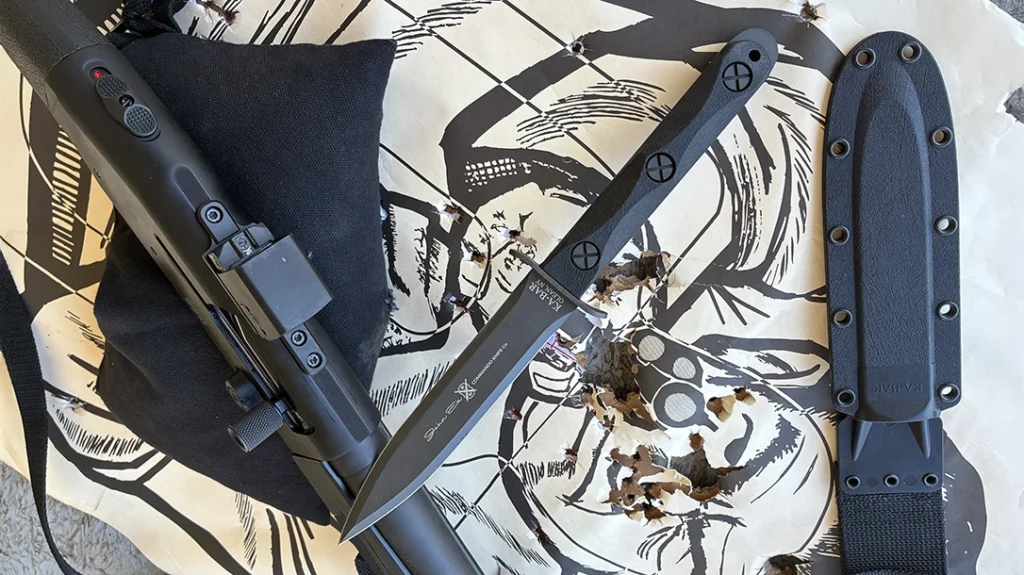
Kaber Ek Model 4 Commando Dagger Specs
| Overall Length | 12.625 inches |
| Blade Length | 6.62 inches |
| Weight | 11 ounces |
| Blade Type | 1095 Cro Van .154 thick, 20-degree flat edge grind, double-edged spear point |
| Rockwell Hardness | 56-58 |
| MSRP | $169 |
WHY OUR ARTICLES/REVIEWS DO NOT HAVE AFFILIATE LINKS
Affiliate links create a financial incentive for writers to promote certain products, which can lead to biased recommendations. This blurs the line between genuine advice and marketing, reducing trust in the content.