


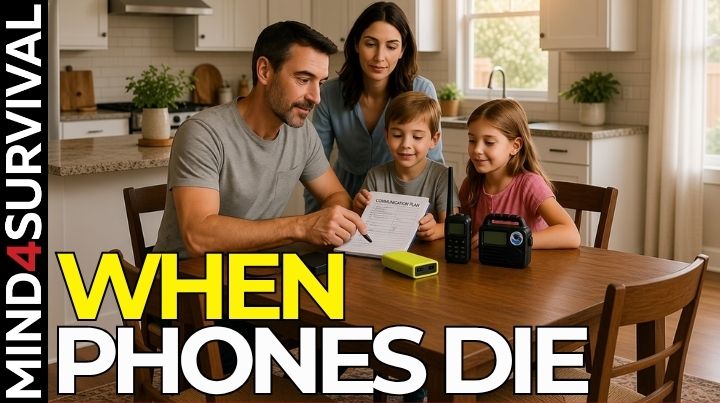
When a major storm rolls through, or the power goes out, most people reach for their phones to communicate. We call family and friends, send texts, or check social media to find out more about what’s happening. Most of the time, this works just fine.
But if you’ve ever experienced a widespread emergency (such as a hurricane or earthquake), you may have found that the cell network can become overloaded and calls may not go through. Even if cell towers are still standing, having thousands of people trying to make calls all at once can make it difficult for them to go through. That’s why it’s a good idea to make a simple communication plan before anything happens. You do not need expensive equipment or training – you just need a few backup options. Here’s how to build a realistic family communication plan.
TL;DR: A family communication plan works best when it follows PACE: primary, alternative, contingency, emergency. Start with cell calls and texts, add an out-of-state contact, then two-way radios, then a pre-arranged meeting place or written message. Write it down, share it, and test it before you need it.
Quick Look at What You’ll Learn
Keep It Simple with the PACE Method
In the military or emergency responder world, planners use a system called PACE, which stands for Primary, Alternative, Contingency, and Emergency. This might sound technical, but it’s really very simple. If one method of communication doesn’t work, use the next available one.
Primary: Cell phone calls and text messaging
Alternative: Out-of-state contacts
Contingency: Two-way radios
Emergency: Physical meeting place or written messages
Primary: Cell phones and text messages
For most families, the Primary method is the one you already have: your cell phone. As long as calls are working as normal, that is the easiest way to keep in touch.
If you can’t connect locally via calling, try the next easy option: send a text. Text messages use less network capacity than calls, so texts often get through even when the local network is congested. During an emergency I experienced where calling had failed, texts made it through, although most took a few minutes to be delivered.
Once batteries begin to run low, agree for everyone to only check for communication at certain times, like the top and bottom of each hour.
Cell Phone Charging
Your cell phone is your Primary Plan, but it’s only useful as long as it has battery life.
Everyone in your household should have at least one reliable way to recharge their phone if the power goes out. A fully charged power bank is the easiest solution and can often recharge a smartphone two or three times before it needs recharging.
If you spend a lot of time driving, keep a 12-volt car charger in your vehicle. During an extended outage, your car can also become a charging station. Just remember to run the engine while charging to avoid draining the vehicle’s battery.
Solar chargers are also a good option, especially for longer emergencies. They usually charge more slowly than a wall outlet, but they can help keep essential devices running if the outage lasts several days.
Finally, don’t wait until an emergency is in the forecast before charging. Make it a habit to top off your phone and charge your power banks as a precaution. Starting an emergency with a full battery gives you a great advantage.
Alternative: Out-of-State Contact
I found this out myself. During hurricanes in Houston, I was able to call my family in other states to let them know we were safe, but had trouble getting calls through locally.
Choose a trusted friend or relative outside your local area (preferably out of state) to serve as a central contact.
If a widespread local emergency happens, such as a major hurricane, local phone networks can become overwhelmed. Sometimes a call or text to someone far away may get through more easily than reaching someone just a few miles from you.
If family members are separated, everyone should try contacting that person to let everyone know who is safe, where they are, and provide updates. The out-of-state contact becomes the central information source.
Contingency: Two-Way Radios
If cell phones don’t work at all, use your next contingency. For many families, a set of two-way radios can be an excellent way to stay in touch.
Family Radio Service (FRS)
If you’ve ever gone camping, you may already be familiar with FRS radios. They are the walkie-talkies you’ll find in sporting goods stores, big-box retailers, and online. They’re inexpensive, easy to use, and require no FCC license.
You’ll often see impressive range claims on the packaging, sometimes advertising 30 miles or more. However, I have found that those numbers are based on nearly perfect conditions that most of us will never experience.
In a typical neighborhood with structures, trees, parked vehicles, and other obstacles, the range is usually much shorter. The actual range falls somewhere between a half mile and a mile or two.
For apartment dwellers, FRS radios can work well for communicating within your complex, across a small neighborhood, or while family members are out walking the dog or visiting nearby friends.
General Mobile Radio Service (GMRS)
If you’d like a wider communication range without getting into amateur radio, GMRS is worth considering. GMRS radios transmit at higher power than FRS models, and in some areas they can access local repeaters that greatly extend their coverage.
Unlike FRS, GMRS does require an FCC license. The good news is there’s no exam. All you have to do is apply online, pay the licensing fee, and one license covers you and your immediate family for ten years.
For families spread across town during the workday, GMRS can provide an extra layer of flexibility when cell service isn’t available.
Save Battery Life by Scheduling Communication
Don’t leave your radios constantly turned on. Conserve the battery life of your radios by scheduling communication times. For example, everyone could turn on their radios for five minutes at the top of every hour. If someone has important information to share, that’s the time to call. Once everyone has checked in, the radios go back off until the next scheduled window. This simple habit can dramatically extend battery life while still allowing everyone to stay connected.
It’s also a good idea to keep spare batteries or a charged USB power bank on hand if your radios use rechargeable batteries.
Emergency: Pre-arranged meeting place and written messages
Finally, if none of the three methods are working and electronic communication is completely unavailable, the last resort would be a physical method for getting a message across or gathering together.
Add a non-electronic backup to your plan, as there is always a chance that technology can fail. Phones run out of power, batteries can drain, and radios can break. This could be a pre-arranged meeting place or agreeing on a location where everyone can go if they cannot reach each other.
Choose a location where family members can leave a written message if they cannot reach anyone. It can be a bulletin board at the apartment complex, an accessible mailbox, or the back porch at someone’s house. A simple message can just say, “We are safe. Went to Aunt Mary’s and will check back tomorrow at noon.”
Write these four steps down and make sure everyone in your household understands what to do. During a stressful situation, having a simple plan helps alleviate uncertainty.
What About Landlines?
Many homes no longer have traditional landlines (through the phone company), but if your home still has one, don’t be too quick to cancel it. Unlike cell phones, many copper landlines continue to work during power outages because they receive power through the telephone line itself.
The important distinction here is ‘traditional’. Many modern home phone services that are provided by the cable company are actually internet-based (VoIP). If power goes out and you don’t have a battery backup for your modem, that phone may stop working too.
If you do have a traditional landline, make sure you also have at least one corded telephone.
Cordless phones need household electricity to power them, so they’re usually useless during a blackout. An inexpensive corded phone can keep you connected even when the lights are out.
Landlines are becoming less common every year, so this won’t apply to everyone. But if you still have one, it can be another valuable layer in your communication plan.
Get Info Without Electronics
To keep up with official weather reports, warnings, evacuation notices, and other emergency information, keep a battery-powered NOAA Weather Radio in your emergency kit. You’ll also need fresh batteries nearby and test it every so often to make sure it’s working properly.
Where does HAM Radio Fit In?
HAM radio can be a great emergency backup. But it requires advanced planning and a commitment from the people you call the most to have this type of set-up.
I have come across a lot of HAM radio enthusiasts in survival blogs – they are a friendly group and are more than willing to show you their HAM radio setup, explain what you need to know about high-frequency antennas, and give tips on how to get a license. I was interested in trying it at one point; however, I realized I don’t have room for all the equipment while living in an apartment. Nothing against it at all; it is a wonderful hobby, and the technology is amazing. But not everyone can devote time, money, or space to getting set up. If you have interest, and the rest of your family is also willing to get set up and licensed, then by all means, you can include HAM radio in your communication plan.
Practice Before You Need It
A communication plan will only work if everyone knows what to do. Test your equipment one afternoon. Go to a nearby park and take your radios with you to see how far they can reach. Test the various channels, and practice making radio calls with each other. Children will enjoy trying out the walkie-talkies; it is more like a game than a drill.
Review your family’s second and third meeting locations. Contact your out-of-state relative or friend and make sure everyone has their phone number.
Final Thoughts
You don’t need a lot of special equipment to make a backup communication system for your family, just a bit of planning. You already have cell phones; you just need to make sure you have a way to keep them charged, get a set of radios, and an out-of-state contact. Make a plan, write it down, and inform everyone in your household so everyone knows what to do in case of emergency.