


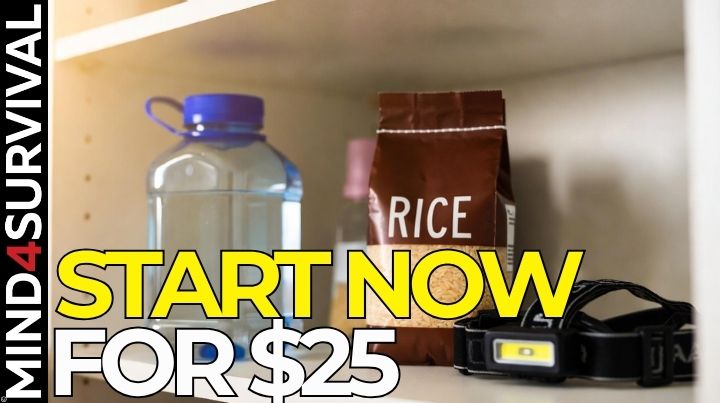
If you start preparing for emergencies while you’re living in a city, you face two main challenges: limited space and a tight budget. Many readers are looking for ways to get started without spending a lot of money. Here is a simple $25-a-month prep plan designed to help you build a 14-day survival kit over the next year without taking up much space or draining your wallet.
TL;DR: Start your emergency preparedness journey for just $25 a month. By focusing on everyday essentials like water, dry food, and basic sanitation, you can calmly build a reliable 14-day survival kit over the course of one year without breaking the bank or taking up valuable space.
Quick Look at What You’ll Learn
Why $25?
Most people are on a tight budget and don’t see spending thousands of dollars all at once on prepping. But if you just spend $25 a month, roughly the cost of a takeout pizza, you can focus on items that you actually use and can fit in a closet.
As a side note, it is always a good idea to take inventory of what you may already have in the house before you get started. You may find you already have some of the items listed. If so, then you’re already ahead; you can skip to the next one.
Phase 1: The Essentials (Months 1–3)
Let’s start with the things you’ll miss the most if there is a disaster that lasts for a few days: water, food, and light.
Month 1: Water
Water is one of the most important items to stock up on. In an apartment building, if the power goes out, the pumps that send water to your floor may stop, too.
The Buy: Two 7-gallon stackable water containers (around $12 each). Wash and fill up the water containers with drinking water. If you’re on a tight budget, you could do this by using containers you already have. Also, for $25, you could buy 25 single-gallon bottles of water and have twice as much on hand, depending on your space.
The Plan: These containers are sturdy and can be tucked under a desk or in the back of a closet. If you have 14 gallons, that should be enough to keep one person hydrated and fairly clean for two weeks. If you have more people in your household, then you’ll need to adjust these quantities.
Month 2: Food
Skip the pre-made “prepper buckets” full of freeze-dried food for now. They’re expensive and take up way too much room.
The Buy: A 20 lb bag of white rice, 10 lbs of dried beans, and a couple of big jars of peanut butter. If you can swing it, add a couple of boxes of crackers (for the peanut butter)
The Plan: For about $25, you’re getting basic carbs and protein. Store them in recycled, heavy-duty plastic bins to keep out any pests.
Month 3: Light
I don’t recommend using candles in a crowded apartment building. They can tip over and start a fire, which would be a disaster in itself.
The Buy: Two decent LED headlamps and a bulk pack of AAA batteries.
The Plan: Headlamps let you stay “hands-free,” so you can cook, find your way in the dark, or fix a leak when the power is out.
Phase 2: Sanitation Needs (Months 4–6)
In a city, sanitation quickly becomes a problem when the grid is down. If the water’s out, you can’t just keep flushing the toilet.
Month 4: The Emergency Bathroom
It’s not glamorous, but you’ll be glad you have it.
The Buy: A 5-gallon bucket with a snap-on toilet-seat lid ($15), trash bags ($4), and a bag of pine-pellet cat litter ($10).
The Plan: This is your “dry toilet.” Put the bag in the bucket. Add the pellets into the bags so they help control odor and moisture, keeping things sanitary inside your apartment when the building’s plumbing fails.
Month 5: A Real First Aid Kit
You need more than just colorful Band-Aids.
The Buy: A high-quality pressure dressing (often called an Israeli bandage) and a bottle of 90% rubbing alcohol.
The Plan: Urban emergencies often involve broken glass or sharp edges. Sanitize your hands and focus on stopping the bleeding from any wounds until help arrives.
Month 6: Cleanliness
The Buy: A box of heavy-duty contractor trash bags, a few packs of wet wipes, and a gallon of hand sanitizer.
The Plan: If you can’t shower, use wet wipes instead. Contractor bags are great for waste, but they also work as emergency window covers or even a makeshift rain poncho.
Phase 3: Comfort and Communication (Months 7–9)
Now that you can eat, drink, and stay clean, let’s focus on staying informed and comfortable.
Month 7: Information
In a crisis, the internet and cell towers are often the first things to go down or get overloaded.
The Buy: A simple, battery-operated AM/FM/NOAA weather radio.
The Plan: Make sure it takes the same batteries as your headlamps. An analog radio is the most reliable way to find out what’s happening in your city.
Month 8: Staying Warm (or Cool)
Apartments are basically concrete boxes that get very cold or very hot without AC.
The Buy: Two heavy-duty Mylar “Space Blankets” and a roll of high-quality duct tape.
The Plan: Use the duct tape to seal off drafts. In the winter, you can tape those Mylar blankets to the wall to reflect heat back into the room.
Month 9: Cooking
A warm meal can be comforting and filling during a stressful situation.
The Buy: A single-burner butane “camp” stove and a few fuel canisters.
The Plan: These stoves are small enough to sit on your kitchen counter. Just make sure you crack a window for ventilation while you’re boiling your Month 2 rice!
Watch this video:
Phase 4: Finishing Up (Months 10–12)
You’re almost there. These last few months are about making your setup sustainable.
Month 10: Portable Power
The Buy: A 10,000 mAh or 20,000 mAh USB power bank.
The Plan: This will keep your phone or your radio charged for a few extra days. It’s a small bit of “normalcy” when the grid is down.
Month 11: The Toolbox
The Buy: A decent multi-tool (with pliers) and a manual, heavy-duty can opener.
The Plan: You’d be surprised how many people forget the can opener! A multi-tool is perfect for small repairs or shutting off a leaky valve under the sink.
Month 12: Knowledge
The Buy: A physical survival book or a folder full of printed maps and emergency contact lists.
The Plan: Use your last $25 to print out info on how to purify water or navigate your city without GPS. If your phone dies, that paper folder is something you can rely on.
The Bottom Line
Prepping doesn’t have to be a scary, expensive hobby that drains your finances. It’s just about choosing select items so you can be comfortable in an emergency. By taking it one month at a time, you can build a kit to help tide you over during a disaster.
So, what are you picking up this month? Time to get started!