


The Brief:
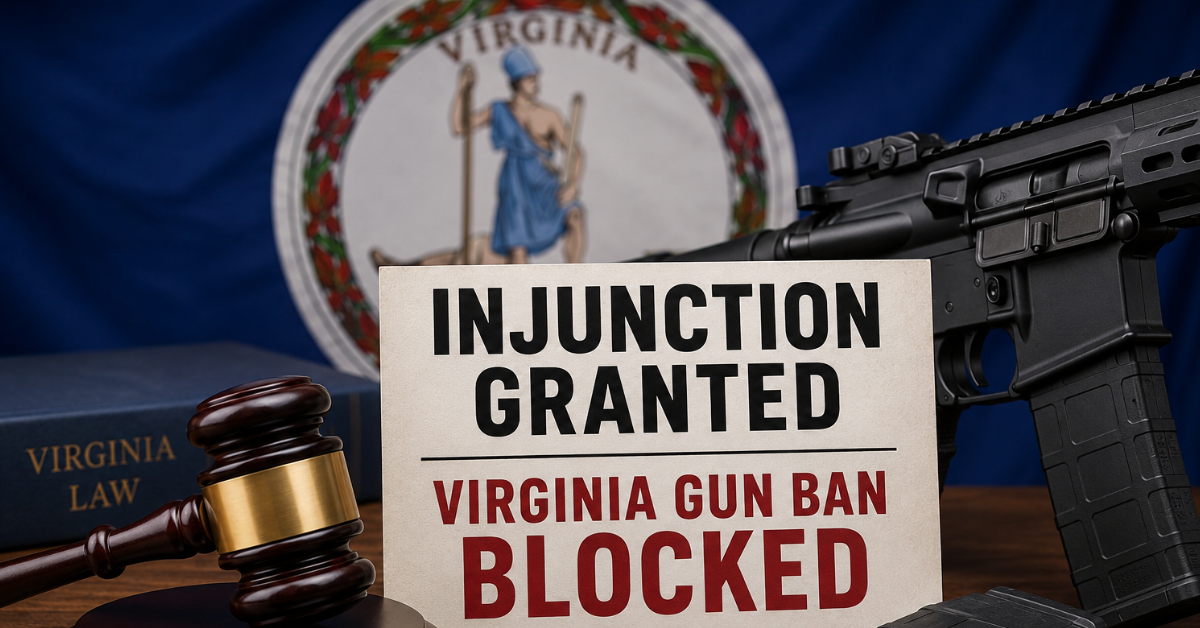
A Virginia circuit judge has issued a preliminary injunction blocking the state’s upcoming ban on “assault weapons” and standard-capacity magazines. The ruling prevents law enforcement from enforcing restrictions on semi-automatic rifles and detachable magazines capable of holding more than 15 rounds. This freeze remains in effect until at least late 2026.
The court determined the proposed regulations lacked a rational basis and failed to meet historical standards for firearm restrictions. While the state intends to appeal, the injunction ensures that the sale and possession of these firearms and magazines remain legal for now. This decision halts legislation scheduled for July 1.
LANCASTER COUNTY, VA — The legal landscape surrounding the Second Amendment has shifted dramatically in the Old Dominion. Following a high-stakes, two-hour oral argument, Circuit Judge John Martin issued a definitive preliminary injunction from his bench, siding with Gun Owners of America (GOA), the Virginia Citizens Defense League (VCDL), and local resident John Crump.
The ruling explicitly bars Virginia State Police and local law enforcement units from executing any administrative or criminal enforcement of the state’s newly passed restrictions. The statutory freeze will remain firmly in place until at least December 31, 2026, or until a comprehensive final order is formalized.
The Anatomy of the Blocked Law
Had the injunction been denied, the legislation would have introduced severe, wide-ranging criminal penalties across the commonwealth on July 1. The statute creates a Class 1 misdemeanor targeting the importation, sale, purchase, manufacture, or transfer of:
- Semi-automatic centerfire rifles possessing specific cosmetic or tactical features, including folding stocks, pistol grips, and threaded barrels.
- Detachable ammunition feeding devices (magazines) capable of holding more than 15 rounds of ammunition.
Judge Martin completely rejected the commonwealth’s framework, declaring that the specific mechanical and physical characteristics outlawed by the bill lacked any “rational basis” when weighed against the text of the law.
The Constitutional Clash: Bruen Meets Article I
The state tried to argue that the federal framework established by the U.S. Supreme Court’s landmark 2022 Bruen decision should not dictate how a Virginia state court interprets its own localized constitution. The commonwealth’s legal team, led by Deputy Solicitor General Trent Taylor, attempted to validate the ban by linking it to 20th-century restrictions on sawed-off shotguns and fully automatic machine guns, while warning that the plaintiffs’ logic would legally entitle citizens to carry grenade launchers.
Judge Martin flatly denied the state’s attempt to isolate its analysis. He held that Bruen’s rigid mandate, which requires the government to conclusively prove that a firearm regulation is deeply rooted in the historical tradition of the United States rather than relying on modern public policy goals, is highly instructive when evaluating Article I, Section 13 of the Virginia Constitution.
Plaintiffs’ attorney David Browne of Spiro & Browne successfully dismantled the state’s assertion that semi-automatic platforms are military-grade anomalies outside the protection of the law. “They are not just common, they are ubiquitous,” Browne informed the court. “The challenged statutes in this case concern some of the most commonly used arms and magazines in the nation.”
Jurisdictional Fractures and Next Steps
The decision arrived on a day of immense logistical maneuvering, occurring just hours after the U.S. Supreme Court handed down its decision in Wolford v. Lopez, which struck down a Hawaii law requiring explicit permission to carry on private property.
While Attorney General Jay Jones expressed deep disappointment, stating that “assault weapons are designed intentionally to inflict maximum damage” and promising an immediate appeal, gun rights advocates are celebrating the structural win. “VCDL is pleased with the temporary injunction,” stated VCDL President Philip Van Cleave. “We expect the commonwealth to appeal the decision, but we also expect to prevail.”
The Lancaster County victory stands in stark contrast to a parallel case in Spotsylvania County, where a separate judge recently rejected a militia-based challenge to the ban. However, because state case law allows a claim to proceed so long as a single citizen with standing is attached to the filing, John Crump’s presence in the Lancaster suit ensures the statewide injunction remains fully operational.
Safety Tip: This dramatic eleventh-hour injunction provides a vital lesson in “Regulatory Fluency” for law-abiding carriers and retailers. When highly restrictive firearm legislation is passed, there is frequently a frantic, shifting window of litigation just days before the effective date. For citizens in Virginia, this preliminary injunction means that the purchase, sale, and transport of standard-capacity magazines and semi-automatic platforms remains completely legal under state law for the immediate future. However, tactical responsibility dictates that you monitor this case closely as it climbs to the Virginia Court of Appeals and the State Supreme Court. Never assume a localized injunction is a permanent shield; keep your inventory and transport protocols meticulously aligned with verified judicial dockets, and ensure your equipment remains safely secured within parameters that leave no room for administrative trapdoors.