


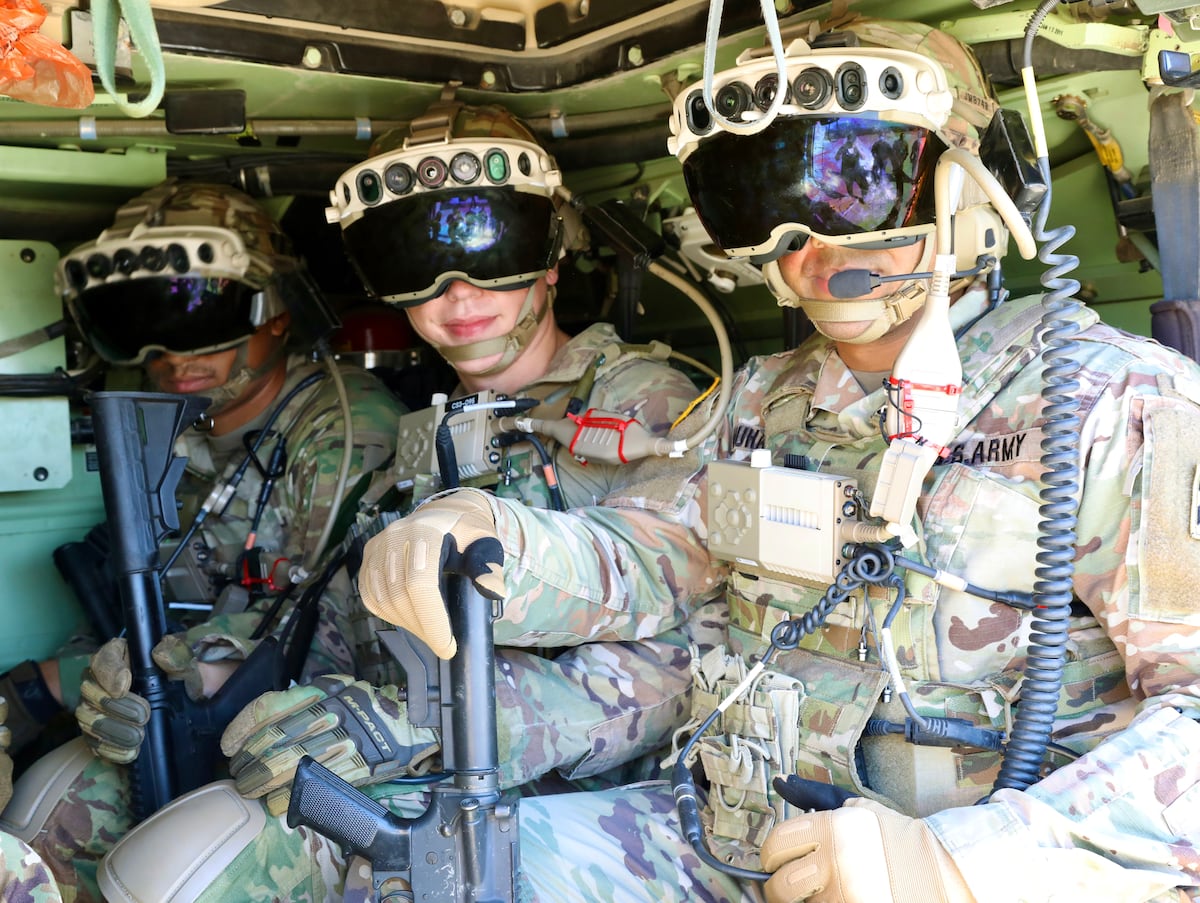
After years of development and nearly $2 billion in investments, the Army is finally calling time of death on its much-hyped Integrated Visual Augmentation System – at least in its current form.
That’s according to a new report from the Government Accountability Office, which found that three versions of the augmented-reality “all-weather fighting goggle” developed between 2018 and 2025 were deemed not ready for fielding and will stay in a warehouse rather than ever reaching soldiers.
The news, tucked within the GAO’s annual weapons systems assessment, was first reported this month by Task and Purpose. The watchdog agency did note that the vision of IVAS is not completely dead; the prototype will be transitioned to a separate effort with similar goals related to improving soldier awareness, and development will begin again. But that leaves almost 10,000 pricey headsets that appear bound for shelf real estate next to the Ark of the Covenant.
“An Army evaluation reported that soldiers found the headsets difficult to wear and noted that they did not perform better than existing equipment,” the GAO report said. “As a result, the nearly 10,000 units that were produced are obsolete and will remain in storage.”
Those 10,000 units include versions 1.0 and 1.1 of IVAS. Version 1.2, which “was expected to address reliability and wearability issues identified in the previous versions such as comfort and low-light performance,” according to the report, will be used instead to inform the new rapid prototyping effort, known as Soldier Borne Mission Command.
Some 400 of the version 1.2 goggles will inform the design of SBMC, in a contract now held by Anduril, who received funding from IVAS in April after the Army reprogrammed the money. Microsoft had previously held the contract.
Anduril announced it had gotten the $159 million contract award for initial prototyping last September, saying the award represented “the largest effort of its kind to equip every soldier with superhuman perception and decision-making capabilities—fusing the best of night vision, augmented reality, and AI into a single system.”
Like IVAS, SBMC aims to overcome the challenges built into legacy night-vision goggles, including lack of a common networked picture and battlefield data integration, resulting in siloed information.
Anduril’s solution, which it touted as developed with the benefit of 260,000 hours of soldier input from the IVAS program, purports to give troops “superhero-like abilities” with an augmented-reality battlefield picture overlaid onto advanced night vision capabilities.
Yet despite the billions invested in IVAS over seven years, the end result was worse than the legacy headsets it purported to replace, investigators found.
“While IVAS used limited elements of leading practices in its prior efforts, the program’s minimal implementation of these contributed to IVAS concluding with no fielded capability. Problems that users reported with the 1.0 and 1.1 versions were not adequately addressed in 1.2,” the report found. “These included poor performance in low-light conditions and the added weight on users’ helmets. The program’s failure to adequately incorporate user feedback into design updates resulted in a product that users report is less useful than legacy equipment.”
Investigators faulted the program for moving into production with “limited evidence from testing in an operational environment” to show that the goggles actually did what the soldiers needed them to do. After a wave of negative feedback on the 1.0 version of IVAS, the program did not even conduct operational testing on the 1.1 version, the report said.
“This runs counter to our prior work, which found that systems-integrated testing in an operational environment helps ensure product designs meet user needs before significant funding is spent on production,” the report stated.
Moving forward, according to the report, the new contractor, Anduril, will conduct continuous operational assessments on the latest version of the goggles, getting user feedback from brigades via the Army.
“The program expects to use these assessments to collect feedback and inform the first phase of SBMC, which aligns with leading practices to make improvements in subsequent iterations,” GAO investigators said.