


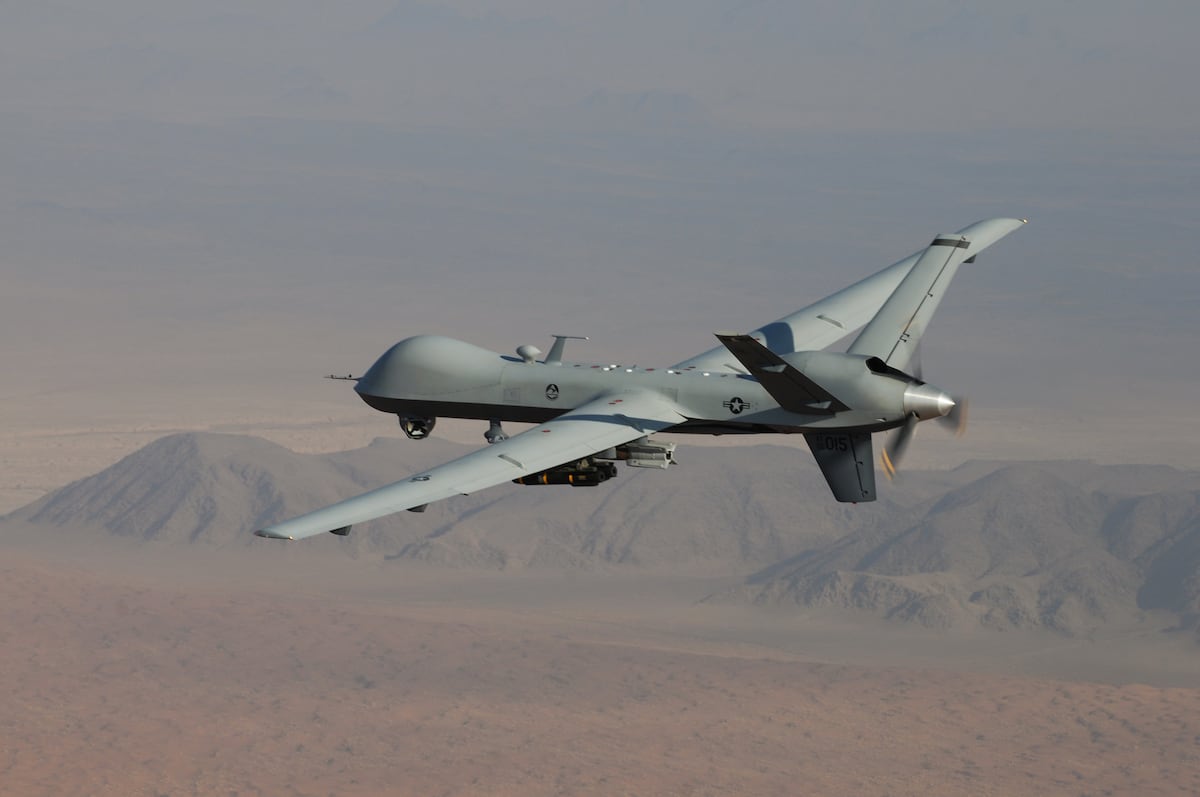
The Pentagon is exploring cheap, long-range drone options that may eventually replace the MQ-9 Reaper.
The search comes after dozens of MQ-9s were swatted out of the sky during the Iran war, according to a May 13 Congressional Research Service report.
With the Air Force currently possessing about 135 Reapers — which cost approximately $30 million apiece — such a loss rate is not sustainable, especially against a force like Iran, whose air defenses are less sophisticated than those of China or Russia.
“The Joint Force’s reliance on low-density, high-value ‘exquisite’ (>$30 million) manned and unmanned aircraft is unsustainable against adversaries utilizing layered defenses enabled by increasingly low-cost antiaircraft capabilities,” warned the Defense Innovation Unit solicitation for a new drone, which the Pentagon wants to “execute missions that the MQ-9A performs today.”
Rather than build a better Reaper, DIU is opting for an expendable replacement. The Massed Modular Aircraft, or MMA, project aims to develop a UAV designed to operate in such large numbers that it can absorb heavy losses and still overwhelm enemy defenses.
Particularly of interest is the size of the MMA. Drone swarms may be the next big thing in unmanned warfare, but generally those hordes are made up of small, inexpensive UAVs with limited range and payload.
But the DIU solicitation envisions a drone that has long range and a heavy payload — and is still inexpensive enough for mass production. The solicitation calls for a payload of at least 2,800 pounds, a bit less than the MQ-9’s 3,800-pound capacity.
The MMA should also have an unrefueled combat range of at least 2,300 nautical miles, according to the solicitation, and a one-way transfer range of at least 8,000 nautical miles. Additionally, the drone should reach speeds of at least 200 miles per hour and have the ability to operate from a 6,000-foot runway or improvised airstrips.
The DIU solicitation states that the drone should have “sufficient available size, weight, power (25kW), and cooling (5kW) to host a variety of internal and/or external payloads,” with a level of autonomous operations that would allow one operator to control several drones.
The solicitation does not specify the MMA’s dimensions, though the specifications suggest a drone comparable in size to the MQ-9. It also did not list a desired price point, though presumably it would be less than the $30 million price tag of an MQ-9.
The timeline for the MMA project, meanwhile, is ambitious. DIU is calling for “full-scale prototype flight testing within 21 months of award, with a targeted Initial Operating Capability (IOC) in FY2031. IOC for MMA is envisioned as 20 mission-ready aircraft delivered to an operational unit, able to be deployed.”
Pentagon solicitations continue to reflect a mindfulness of lessons from the Ukraine War, as well as the experiences during the Iran War. In both conflicts, the defender exhausted interceptors before the attacker ran out of drones.
“Keeping a constant airborne MMA presence to launch weapons, gather intelligence, perform electronic warfare missions, or relay communications will force an adversary to stay on the defensive,” DIU said. “This relentless pressure will exhaust the adversary, forcing them to burn through expensive anti-aircraft missiles and resources faster than they can be replaced.”
Michael Peck is a correspondent for Defense News and a columnist for the Center for European Policy Analysis. He holds an M.A. in political science from Rutgers University. Find him at theuncommondefense.com. His email is [email protected].