


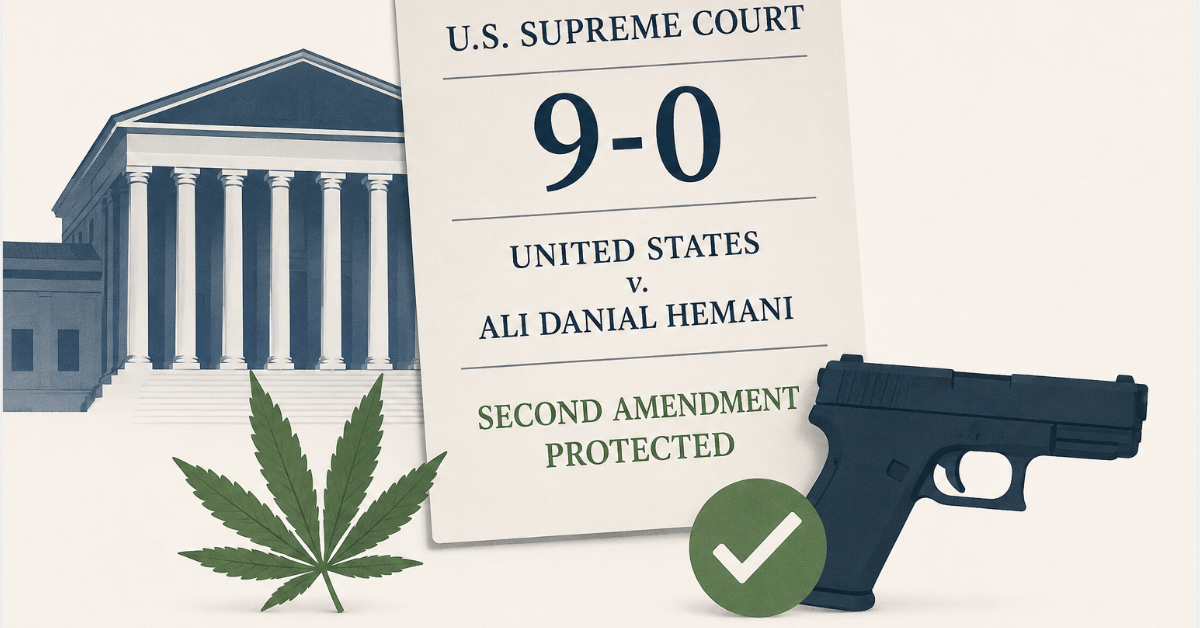
WASHINGTON, D.C. — The landscape of federal firearm restrictions has been profoundly reshaped by the nation’s highest court. Delivering the opinion for a unanimous bench, Supreme Court Justice Neil Gorsuch struck down a critical provision of the Gun Control Act of 1968, marking a monumental victory for cannabis consumers and the broader Second Amendment community.
The ruling represents a stinging defeat for the federal government’s attempt to maintain categorical restrictions on a demographic that now encompasses tens of millions of Americans living in states where cannabis has been fully integrated into local commerce.
“Whatever one thinks of these developments, the federal government has not just tolerated them; it helped fuel them,” Gorsuch wrote, highlighting the glaring contradiction of the state’s posture. “All of which leaves it awkwardly positioned to suggest that the millions of Americans who now regularly use marijuana are categorically and unusually dangerous.”
The Catalyst: A Texas Closet Raid
The constitutional showdown began in August 2022 when federal agents executed a search warrant at the Texas residence of Ali Danial Hemani. During the sweep, investigators uncovered a standard Glock 9mm pistol and 60 grams of marijuana. When questioned, Hemani honestly acknowledged to agents that he consumed cannabis “about every other day” to relax.
Solely on the basis of that routine consumption and firearm possession, the Department of Justice secured a grand jury indictment under 18 U.S.C. § 922(g)(3), a federal statute making it a felony for any “unlawful user of or addicted to any controlled substance” to own a firearm. Hemani fought back, arguing the law was unconstitutionally vague and a direct violation of his right to bear arms. Both a federal district judge and the U.S. Court of Appeals for the Fifth Circuit agreed, throwing out the indictment and forcing the government to appeal to the high court.
The Historical Failure of the Government’s Argument
To defend the restriction under the rigorous “text, history, and tradition” standard established by the 2022 Bruen decision, federal prosecutors tried to compare modern marijuana bans to founding-era “habitual drunkard” laws. Those historical statutes allowed local authorities to seize weapons from individuals who were severely incapacitated by alcohol.
Justice Gorsuch completely rejected the comparison, stating the government’s argument fundamentally misapprehended the history. Founding-era drunkard laws, Gorsuch noted, were not designed to protect the public from mass violence. Instead, they were civil tools engineered to protect alcoholics from financial ruin and insulate their families from economic devastation.
Furthermore, Gorsuch emphasized that historical intoxication laws only restricted firearm use or carriage during periods of active, present impairment on public streets, rather than enforcing a permanent, blanket ban on keeping a weapon safely stored in a private home closet.
A Narrow Guardrail: Addicts and Active Intoxication
While the 9-0 ruling completely clears the path for law-abiding, casual cannabis consumers to possess defensive tools, the court included careful parameters to limit the scope of the decision:
- Active Intoxication: The ruling does not impact local or federal laws that prohibit individuals from carrying or discharging a firearm while actively under the influence or presently intoxicated.
- Severe Addiction: The court explicitly avoided addressing bans targeting severe chemical dependency or advanced substance addiction that compromises cognitive stability.
- Individualized Danger: The government retains the absolute right to disarm an individual if prosecutors provide distinct, customized evidence proving that a specific person’s drug use renders them an immediate danger to themselves or others.
Unusual Political Alliances
The high-stakes case dissolved traditional political divisions, forging a rare coalition of advocacy groups. A diverse array of organizations, including the National Rifle Association (NRA), the American Civil Liberties Union (ACLU), and cannabis legalization advocates like NORML, filed unified amicus briefs supporting Hemani.
“The court has sent a strong message that the government cannot criminalize the conduct of large numbers of people by making categorical and unfounded assumptions about whether they are dangerous,” stated Cecillia Wang, legal director at the ACLU.
Conversely, the decision is a notable defeat for the current administration’s Department of Justice, which had fiercely defended the 1968 restriction. Notably, this identical statute was utilized in Delaware to secure a felony conviction against Hunter Biden, who was later pardoned by his father.
Safety Tip: This historic Supreme Court victory represents a monumental shift for the 2A community, but defensive carriers must maintain strict operational compliance during the transitional legal window. While federal prosecutors can no longer use casual, off-the-clock marijuana consumption as a standalone justification to strip you of your Second Amendment rights, Federal Form 4473 (the background check document executed at retail gun shops) still contains explicit questions regarding controlled substance use. Until the Bureau of Alcohol, Tobacco, Firearms, and Explosives (ATF) formally revises its administrative paperwork to reflect the Hemani precedent, falsifying answers on that document remains an independent federal offense. Tactically, keep your lifestyle choices completely separated from your defensive deployment: never carry a concealed weapon on your person if you are consuming any intoxicating substance, and ensure your defensive assets are managed with absolute sobriety.