


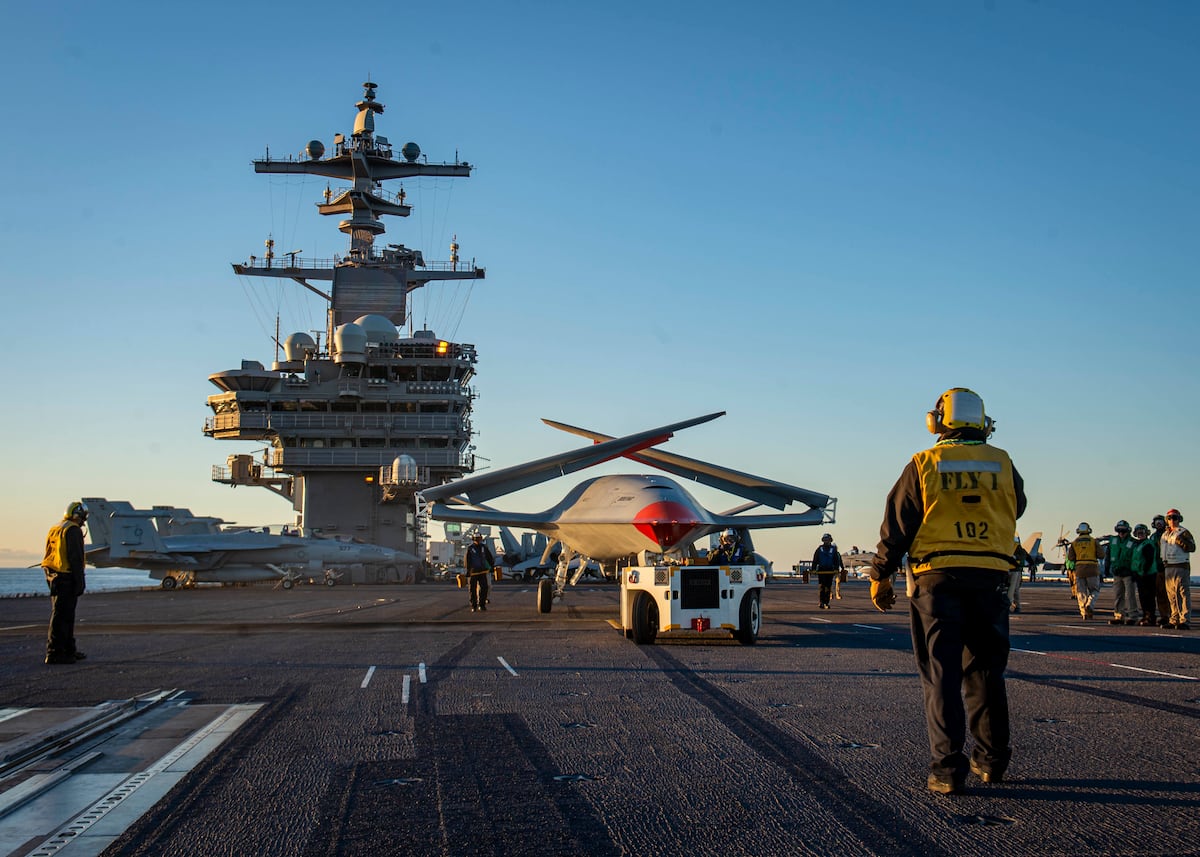
The U.S. Navy is looking for a family of carrier-based drones that can fulfill a variety of missions, according to a July 14 Request for Information.
The sea service “is exploring the industrial base’s capacity to deliver highly capable, autonomous platforms optimized for operations from Ford-class and Nimitz-class Nuclear Aircraft Carriers,” according to the RFI. The response deadline has been set for Aug. 13.
The drones the service is targeting, part of the Air Wing of the Future Family of Systems, can be designed as “a single-role platform, a multi-role platform, or a modular FoS [family of systems],” according to the service.
But whatever the solution, the Navy wants the platforms to be capable of performing eight different missions: strikes against surface ships, strikes against land targets, anti-submarine warfare, air-to-air combat against enemy aircraft and missiles, electronic warfare, ISR, aerial refueling, and resupply flights for a naval task force.
The service is soliciting “industry expertise to identify a mix of platforms that can provide affordable mass, risk-tolerant platforms that can perform the above missions to counter current and emerging threats,” the request states.
The RFI lists a few specific requirements, including a minimum 1,000-nautical mile range for strike missions.
Drones must also possess “flight autonomy (e.g., carrier pattern, taxiing) and mission autonomy (e.g., dynamic tasking/retasking, threat evasion, automated aerial refueling) maturity.”
Additionally, they must be compatible with existing Unmanned Carrier Aircraft control systems, according to the RFI.
Significantly, while the RFI mostly focuses on carrier-based drones, the Navy also wants vertical-takeoff UAVs that can operate from other types of vessels, such as destroyers and mobile sea bases.
“The Navy is interested in novel concepts that can operate from any air capable platform in addition to the CVN (e.g., DDG, ESB) using Vertical Take-Off and Landing (VTOL),” the RFI said.
The RFI is indicative of the Navy’s desire to eventually move on from fourth-generation carrier air wings to an air wing composed of fifth- and sixth-generation manned and unmanned aircraft.
The new drones “must demonstrate increased combat effectiveness over current fourth generation platforms at a given spot factor.”
The Air Wing of the Future, as designed, appears to be modeled for an old-fashioned battle of attrition, in which combat is waged by affordable — and expendable — drones rather than a handful of expensive platforms.
Contractors responding to the RFI are asked to “detail how your production approach supports rapid scaling and elasticity in a surge scenario,” and what techniques they will use to “keep unit recurring flyaway (URF) and sustainment costs within sustainable limits.”
Companies should also explain how their proposed designs will minimize maintenance requirements and fit into existing naval supply chains, according to the RFI. Potential manufacturers should also submit “planned capital investments (CAPX) or Internal Research and Development (IRAD) commitments to mature the solution.”
The Air Wing of the Future Family of Systems is part of the Trump administration’s Golden Fleet expansion plan for the Navy.
Existing family-of-system drone projects include the MQ-25A Stingray tanker and the Collaborative Combat Aircraft, or CCA.
Michael Peck is a correspondent for Defense News and a columnist for the Center for European Policy Analysis. He holds an M.A. in political science from Rutgers University. Find him at theuncommondefense.com. His email is [email protected].