


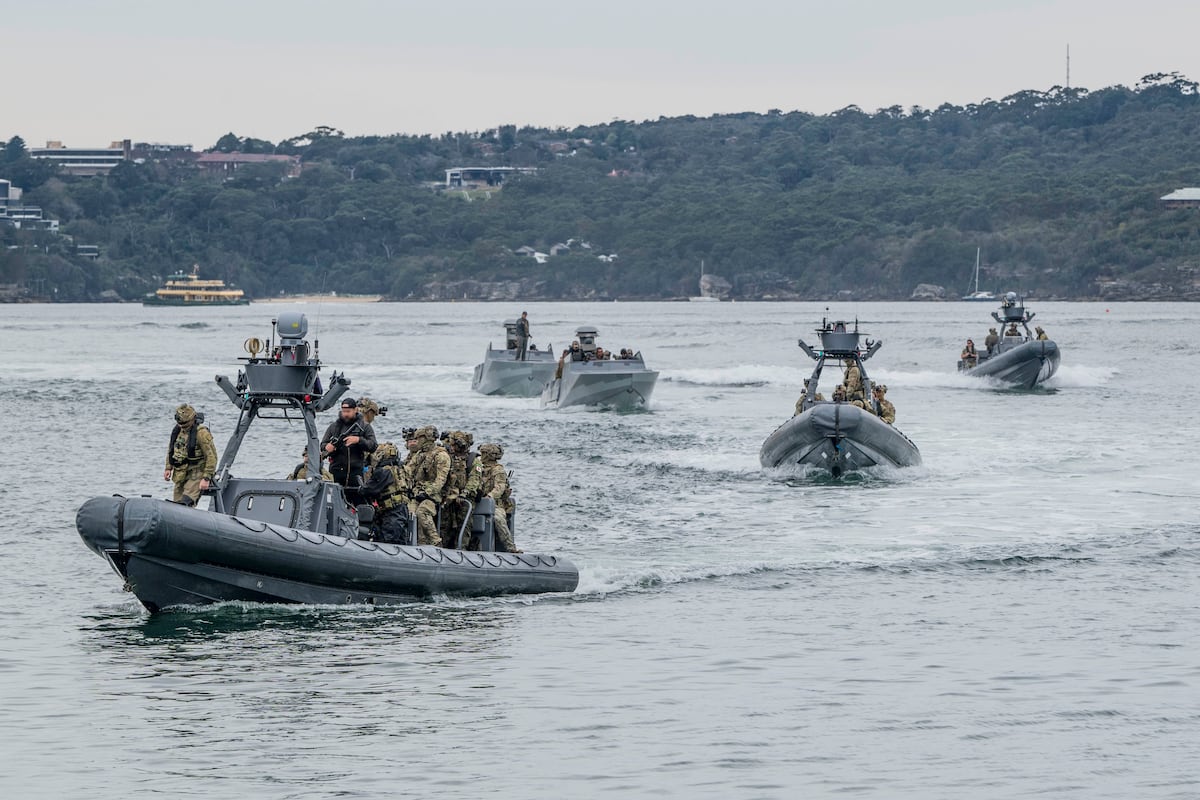
The Navy failed to identify and treat special warfare personnel who exhibited symptoms of a traumatic brain injury, a government watchdog found.
The Defense Department Inspector General published a report Wednesday that criticized Naval Special Warfare Command for relying on an evaluation system that fell prey to a lack of oversight and compliance.
“The Naval Special Warfare Command did not consistently implement Do[D] and Naval Special Warfare Group Four (NSWG-4) policies regarding the identification, clinical evaluation, and subsequent care of SWCCs presenting symptoms of TBI,” the report found.
The Defense Department defines a traumatic brain injury as one that disrupts brain function as a result of external force.
The indications of TBI are identified through changes in mental function, including confusion and slower processing; memory loss; and dips in consciousness.
Navy special warfare personnel are required to fill out a mild TBI and Exposure Report form after returning from being away at sea and report any symptoms they’ve experienced that may be related to TBI.
If that person reports or displays symptoms indicative of a concussion, medical personnel perform an evaluation and screening called a Military Acute Concussion Evaluation, Version 2, to try to diagnose a concussion and a TBI.
But the Defense Department Inspector General found that many service members returning from an underway never filled out the report.
Between Jan. 1 and April 1, 2026, only 24 sailors with Naval Special Warfare Command completed the form, accounting for just 21 of 193 underways reported by Special Boat Team 12 and Special Boat Team 20 during that period.
The inspector general said this happened because there is currently no program that oversees the form-filling process or enforces compliance.
The watchdog found no evidence that commanders and senior leaders made sure service members completed the forms.
The forms also take several hours to complete, which discourages sailors from finishing the important paperwork.
Most importantly, over the span of six years, Naval Special Warfare Command didn’t record a single completed MACE-2 test for Special Boat Team 12 and Special Boat Team 20.
Between 2020 and 2026, 144 service members completed 634 TBI Exposure Forms after exhibiting symptoms of TBI, but not one of them underwent the concussion evaluation MACE-2 test meant to diagnose TBI.
The inspector general said this problem arose because the Navy’s concussion management plan only requires a corpsman to conduct a MACE-2 test if the service believes the sailor has a concussion.
But there is no foolproof way to identify a concussion, the inspector general said, leaving massive room for human error.
Medical personnel don’t conduct a MACE-2 unless the Navy special warfare service member, or senior official above them, asks for it.
Symptoms listed on the mild TBI and Exposure Report form also include maladies that don’t only pertain to concussions, making it unclear what may be indicative of a concussion.
The inspector general discovered that Navy special warfare personnel also sometimes deliberately circumvent the TBI process by providing answers to the MACE-2 test they have memorized beforehand.
These answers are delivered to downplay the severity of any potential symptom or injury.
The government watchdog said the weakness of the test is a byproduct of the Defense Department not having a standardized test for wave-impact events.
Naval Special Warfare Command additionally failed to ensure that service members displaying TBI symptoms arrived for follow-up appointments for medical attention.
The Navy’s concussion management plan requires a service member to return for a medical follow-up appointment within two weeks of returning to duty.
But none of the 634 TBI Exposure Forms completed between 2020 and 2026 documented a completed follow-up appointment within that time frame.
One Navy special warfare service member told the inspector general that fear of losing their job on the boat played into ditching follow-up appointments.
They said reporting symptoms could derail deployment exercises.
In response to their report, the inspector general recommended that Naval Special Warfare Command develop a more comprehensive way to identify TBI in special warfare combat crewmen and ensure service members receive follow-up treatment.
The government watchdog also recommended that Naval Special Warfare Command’s senior medical officer work closely with the branch chief of the Traumatic Brain Injury Center of Excellence to institute a standardized checklist to assess TBI from wave impacts.
Riley Ceder is a Navy reporter at Military Times, where he covers issues directly affecting service members and their families, as well as breaking news.