


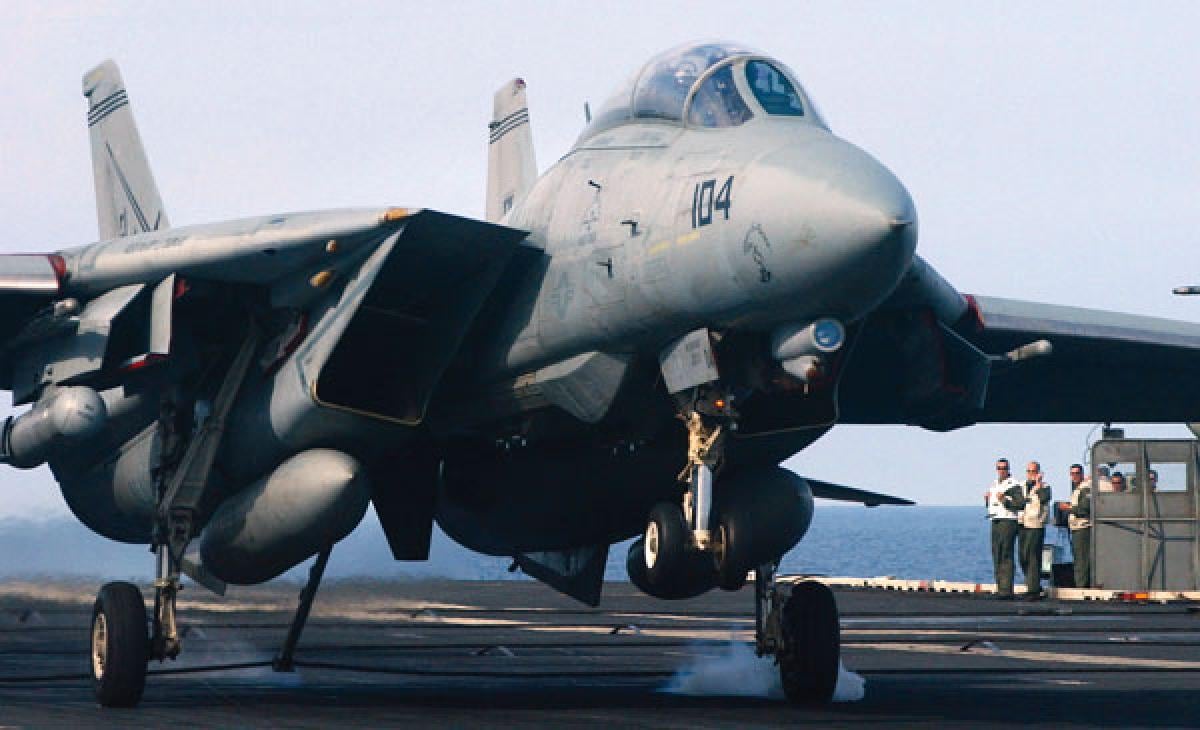
Four decades after Tom Cruise’s Pete “Maverick” Mitchell first felt the need for speed in the cockpit of an F-14 Tomcat, new legislation is keeping hope alive that the iconic swept-wing fighter could someday fly again.
In late April, the U.S. Senate, led by sponsor Sen. Tim Sheehy, R-Mont., unanimously approved the “Maverick Act,” introduced by freshman U.S. Rep. Abraham Hamadeh, an Illinois Republican and Army Reserve officer. The bill, which has yet to become law, authorizes the secretary of the Navy to hand over the service’s three remaining F-14D Tomcats to the U.S. Space and Rocket Center Commission in Huntsville, Alabama.
It allows the commission to put the aircraft on display, but also permits them to be operated in “an airshow … or a commemorative event to preserve United States naval aviation heritage.”
In other words, U.S. F-14s could take to the sky once more.
This is all significant because of the aircraft’s complex and high-stakes national security history. When the Grumman-made aircraft was retired in 2006 after 32 years of service, Congress acted quickly to mitigate the threat of foreign theft or security breach, specifically from Iran, which has operated variants of the Tomcat since 1979 and is the only remaining country to fly them.
(Notably, in 2022’s “Top Gun: Maverick,” Cruise gets back into the cockpit of an old F-14 found in the hangar of an unnamed adversary nation. While there are some conflicting details mixed in to keep the identity of that rogue nation vague, that still-operational Tomcat is a definite tip-off.)
The Fiscal Year 2008 National Defense Authorization Act specifically prohibited the Department of Defense from selling any F-14 fighters or parts, or granting an export license to allow any to leave the country. While it did carve out a narrow exception to allow sales to museums for historic preservation, the legislation led DoD to take radical measures to ensure none of the retired aircraft fell into the wrong hands.
Retired F-14s that had been sent to the “Boneyard” at Davis-Monthan Air Force Base, Arizona — a common resting place for retired aircraft that might have some future military use as parts or spares — were ordered shredded into two-foot-by-two-foot “bits” by a contractor paid nearly $1 million to carry out the work.
The move came after the Associated Press found foreign buyers had been able to get their hands on F-14 parts, despite the caution and prohibitions.
“Investigators also found some sensitive items accidentally slipping into surplus auctions rather than being destroyed as they were supposed to be,” CBS reported at the time. “In an unusual move when dealing with retired aircraft, the Pentagon is trying to shut off all avenues for Iran’s parts purchasers by demolishing the F-14s, then combing through the scraps to make sure nothing useful remains.”
In a fascinating coda to the F-14 saga, NPR reported in March that Iran’s last 10 operational Tomcats may have been destroyed in strikes executed since the start of the current war on Feb. 28.
The Maverick Act names three specific F-14D aircraft by tail number, requiring that they be demilitarized and “do not possess any capability for use as a platform for launching or releasing munitions or any other combat capability, as determined by the Secretary,” according to the legislation.
The transfer to Huntsville for education and display must take place at no cost to the U.S., and the legislation specifically prohibits restoration of combat capability or foreign transfer.
“I want to thank Senator Sheehy and his colleagues for passing this legislation aimed at preserving for history one of the most iconic aircraft ever flown,” Hamadeh said in a statement. “As a former U.S. Army officer, I know that many of the men and women I served with felt the same way. That is why I proudly introduced this legislation.”
Hamadeh also noted that he had moved to save five retiring T-37 jet trainer aircraft from the Boneyard in a separate bill.