


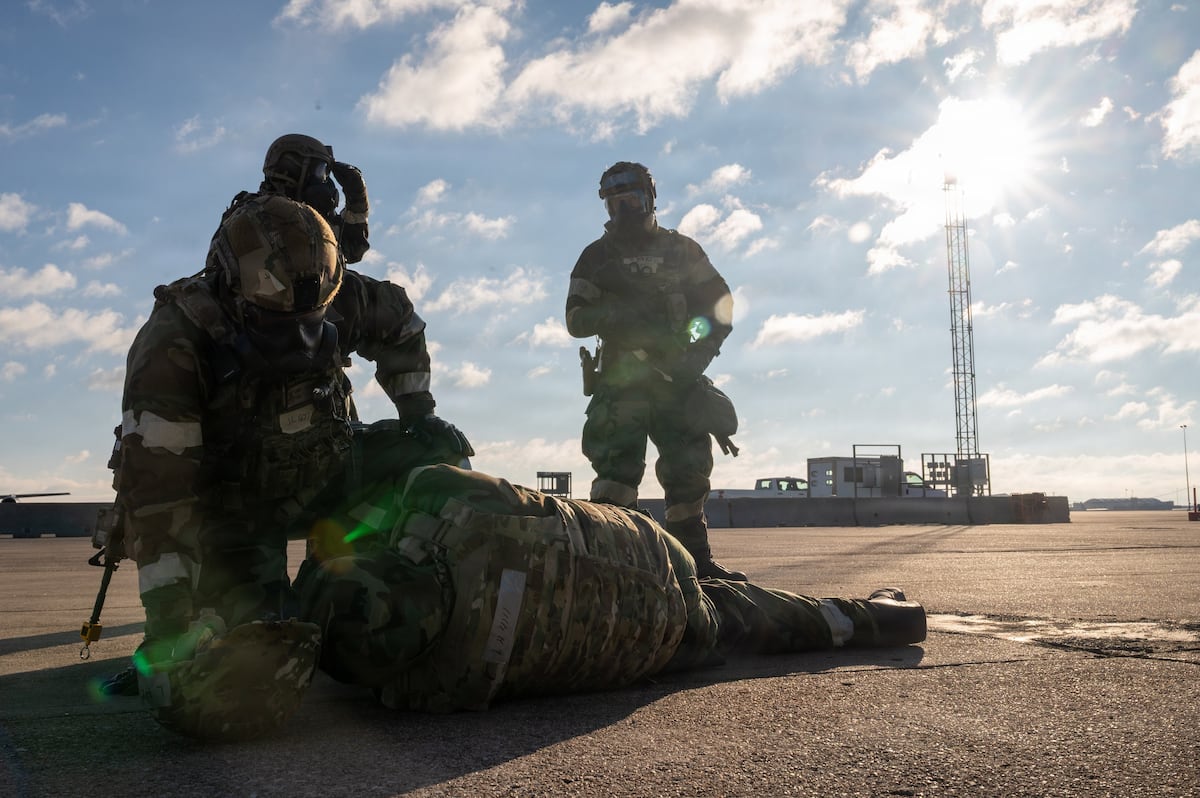
In situations where battlefield medical care becomes overwhelmed during heavy combat, the U.S. Defense Advanced Research Projects Agency is looking toward a future in which robot medics tend to casualties.
The agency envisions swarms of robots linking up to drag wounded personnel to safety. They would also inject lifesaving drugs and even shapeshift themselves to form splints around broken limbs, according to a DARPA Small Business Innovation Research solicitation.
The goal is to create an “autonomous, self-deploying, wound assessing, swarm-capable, self-linking, mobile robotic solution to assist reaching and moving casualties and perform life-saving interventions at the point-of-need,” the solicitation states. The deadline is June 3.
The current battlefield medical system may have worked for the small-unit counterinsurgency warfare of recent years, but it can’t handle casualties from big-unit warfare.
“Future Large Scale Combat Operations predict massive casualty incidents, delayed evacuation, and insufficient capacity of the medical system,” DARPA noted.
Delayed battlefield medical treatment results in a “high chance of dying due to lack of hemorrhage control which is the leading cause of potentially survivable death in both battlefield and civilian trauma cases prehospital.”
The question is whether robots can stop the bleeding.
“We believe this is achievable due to the recent advancements in swarm, self-assembling, and mobile robotics, as well as robotics for medical applications,” DARPA said.
Any solution must satisfy at least two of four requirements listed in the solicitation. One calls for a robot that can drag an injured soldier a short distance — 10 meters — onto a litter.
If a single robot isn’t strong enough, then the system must allow a swarm of bots to combine their strength to move the casualty. The system should also enable multiple robots to wrap themselves around an injured limb to prevent further damage as the casualty is being dragged to safety.
DARPA is also interested in robots that can inject medicines. One specification calls for robot swarms to form tourniquets.
They would “self-arrange and reassemble into shapes to provide massive hemorrhage control,” said the solicitation. “The goal will be to create a ‘smart tourniquet’ capable of autonomously clamping around injured limbs to stop arterial blood flow as well as apply sufficient pressure and coverage over a junctional wound.”
Even as the U.S. Army explores unmanned ground vehicles to evacuate wounded, DARPA envisions medicbots working in tandem with such vehicles.
“Due to the intended smaller size, the medical robotic solution could be an ideal assistant in the tight quarters of unmanned evacuation vehicles,” DARPA noted.
While emphasizing that these medicbots can be of any shape, DARPA prefers a system that can fit into an Individual First Aid Kit or one lightweight enough to be deployed via drone-swarm.
The first phase of the project involves demonstrating multiple capabilities for a system, including swarming and identifying injuries, as well as mobility across rough terrain and “over/across the human body” and “interlocking units, shape-changing, and rigid stability.”
These capabilities can be demonstrated in a laboratory or on a medical manikin.
Phase two calls for a prototype that can be tested under field conditions using “perfused cadavers, animal models, or high-fidelity medical training phantoms.” Companies must also provide a manufacturing plan that meets requirements set by the U.S. Food and Drug Administration.
DARPA also sees potential uses for swarming medicbots in the civilian world.
“Collapsed buildings, fires, and hazardous chemicals can make reaching civilian casualties impossible outside of the means of robotic and autonomous systems,” the solicitation said. Initial lifesaving care “can provide the necessary time for stabilization until medical response teams arrive and continue care.”
Michael Peck is a correspondent for Defense News and a columnist for the Center for European Policy Analysis. He holds an M.A. in political science from Rutgers University. Find him on X at @Mipeck1. His email is [email protected].