


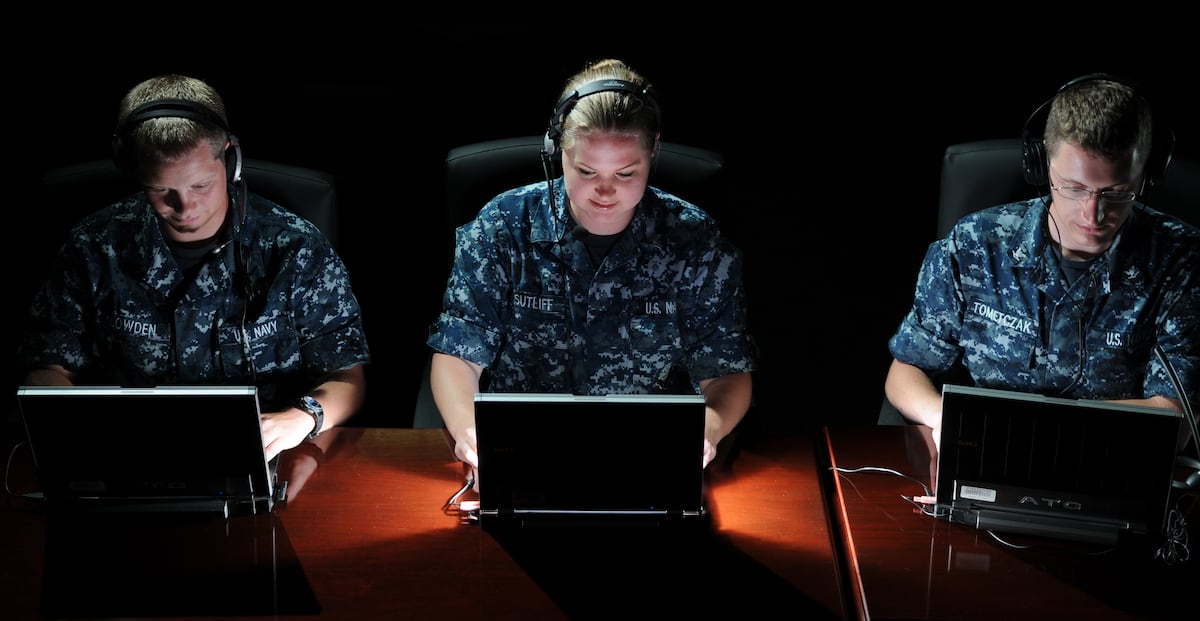
AI-powered “decision support tools” are helping the U.S. Navy hang on to more of its highest-priority sailors — with the help of commanders authorized to persuade and offer flexibility incentives.
In the little more than a year since the service launched the “Full Power Navy” pilot program in February 2025, leaders have “converted” 3,300 sailors who had begun the process of separating, convincing them to re-up instead.
In the group targeted for engagement — sailors with between five and 20 years in service in ratings designated as high need — 20% more are choosing to stay in, said Rear Adm. Jeffrey Heames, assistant commander of Navy Personnel Command.
The program aims to communicate with command triads about sailors whose data indicates they are at or near a departure decision from the Navy and initiating a conversation about the reasons for leaving, and what might convince them to stay instead.
“The most important part of this is having the command talk to the sailor about staying in the Navy, and what you know, what are the obstacles, and identifying some of those, and informing us through our digital tracking system, so that we can reach out to them and hopefully craft up the new solution,” Heames said.
Solutions that might be offered include alternative assignments that better align with career or family needs or put them in a desired location. In fact, location needs or mismatches are the most common driver for sailor departures, Heames said.
“Some sailors are looking for opportunities to go back to their hometown areas. In some cases, sailors are looking to stay in the same geographic area where they are,” he said. “Geographic location, and in some cases, stability, is a really, really high priority for our sailors.”
In some ways, the program sounds like the consumer retention programs that will drastically drop subscription rates or offer hidden benefits for customers moving to take their business elsewhere.
“I would say that’s less of a secret menu and more of a constantly evolving set of opportunities, because it just changes every single day based on what happens with people, where we have losses that are unplanned,” Heames said. “When you have more billets than you have people, there’s always an excess of opportunity, so it’s less of a secret and more of a curated opportunity based on what’s available today, when we’re talking to them.”
RELATED
For the broader fleet, another tool known as “Project Compass” creates an algorithmically populated marketplace of jobs aligned with sailors’ interests, needs and skills, based on the copious data the Navy has on them.
“As it turns out, we have lots of data about our sailors. It just happens to be in 100 different silos, and so one of the efforts we undertook when we started was to build data aggregation pathways of all of these different systems, so that we could aggregate the data together about the individual, and then use that to develop a coherent profile again that we would use as part of this this tracking of the stay-go decision of every sailor,” Heames said.
“So, fast forward, we want to get ahead of the problem [addressed by] Full Power Navy by getting sailors more dialed when they go into the marketplace,” he continued. “So we took that same digital information and we began to do algorithmic pairing of individual rollers before they’re in the marketplace, so we have all of the digital information of the sailor, and then we would have all of the billets that the fleet wanted us to fill as their top priority.”
Established as a pilot eight months ago, Project Compass is now sending “10 to 15,000 emails to sailors” with job recommendations ahead of formally entering the marketplace for their next assignment.
“We find that sailors who get these job recommendations by email … make three applications, where a sailor who doesn’t get the recommendations makes only two, so that increase in participation, we hope, is going to get better-quality pairings and a volumetric improvement in quality pairings,” he said. “Ideally, we’re getting sailors latched into jobs that they like, they want, they’re career-enhancing.”
While AI allows the Navy to better collect and use data, Heames said the future for the effort is all about more active career management using what’s already known about applicants.
RELATED
“Instead of just providing a job recommendation with a cold description of the job, we would like to have really advanced descriptions that are relevant to that sailor using their digital information,” he said.
That, he said, could look like charts that show a sailor’s promotability timeline, expected compensation, and career progression.
While Heames couldn’t immediately provide numbers, he said last year saw the Navy reach its retention objectives and transition to its “stretch goal” — an important accomplishment, he said, as leaders don’t want to count on a continued recruiting boom to cover longtime retention shortfalls.
This year, he said, the Navy was on a “glide slope” for similar retention performance.