


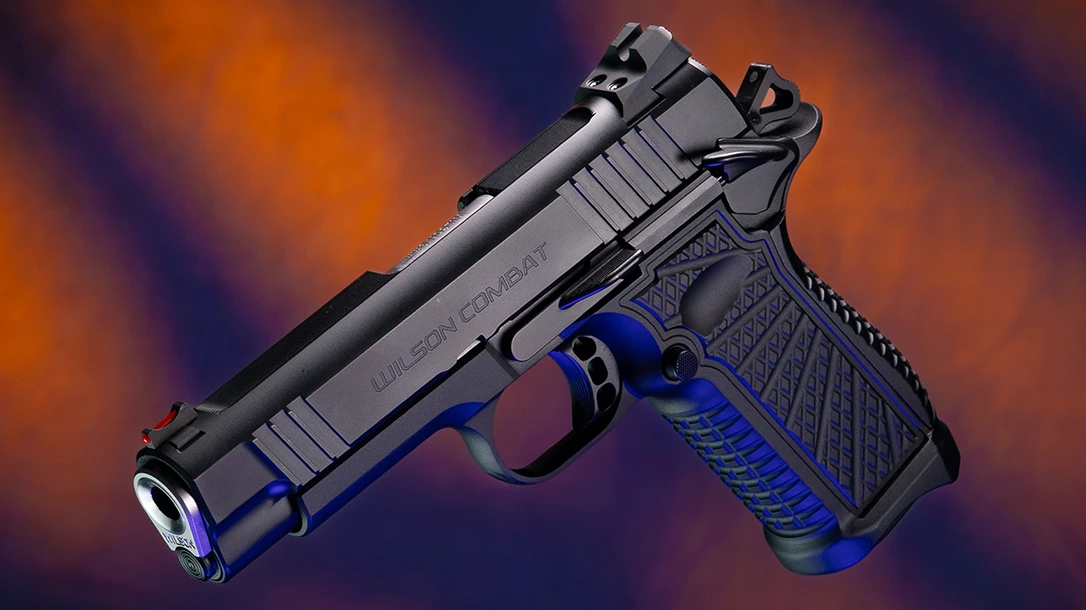
If you follow the American handgun market, you already know Wilson Combat for tuned 1911s, spotless fit and finish, and an almost stubborn insistence on reliability. What you may not know is how deliberately the company has been reshaping its lineup around high-capacity 9mm pistols that retain the control layout and trigger feel people love in a classic single stack. The Wilson Combat SFT9 sits right in the center of that pivot.
The Wilson Combat SFT9
This is a double-stack 9mm built on Wilson’s solid-frame architecture. It is meant to bridge two worlds that rarely overlap: heirloom build quality and duty-grade practicality. The question this review answers is simple. Can a pistol that is this refined still qualify as a high-value choice for shooters who actually train and carry?
Custom .45s to Alloy-Frame 9s
Wilson Combat began life in 1977 as Bill Wilson’s custom 1911 shop in Berryville, Arkansas. For decades, the company earned its reputation in the traditional single-stack lane, shipping immaculate .45s and supporting them with in-house gunsmithing, parts, and, later, ammunition.
Advertisement — Continue Reading Below
The strategic turn came when the market pulled hard toward high-capacity 9mm carry guns. Wilson’s answer was the X-Frame, first seen on the EDC X9. It kept a 1911-quality trigger and safety layout while feeding from wide-body magazines.
The “solid-frame” concept that followed pushed the idea further. Rather than a conventional two-piece grip and frame, Wilson machines the grip module as part of the frame itself. The result is a monolithic structure that is thinner than a conventional double-stack, more rigid under recoil, and shaped so it feels like a 1911 in the hand without the bulk many associate with high-capacity pistols.
The SFX9 carried that banner, and the SFT9 evolved it again with details that lean more toward traditional 1911 construction on top, while keeping the modern capacity and geometry beneath.
Advertisement — Continue Reading Below
Quiet Sophistication, Deliberate Choices of the SFT9
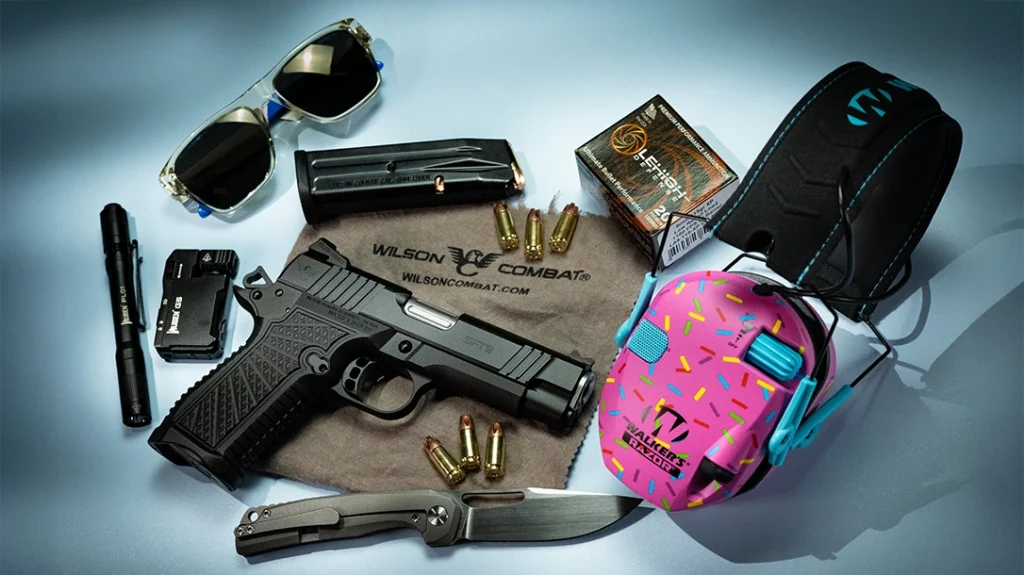
The SFT9 does not shout at you. It is black on black, with small parts that match, and a stainless accent at the muzzle, including the barrel bushing, and on the slide where the barrel peeks through. Yes, there is a bushing. That alone hints at Wilson’s intention here. You get a 1911-style top end with a familiar field strip and the confidence of a fitted bushing, paired with a wide-body frame that carries like a trimmed-down service pistol.
Almost every control sits where a 1911 shooter expects it to be. The shapes and lengths are Wilson’s own, and some locations are nudged to work with the solid-frame grip. However, the learning curve is basically zero if you run a thumb safety and slide stop frequently.
Advertisement — Continue Reading Below
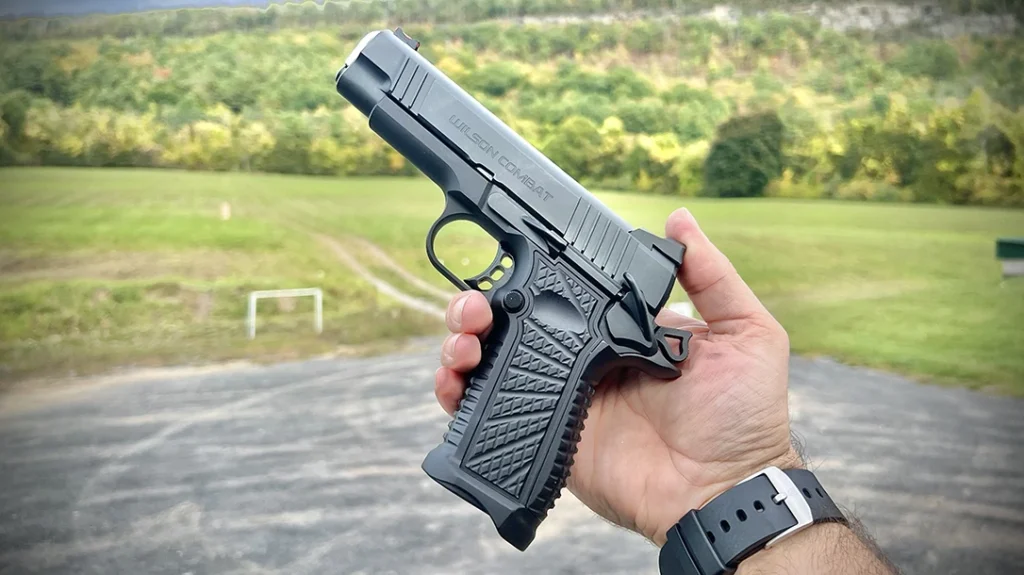
Strip the pistol, and you see more of the philosophy. The slide carries three radial locking lugs. Correspondingly, the barrel is timed to run on two of them, which is standard on many modern 9mm 1911-pattern barrels. The barrel feet are correctly cut to the cross pin. There is a substantial rear lug area that lands firmly on the frame. In addition, the feed ramp is polished so the gun digests quality 9mm without drama.
The barrel itself is stainless and heavy through the muzzle, with an aggressive crown that protects the rifling and gives the front of the gun a crisp, finished look. The SFT9 uses a traditional plug system. So, field stripping feels like any bushing gun, and the barrel has zero perceptible end shake once assembled.
Advertisement — Continue Reading Below
It’s a modern take that keeps just enough of the old playbook to make a 1911 shooter feel at home.
Slide and Sights
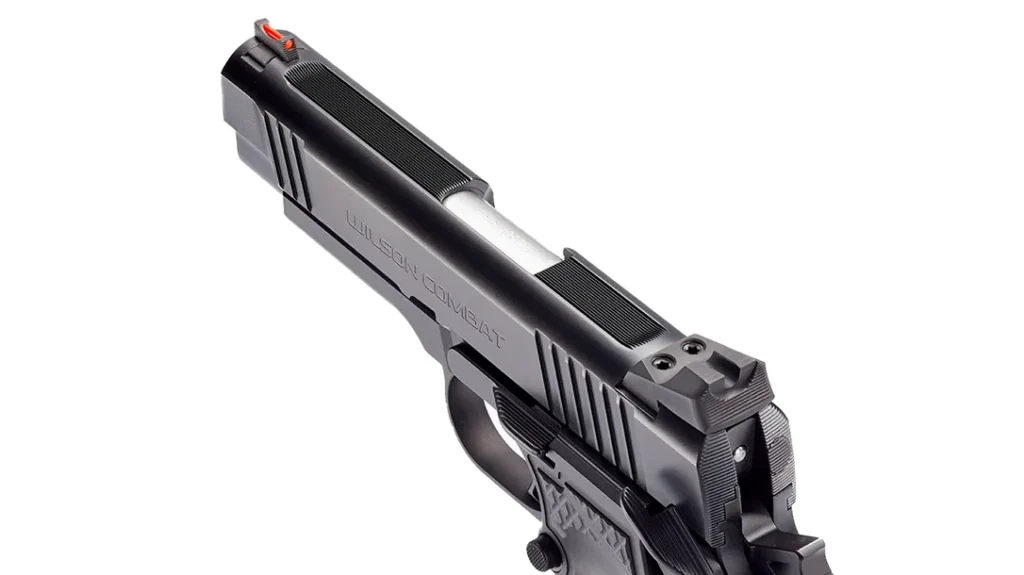
Wilson equips the SFT9 with forward cocking serrations, fifteen fine glare-cut serrations along the top of the slide, and lateral serrations at the rear and on the sight. Those features are not just cosmetic. Under bright sun, they reduce sparkle on the topstrap and rear face. This keeps the sight picture cleaner when you are pushing speed at outdoor ranges.
Advertisement — Continue Reading Below
The rear sight is a blackout U-notch with a flat forward face that works well for one-handed slide manipulations off a belt, a pocket edge, or a bench. The front is fiber optic, and Wilson includes spare fiber in the bag. It is a very practical set for a carry-and-training pistol. It’s quick to index yet precise enough to settle into fine alignment for distance.
Solid Frame, Controls, and Magazines
The grip module is the story. Wilson mills it as part of the frame, then finishes the exterior texture to balance traction and comfort. There is a minimal flare at the magwell that helps guide reloads without bulking the heel. Likewise, the mainspring housing remains a separate component, so future service or changes are straightforward.
There is a beavertail, but no grip safety. That design decision makes sense in a modern defensive pistol. I have shot 1911s with pinned safeties and Novak-style inserts that mimic this outcome, and it’s wonderful. Deleting a grip safety simplifies the interface, reduces potential points of failure, and keeps the backstrap profile slim.
Advertisement — Continue Reading Below
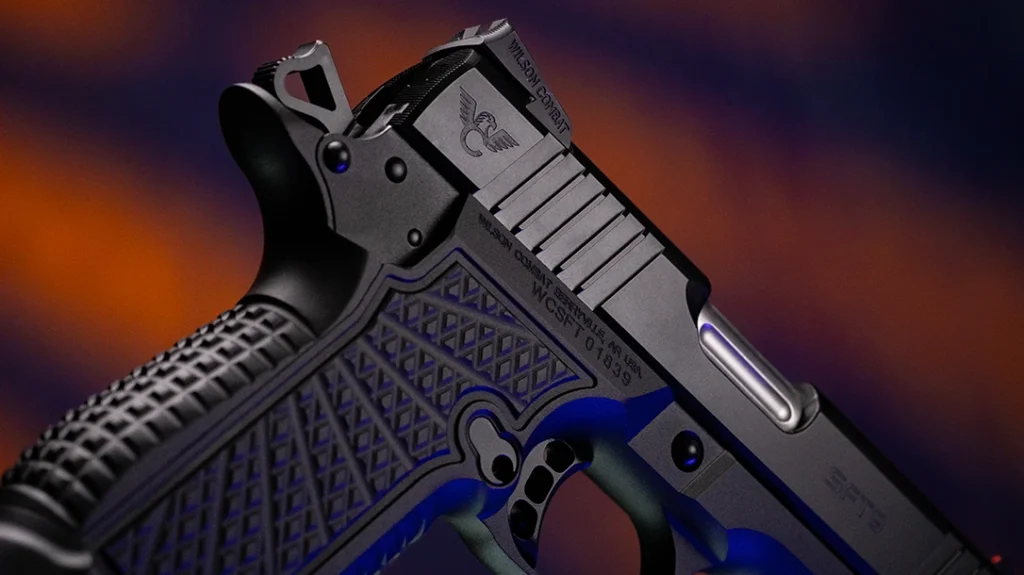
Controls are extended and positive. The safety detents are tuned with audible and tactile clicks. I can run the thumb safety, magazine release, and slide stop with the strong-hand thumb without changing my master grip.
Shooters with very large hands sometimes comment that the slim, solid-frame circumference feels small. So, if you have big paws, it is worth getting one in hand before you decide. For me (with normal hands), the geometry is ideal. It anchors the pistol high in the web without any of the pinch or edge pressure you sometimes feel on traditional double-stacks.
Magazines are stamped “Made in Italy.” They are Mec-Gar products built to Wilson spec, which is exactly what you want from this category. Capacity is eighteen rounds, and the pistol ships with two. I would never complain about a third. However, two is the real minimum a factory should provide, and these ran correctly in testing.
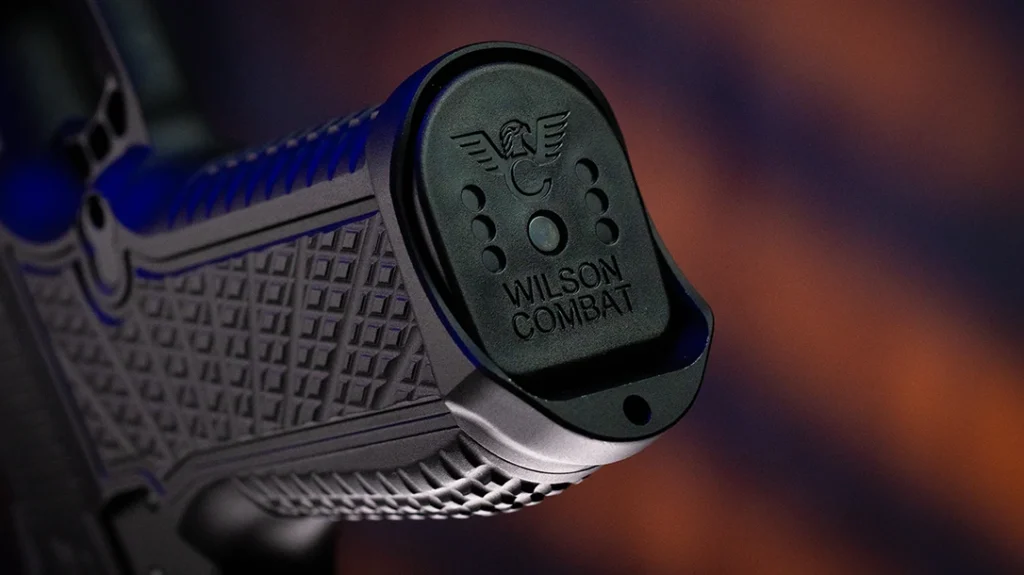
The feed geometry, follower behavior, and basepad profile all play nicely with the magwell flare. Empty mags fall smartly, and reloads are guided into place without hunting for the opening in the frame.
The Wilson Combat SFT9 On Paper
On the scale, the SFT9 weighs 1 pound 11.1 ounces, unloaded. That is a very manageable carry weight for a metal-frame pistol with this capacity. The trigger averaged 2 pounds 2.8 ounces across six pulls, with the pistol clamped in a vise and a calibrated gauge. The break is crisp, and the reset is short enough that you never wonder whether it has returned.
Recoil impulse is soft, helped by the spring rate selection and the barrel and slide mass balance. The slide is easy to rack. The overall cycle feels smooth and deliberate, with enough closing authority that you do not catch it hesitating when the pistol gets warm and dirty.
I rarely plant a flag on group size, because too many variables stack the deck in either direction. However, I did shoot structured five-shot strings at forty feet with several loads. With Lehigh Defense 115-grain Controlled Fracturing +P, the pistol clustered just under two inches. Lehigh Defense 90-grain XD averaged 1,366.1 fps at the muzzle on my chronograph. The 115-grain “Low Recoil” load averaged 1,122.4 fps.
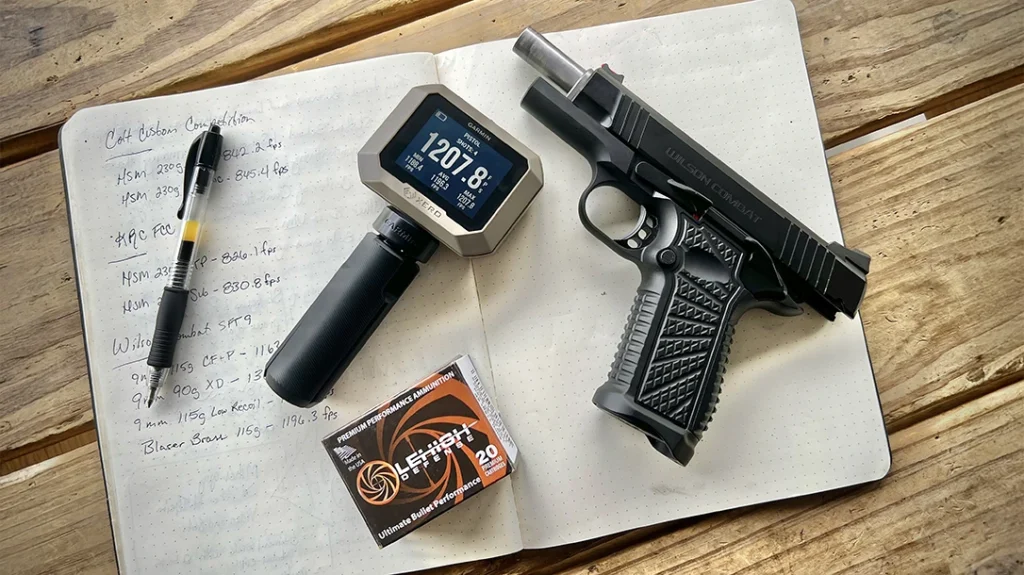
A control box of Blazer Brass 115-grain ran at 1,196.3 fps and printed wider, but not much. The point here is not to sell a single ammunition choice. It is to show that the SFT9 shoots to point of aim with a sensible range and carry loads. Likewise, the sight picture translates into honest hits when you keep your grip and cadence clean.
Why It Feels “Right”
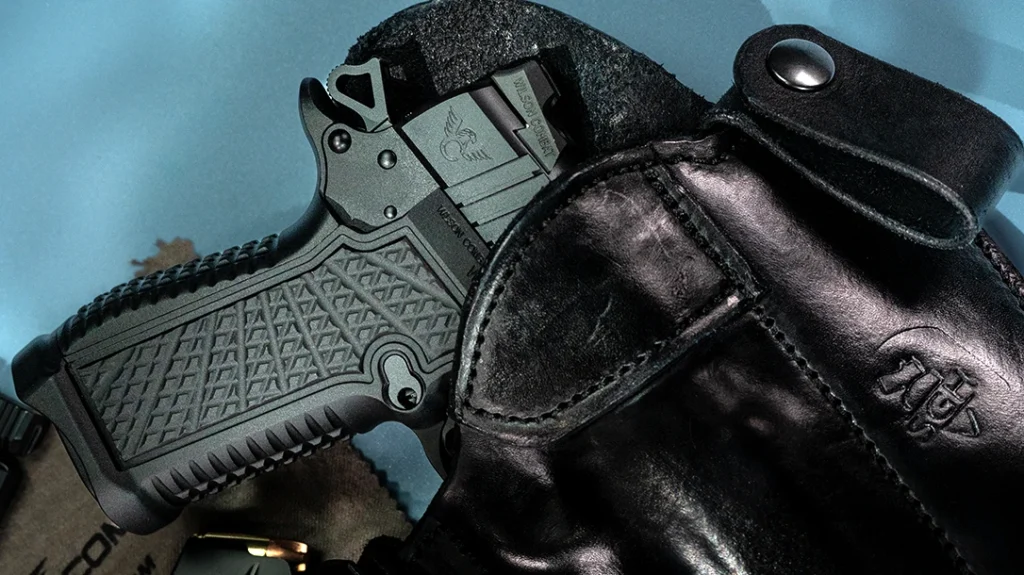
I carried the SFT9 longer than I usually keep a test gun because the solid-frame profile hides better than most metal pistols that are not micro-compacts. The grip is slim enough to disappear under clothing, then fills the hand like a purpose-built shooter once it clears leather or kydex.
On the range, it encourages speed. Recoil control feels intuitive, sights fall back into the notch without hunting, and the control layout lets you reload and clear with minimal grip disruption. Magazines seat with authority, the slide stop is where your thumb expects it, and the safety detent is positive without being stiff.
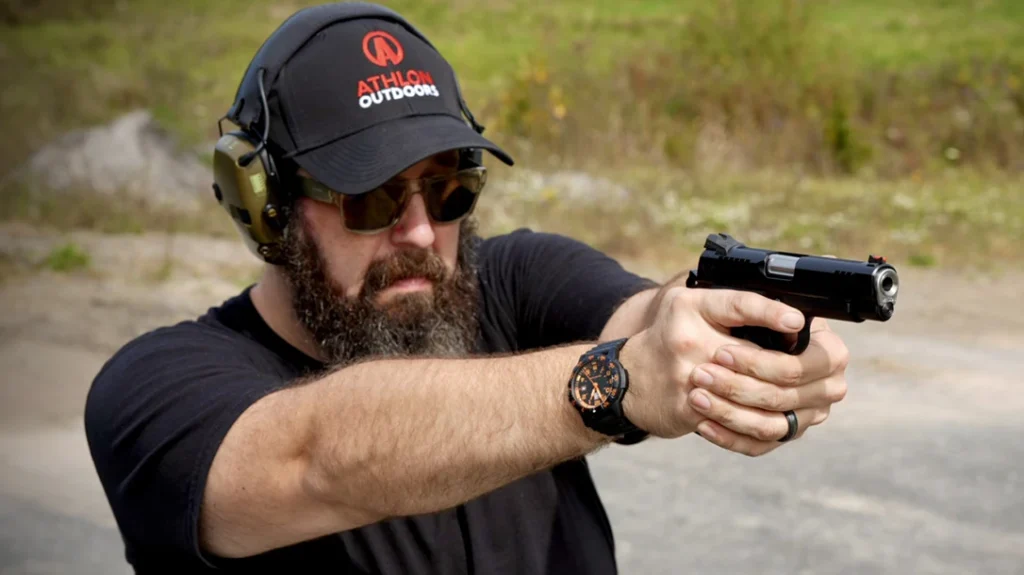
The bushing and heavy-profile barrel are not at odds. What matters is how the slide, bushing, and barrel lock and unlock. Wilson fits these parts so there is ZERO discernible end shake when assembled. The extra barrel mass steadies muzzle tracking, the crown protects the rifling, and the bushing keeps field service familiar while the frame and magazine system deliver modern reliability.
Where the SFT9 Fits
Across mixed ammunition, from premium defensive loads to range fodder, the pistol ran cleanly and returned to the same sight picture with little effort. That consistency is what lets a gun work hard through long training blocks without babying. Value follows from that behavior.
The solid-frame build brings rigidity you do not get from two-piece grips. In addition, the magazines are proven, the sight package is practical, and the barrel fit shows up on paper without turning finicky when hot. If you train weekly and carry daily, that is the kind of value that matters.
The market leans heavily toward tiny optic-ready micros and polymer duty guns. Metal double-stacks with a 1911 manual of arms serve a different user. If you live on a thumb safety, prefer a straight-back trigger, and want on-demand precision, this pistol makes immediate sense.
It is not a pocket gun. It is a serious carry-and-training pistol with manners that reward reps, a weight that is kind to your belt, and geometry that conceals more easily than you expect.
Final Shots
The SFT9 is the logical endpoint of Wilson’s move from bespoke single-stacks to high-capacity 9mm while keeping the soul of a 1911. Its solid frame defines its character, the barrel and slide choices define its shooting manners, and the controls make the transition easy for anyone already fluent with a safety and straight-back trigger.
My sample weighed 1lb 11.1oz, broke at 2lb 2.8oz, and shot to point of aim with quality loads. Recoil is gentle, the cycle feel is smooth, and the magazines do their part.
High-end and high-value can live in the same pistol when build quality, reliability, and practical performance align. Here, they do. If you are a serious shooter who wants a modern wide-body that behaves like a refined fighting pistol, the SFT9 belongs on a short list.
Shoot safe.
WHY OUR ARTICLES/REVIEWS DO NOT HAVE AFFILIATE LINKS
Affiliate links create a financial incentive for writers to promote certain products, which can lead to biased recommendations. This blurs the line between genuine advice and marketing, reducing trust in the content.