


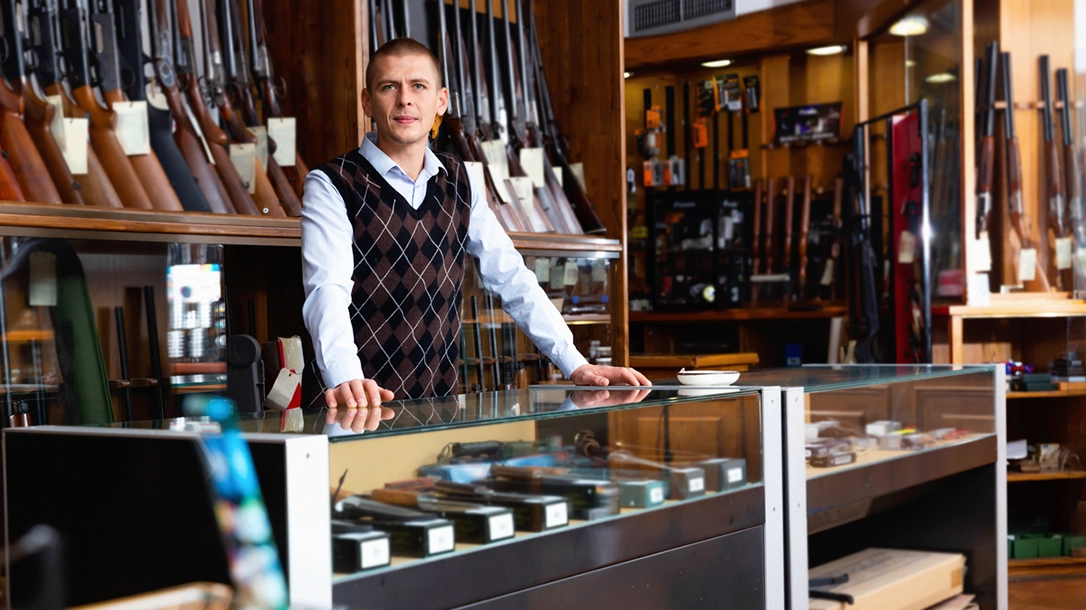
Shopping for and buying firearms isn’t like walking into a box store, picking up what you need, and walking out. Firearms are tools, but they are inherently dangerous tools if not handled properly, even in the store. So, gun shopping entails a certain gun store etiquette not found elsewhere in the retail world.
With so many new gun owners and people looking to buy their first gun, discussing those rules of etiquette may be helpful. It may also improve the shopping and buying experience for everyone involved. Even experienced gun buyers may benefit, as people can sometimes become lackadaisical. So, let’s look at some things to do and not do when shopping for and buying a firearm.
Safety First
Firearm safety is no joke. Safety rules exist for a reason. Let’s start with the basic rules of firearm safety. Abiding by these rules, even in gun stores, will go a long way toward courteous behavior in those gun stores.
Advertisement — Continue Reading Below
- Always keep a firearm pointed in a safe direction.
- Treat all guns as if they are loaded.
- Keep your finger off the trigger until you are ready to shoot.
- Always be sure of your target and what is beyond it.
The wisdom of those rules is self-evident, but they are violated every single day, even by people who should know better. For this article, let’s address them in terms of gun shopping. Understand that breaking these rules in a gun store may lead to the staff correcting you. Don’t be offended. They are trying to help you and everyone around you. Responding to correction by saying something like “It’s not loaded” just marks you as being more ignorant and disrespectful than you already appear. Take the correction, apologize, and move on.
Always Keep Firearms Pointed in a Safe Direction
Some people phrase this one as something like “never point a firearm at something you aren’t willing to destroy.” It’s phrased that way to drive home the rule’s seriousness. Remember, you can’t take back a bullet. Ever.
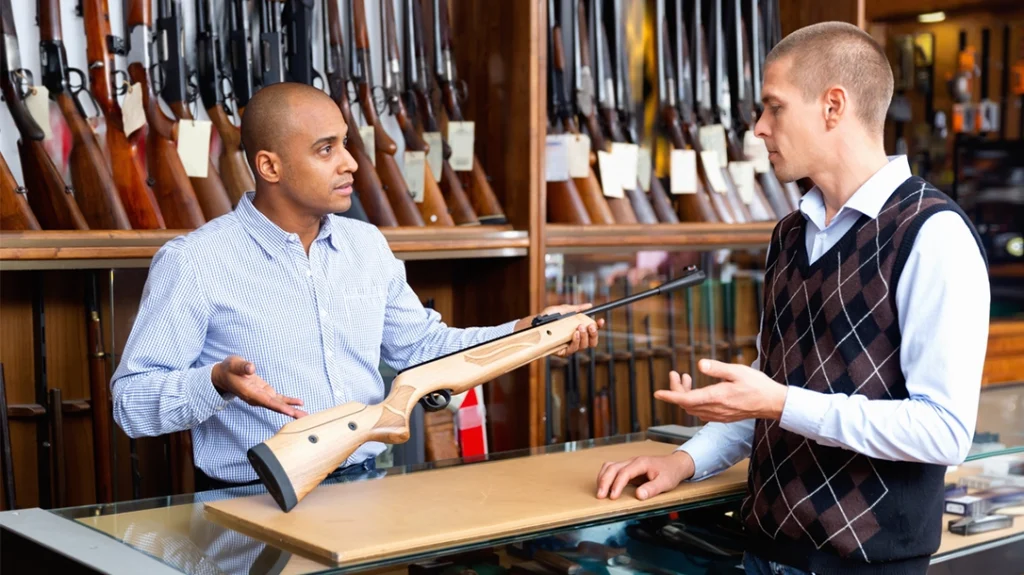
When firearm shopping, you naturally want to handle the gun in question before buying it. Guns fit people differently. What feels right for me might feel wrong for you. You should already have identified a safe direction to point a gun you want to look at before the salesperson hands it to you.
Advertisement — Continue Reading Below
Usually, this will be the floor directly in front of you. Try not to point it at the salesperson as you bring it up a bit. If you aren’t sure of a safe direction, ask the salesperson what direction he or she would prefer. Some stores have corners set aside for just that purpose. When I handle long guns in a store, I usually point them at the ceiling. It gives me a better feel for how the gun fits me. But I always ask the salesperson first. I don’t do that if the building has a second story. It stays pointed at the floor.
DO NOT raise the gun and swing it around the room. If you’ve spent any time in gun stores, you’ve likely seen this. Doing so is a flagrant violation of gun safety. Expect bad reactions from customers and staff alike. Put yourself in their shoes and think how seeing a gun pointed directly at you would feel like.
Treat All Guns as if They are Loaded
This builds on the last rule. Treating a gun as if it is loaded means you will not point it at anyone. At least I hope you won’t. Most salespeople will safety check a gun before they hand it to you. The action will likely be locked open. That’s for your protection and theirs. They are showing you that they are handing you an unloaded firearm. The muzzle will likely be pointed straight down as they give it to you. Visually inspecting the gun just to make sure will ease their mind as to your competence. It’s also just a good habit.
Advertisement — Continue Reading Below
Safety check the gun again before handing it back. Visually inspect and lock the action open. Hand it back the same way they handed it to you. Don’t be offended when they check it again. It may seem repetitive, but that repetitiveness builds good habits, prevents negligent discharges, and literally saves lives.
I’ve seen groups of hunters admiring one another’s rifles in deer camps. The rifle may pass through four or five sets of hands, yet each one safety checks it when he receives it and when he passes it on. Establish that habit. The gun store’s employees and customers will appreciate and respect you for it.
Keep Your Finger Off the Trigger Until You Are Ready to Shoot
This is so simple but so many people neglect it. Yes, you do want to check the trigger on any gun before you buy it. If your finger goes right to the trigger when a salesperson hands you a firearm, you immediately raise red flags. You will be marked as someone who either does not understand and value firearm safety, or as being careless and disrespectful of others in the store. Or all of the above.
Advertisement — Continue Reading Below
Dry firing a gun before buying it is part of the process. But do it correctly. Ask the salesperson if you may try the trigger. The answer will almost always be yes. Then refer to the previous two rules. Confirm the gun is unloaded. Point it in a safe direction. Then you can try the trigger. You can even try it several times. Just do it the right way and keep that finger off the trigger at all other times. In fact, over-emphasizing trigger safety by placing your finger high on the gun will be noted and appreciated.
Always Be Sure of Your Target and What is Beyond It
This rule is an extension of pointing the gun in a safe direction. Remember when I said I wouldn’t point a long gun at the ceiling of a two-story building? That’s an example of this rule. I don’t whether someone is up there and, therefore, cannot be sure of what is beyond my “target.” Again, if you aren’t certain which direction is safe, ask the salesperson. They’ll appreciate it and will direct you accordingly.
Know Why You Want the Gun
When buying a gun, it’s helpful to know what you want that gun for. Concealed carry? Home defense? Hunting? Target shooting? Knowing that stuff up front enables the salesperson to help you find the best choice for you. A good salesperson will ask for that information if you don’t volunteer it. But you should ideally have a list of questions you want answered. If you’re new to gun ownership, those questions may not be evident at first. Don’t be afraid to ask when they pop up.
Advertisement — Continue Reading Below
You should also be prepared to ask for alternatives. Not all guns feel the same, cost the same, or offer the same quality. Know what’s important to you. If your budget is $500, say so up front. Or if you know you’re recoil sensitive, ask about recoil.
If a salesperson tries to push a particular gun on you without offering alternatives, ask for them yourself. If the salesperson keeps pushing, my advice is to go somewhere else. Another red flag is if they don’t, or won’t, explain the differences between different guns, calibers, or brands. “There’s no real difference” usually isn’t an adequate answer. That person probably doesn’t have your best interests at heart.
Advertisement — Continue Reading Below
Social Etiquette
As with anything, certain behaviors are considered polite in a gun store. Perhaps that seems strange to some, but it’s a fact. Here are some things to do and not do.
Don’t Be “That Guy”
If you’ve spent any time in gun stores, you’ve probably seen the guy who is convinced that his gun is the greatest thing going. In his mind, there is no other choice. And he’s not shy about proclaiming that “fact” to everyone, especially novice gun buyers. Look at that guy as an example of how NOT to act as you become more knowledgeable.
This tendency manifests itself in different ways. For instance, such a person might interject himself into a sales transaction between salesperson and customer. He thinks he’s offering good advice, and maybe he is. But he’s out of line, nonetheless. Let the salesperson do their job. Respect the customer’s right and ability to choose what is best for them. You may be convinced of the absolute superiority of the brand and model of your choice, but everyone is different. Do everyone a favor and shut up.
Such people sometimes air their opinions loudly, hoping to demonstrate their “knowledge” or prompt questions from other customers. They are trying to attract attention. You can tell because they will look around as they pontificate. Don’t be that guy. It’s been my experience that you may inadvertently engage with someone who will show you exactly how much you DON’T know. Respectful conversations are great. That’s how we learn from one another, and I’ve learned quite a bit from talking to people in gun stores. But do it respectfully.
Don’t Intervene in a Trade or Sale
We discussed not interfering with a retail transaction. But most gun stores also buy firearms from individuals. If the owner or manager is negotiating such a sale, stay out of it. Here’s a real-world example.
Twice in the last year I’ve been in my favorite gun store when a customer brought in guns to sell. I’m always looking for cool stuff, and people bringing in guns often yields something interesting. That was the case in both instances. The owner is my friend, so I didn’t mind standing close enough to listen in on the transaction. I acted nonchalant, of course. Just browsing, you know. The first time, the guy had several old guns that he sold as a package deal, including a World War II-vintage M1 Carbine. I love M1 Carbines.
Now, I could have interrupted and offered to buy the Carbine from the seller. I’m certain I would have paid less than I eventually did. But the negotiation was already underway. It was a matter of respect. I heard the price they settled on. I also knew the approximate value of the Carbine.
I waited until they settled, and the man left. Then I asked my friend to let me know what price he set for the Carbine. He knew I heard the transaction. He also knew that I probably had a better grasp of the Carbine’s value than he did. But I let him decide because it’s his store. He came up with a figure and I bought the gun for that price.
Why That Matters
He made a profit, even though he had the gun for less than an hour. But that’s how it works. I should note that I was satisfied with the price, so we both won. He did say, before quoting me the price, “You probably know where you are on this gun, don’t you?” I smiled and replied, “Yep,” and said nothing else. He grinned and sold me the Carbine. As I said, we both won.
He deserved a profit because federal law requires him to log that gun into his inventory, which he paid an employee to do. He then had to transfer it to me, which included a background check also facilitated by an employee. Had he just sold it to me directly, he would have committed a felony. Take such things into account. He dealt fairly with me, and I with him.
A similar thing happened a couple of months later. I asked him the price when he was done. I decided I didn’t want that gun at that price. But I did not interject myself into the transaction. It’s just how things are done.
Don’t Wander
When you’re handling a gun, stay by the counter. Don’t walk away to show it to your friend. Don’t walk over to try it in a holster. Remember that doing so takes control away from the salesperson, which makes people nervous. They don’t know whether you’re making a break for the door or maybe even pulling ammo from your pocket. That stuff happens.
Stay by the counter and acknowledge that the salesperson controls the situation. Call your friend over. Ask to look at holsters or accessories with the gun. The salesperson will help you.
Don’t Nickel and Dime the Store
If you saw that same gun for a better price online, don’t say so to the salesperson. Gun stores operate on thin margins. If you want to go home and buy it online, then go do it. It’s alright to politely ask a question like “Is this the best you can do?” If they say yes, accept it. Either buy it or don’t.
Keep in mind, however, that the online price doesn’t include tax or shipping. Nor does it include the transfer fee when you ship it to a licensed dealer, which the law requires. You may end up paying the same or more when it’s all done. There’s nothing wrong with looking for the best deal. But do it right.
Don’t Ask the Store to Break the Law
I’m not talking about crazy things here, but even something small can cost a gun dealer their business, their livelihood, and even result in criminal charges. Here’s an example.
Say you’ve decided to buy a gun. But when they ask for your ID, you discover you left it at home. Don’t turn to your buddy or your girlfriend and ask them to buy it for you. That qualifies as a straw purchase and is against the law. The store will rightfully refuse to sell that gun to someone on your behalf. Don’t ask them to. Go home and get your ID. More generally, if the store tells you that something is illegal, then drop it. They don’t want to go to jail for your convenience.
Odds and Ends
- If you’re bringing a gun into the store for maintenance or to sell it, carry it in a case. Walking into the store with a gun in your hand will alarm everyone, even at a gun store.
- Don’t remove your carry gun from its holster. Again, this alarms people. If you need them to look at it, refer to the previous rule.
- If you want to sell or trade your gun, don’t expect full market value. The store owner has to make a profit. It’s the same principle as selling to a pawn shop or trading in your old car. If you want full value, sell it to an individual. Just make sure you know your state’s laws before doing so.
- Develop a relationship. If you only plan to buy one firearm, then this doesn’t really apply. But many gun owners like to have more than one. Some of us may or may not have a problem. If you want to get more into gun ownership, spend time talking to the folks in the store. They’re usually happy to do it, as long as you aren’t hindering their business. I hang out at gun stores all the time. They know me. That leads to some good deals on occasion. And you’ll learn a lot.
It’s Not Difficult
Gun store etiquette isn’t difficult. Live by the gun safety rules, respect the employees and other customers, and be polite. As my Dad used to tell me, “Act like somebody.” Buying a gun doesn’t have to be intimidating and it can be lots of fun. Just don’t be “that guy,” and you’ll be fine.
WHY OUR ARTICLES/REVIEWS DO NOT HAVE AFFILIATE LINKS
Affiliate links create a financial incentive for writers to promote certain products, which can lead to biased recommendations. This blurs the line between genuine advice and marketing, reducing trust in the content.