


There were several significant battles of the Pacific War, beginning with the Attack on Pearl Harbor in December 1941, the Battle of the Coral Sea in May 1942, the Battle of Midway in June, and then the Guadalcanal Campaign from August 1942 to February 1943. The latter was the first major Allied offensive against Japan, and it effectively ended the Japanese offensive efforts, putting Tokyo on the defensive in the Pacific Theater for the rest of the war.
Moreover, while the Battle of the Philippine Sea in June 1944 was a decisive naval battle that resulted in the elimination of the Imperial Japanese Navy’s (IJN) carrier-based air power, it was the Battle of Leyte Gulf in October 1944 that will forever be remembered as the largest naval battle in history. An American victory, it resolutely crippled the Japanese Navy and ensured near absolute Allied control of the Pacific.
The battle is also noteworthy in that it was the last significant battleship-vs-battleship engagement, the first organized use of kamikaze attacks by the IJN, and further demonstrated the overwhelming power of carrier-based air superiority. The Battle of Leyte Gulf should also be remembered for being an unlikely American victory, and one that the United States Navy could have very easily lost.

With better timing and communication, and a bit of good luck, it could have been a daring Japanese victory. It wouldn’t have turned the tide of the war back in favor of the Japanese, but could have extended the war, or perhaps sullied the morale of the American people.
The four-part Battle of Leyte Gulf encompassed every type of naval warfare invented to that point, including heavy and light gunfire from the surface combatants; bombing and strafing by aircraft; the use of rockets and torpedoes from land-based and carrier-based aircraft; and torpedo attacks by submarines, destroyers, and motor torpedo boats. Every naval weapon of the era, apart from mines, was employed by both sides.
American Prelude to the Battle
Following the Battle of the Philippine Sea, the IJN’s forces were incapable of achieving a strategic victory against the Allies. Yet, it sought to deter any invasion of mainland Japan by positioning its remaining major naval vessels near the Philippines. The Japanese still hoped to disrupt the U.S. campaign, secure its oil supply lines, and, most importantly, force a favorable negotiation.

The United States had seen a winning streak, including decisive victories in the Solomon Islands and New Guinea, but that opened a debate as to where the United States should head next. There were U.S. leaders — including Chief of Naval Operations Ernest King, Admiral Chester Nimitz, and Army Chief of Staff George Marshall — who favored an advance towards Formosa (Taiwan), bypassing the Philippines entirely. The thought was that Formosa would be an ideal staging ground from which to launch an assault on the Japanese home islands.

Historians now argue that landings on Formosa would have been costly and that the United States might have been tied down for months rooting out Japanese forces that almost certainly would have moved to the island’s mountainous jungle interior.

General Douglas MacArthur, who had famously vowed to return when he was ordered to evacuate the Philippines in March 1942, argued that liberating the Philippines would be easier to defend once taken and would allow the Allies to cut off Japanese sea lines of communication. MacArthur further argued that if the Philippines were recaptured, it would make an invasion of Formosa easier, or perhaps even unnecessary.

Live The Armory Life. The latest content straight to your inbox plus an automatic entry to each of our monthly gun giveaways!
The debate was finally settled by President Franklin D. Roosevelt, who traveled to Hawaii in July 1944. MacArthur pressed his point that Luzon could be taken more cheaply than Formosa and would serve a similar strategic purpose. The U.S. Army general also emphasized that it was a matter of American honor and prestige, as the Philippines was a U.S. territory, and he noted that the Filipinos’ loyalty would render it unnecessary for the U.S. to maintain a large occupation force.

MacArthur made his case, and Roosevelt ordered that an American invasion plan was to be put into motion.
The flamboyant general, who was noted for having a flair for the dramatic, landed on Leyte Island on October 20, 1944, and shortly after delivered his famous “I have returned” speech on the beach. It was a carefully managed public relations event, one that became an iconic moment in the war. As importantly, by the end of the first day, more than 130,000 men were ashore.
The Japanese Plan — A Daring Gamble
Even as the U.S. was preparing to liberate the Philippines, the IJN maintained its ambition to fight a decisive naval battle that could reverse the Allies’ successes. The IJN even expected the Americans to concentrate on the Philippines and planned an operation to trap the entire American fleet in the Leyte Gulf by employing a pincer maneuver. However, the IJN, facing significant aircraft and pilot shortages, also went into the battle knowing it was a monumental task. The IJN expected to take heavy losses to meet its objectives.
Admiral Soemu Toyoda, the commander of the IJN’s Combined Fleet, even knew he was deliberately risking its destruction by engaging the American forces. Yet, he also understood that if the Americans succeeded in taking the Philippines, land-based aircraft could cut off the IJN, preventing it from moving north to south. If isolated to the south, the IJN could receive no ammunition from Japan. If trapped to the north, it would be denied the much-needed fuel from the East Indies.

Toyoda was quoted as stating, “Even if you had a fleet, it would have been a white elephant.”
Thus, the Japanese entered the Battle of Leyte Gulf fully aware that it was their last real chance to survive and their final opportunity to stem the enemy tide.
The IJN plan was simple in concept, yet it was likely too intricate in design to ever achieve complete success. It called for luring the American fleet into place by employing Vice Admiral Jisaburō Ozawa’s Northern Force — built around the carriers Zuikaku, Zuiho, Chitose, and Chiyoda — as a decoy, hoping that his four aircraft carriers and escorts would draw Admiral William “Bull” Halsey’s Third Fleet away from Leyte, leaving Admiral Thomas Kinkaid’s Seventh Fleet unprotected. The plan, known as “Sho-1,” accepted that Ozawa’s fleet would be destroyed, but the mission was described as “wholly one of sacrifice.”

It was meant to allow Admiral Takeo Kurita’s Force “A” or Center Force, which included the 68,000-ton super-battleships Musashi and Yamato, along with nine heavy cruisers, to engage and sink the U.S. Navy’s Seventh Fleet, before presumably annihilating Halsey. If it succeeded, the IJN believed it would also trap General MacArthur in the Philippines, much like the situation he faced in Bataan in 1941-42.
As with many Japanese strategic plans, it called for a mix of division, deception, and forces arriving at unexpected locations. Sho-1’s success hinged on precise timing and coordination, which explains why it almost immediately went awry and was doomed to fail.
Part One: Battle of the Sibuyan Sea
The Japanese plan began to unravel almost as soon as it began. On the morning of October 23, 1944, Kurita’s Center Force began to move into position, but it was spotted by two American submarines, which quickly radioed the news to Halsey. The submarines sank two heavy cruisers, including Kurita’s flagship, but even more importantly, the Americans knew the location of the Japanese fleet.

The next day, the first phase of the Battle of Leyte Gulf began in earnest.
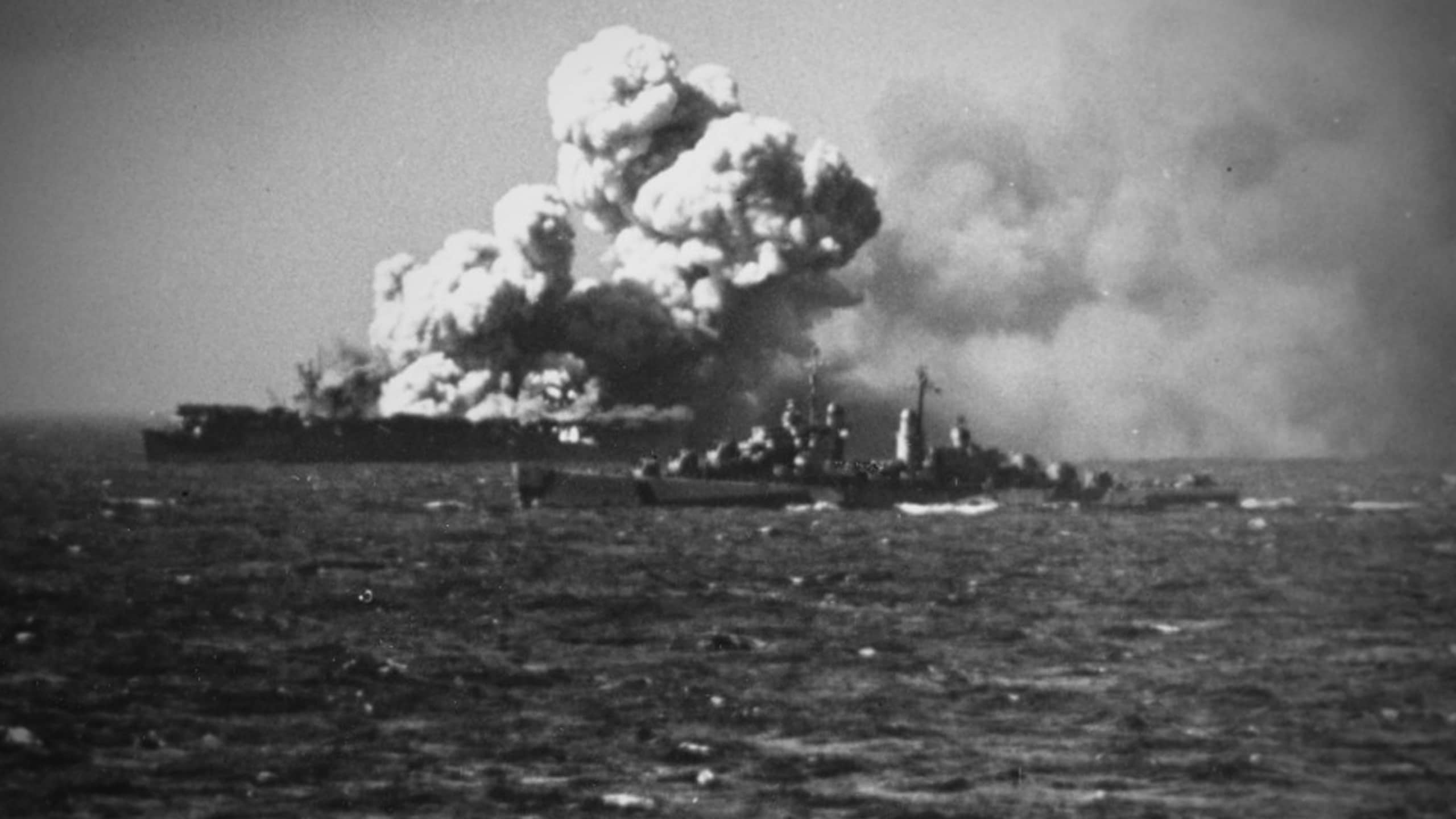
Luck appeared to be on the IJN’s side, as a bomb dropped by a Yokosuka D4Y “Judy” dive bomber hit the Independence-class light carrier USS Princeton (CVL-23). The bomb punched through the wooden flight deck and hangar before exploding. Although the structural damage was relatively minor, the explosion sparked a fire that spread quickly. The Cleveland-class light cruiser USS Birmingham (CL-62) pulled alongside the carrier to assist with damage control. The warships collided, causing damage to the cruiser.
As efforts to control the fire were still underway, a second explosion, likely a bomb in the magazine, detonated. The explosion caused significant damage to CL-62 and crippled the carrier. By late afternoon, USS Princeton was beyond saving. The Fletcher-class destroyer USS Irwin (DD-794) had attempted to fire torpedoes to finish off the carrier, but the tubes may have been damaged; DD-794 had also collided with the carrier during the efforts to save her. An even larger explosion, likely from the remaining ordnance, finally destroyed the carrier, which sank under the waves.

USS Princeton was the largest American warship lost in the battles around Leyte Gulf, and the only Independence-class light carrier sunk in combat. It was the only real “win” for the Japanese, and a costly one at that, as the U.S. Navy surface ships and carrier-based aircraft inflicted heavy losses on Kurita’s fleet.
Whatever luck the IJN may have had ran out.
As CL-62 was vainly struggling for survival, the U.S. Navy launched around 259 aerial sorties from its five fleet carriers and one light carrier against Kurita’s fleet, which had no combat air patrol to speak of. The IJN battleships Nagato, Yamato, and Musashi all took hits. Aircraft, including the Curtis SB2C Helldivers and Grumman F6F Hellcats from USS Essex (CV-9), were part of a wave that scored nearly a dozen hits on Musashi.

The super-battleship began to list and withdrew, taking additional hits from aircraft launched by USS Enterprise (CV-6) and USS Franklin (CV-13). After being struck by at least 19 torpedoes and 17 bombs, Musashi capsized and sank with a significant loss of life.
Admiral Kurita then reversed course, signaling to the American forces that the IJN was withdrawing.
Part Two: Battle of Surigao Strait
Just as Kurita’s forces went into action, Vice Admiral Shōji Nishimura, commander of the IJN’s Southern Force, which was supported by land-based aircraft from Luzon, began to engage with the U.S. Navy’s Seventh Fleet in the Surigao Strait. Nishimura had been unable to synchronize his movements with Shima and Kurita because of the strict radio silence imposed on the Center and Southern Forces.

Nishimura’s force comprised the battleships Fuso and Yamashiro, the heavy cruiser Mogami, and four destroyers, supported by Admiral Shima’s Second Striking Force, which consisted of two heavy cruisers, a light cruiser, and four destroyers. The flotilla was sighted by carrier planes around midday on the 24th.
The Southern Force, consisting of the seven older and slower warships, went into action like lambs to the slaughter.
Vice Admiral Kinkaid correctly estimated (or had a lucky guess) that the Southern Force would try to penetrate Leyte Gulf via the Surigao Strait at night, and he responded accordingly, ordering the fire supports to prepare to meet the enemy. The Seventh Fleet was able to ambush the attacking Japanese in a classic “crossing the T” formation. The engagement was noted for involving everything from big gun battleships to fast-moving PT boats.

The Seventh Fleet inflicted heavy losses on Nishimura’s fleet, and the admiral was among those killed in the action. The battleships Fuso and Yamashiro were sunk, and the cruiser Mogami was crippled. By the morning of October 25, 1944, it had appeared that the IJN’s main force was repulsed, and that the U.S. Navy had won another victory.
The Battle of Surigao Strait is now remembered as the last naval engagement fought between battleships.
Part Three: Battle Off Samar
This part of the larger Battle of Leyte Gulf has been described as one of the strangest incidents in modern war, and it was also the most confused and desperate of the four small battles. The Japanese Center Force managed to surprise a small, lightly armed group of U.S. escort carriers, destroyers, and destroyer escorts known by its code name “Taffy 3” off Samar Island in the Philippine Sea.

Here, the IJN was able to arrive at an unexpected location and caught the Americans off guard. Additionally, the Japanese had a numerical advantage, with a fleet comprising four battleships, six heavy cruisers, two light cruisers, and 11 destroyers. By contrast, Taffy 3 consisted of six escort carriers, three destroyers, and four destroyers. Yet, the U.S. fleet had a vastly superior number of aircraft.
The American warships fought heroically, carrying out torpedo attacks, firing surface-to-surface gunfire, and engaging in harassment to protect the vulnerable escort carriers. Rear Admiral Clifton Sprague, commander of Taffy, ordered his ships to conduct a tactical retreat that prioritized the escape of the carriers — the courageous and even at times desperate actions paid off, aided by strategic miscalculations by Admiral Kurita.

The escort carriers launched multiple bombing and torpedo runs, and when their ordnance was depleted, the aircraft made “dry runs” over the Japanese warships to distract their guns. Historians have suggested that Taffy 3 might not have survived had Kurita’s ships not been under constant air attack. The result was a hard-earned victory for the U.S. Navy. Two of the escort carriers, along with two destroyers and a destroyer escort, were sunk. The rest of Taffy 3 had taken damage as well, yet the IJN lost two heavy cruisers, with another damaged beyond repair. Two of the battleships and two heavy cruisers were also damaged.
The Battle Off Samar has been remembered as one of the greatest “last stands” in naval history. The Japanese were forced to withdraw, allowing the Leyte invasion to proceed.
Part Four: Battle off Cape Engaño
As expected, the decoy led by Admiral Ozawa’s Northern Fleet did its job and lured Admiral Halsey’s Third Fleet away from the Seventh Fleet. The IJN force was built around four aircraft carriers of the 3rd Carrier Division, and included the Zuikaku, the last of the six carriers that attacked Pearl Harbor in December 1941.

Halsey’s fleet succeeded in overtaking Ozawa’s diversion force, yet, in the midst of the battle, the U.S. received communications from Admirals Kinkaid and Nimitz that the Seventh Fleet was under attack. Realizing his error, Halsey divided his fleet into three task forces, leaving two to finish off Ozawa, while the third steamed back to Leyte Gulf.
The U.S. Navy’s two task groups managed to sink all of Ozawa’s carriers, two light cruisers, and multiple destroyers. No U.S. warships were lost, while 12 aircraft were shot down.

The Battle of Cape Engaño fulfilled a prophecy from Japanese Admiral Isoroku Yamamoto that all of the carriers used in the sneak attack on Pearl Harbor would be destroyed if the Japanese couldn’t achieve a quick victory. Yet, Ozawa managed to do what no other Japanese admiral had been able to do in the Battle of Leyte Gulf, namely, completing his assigned mission.
Battle of Leyte Gulf Final Assessment
The Battle of Leyte Gulf was the IJN’s desperate last-ditch attempt to sink the Allied invasion force, but the plan was too complex and likely never had a serious chance of success. If the American fleet hadn’t made mistakes, the situation could have been worse for the IJN. It saw the introduction of a deadly new weapon, the kamikaze, which went on to claim thousands of Allied lives in the final months of the war.
The engagement was an American victory, but it came at a price. In addition to the loss of a light carrier and two escort carriers, as well as two destroyers and a destroyer escort, thousands of sailors languished in the waters of the Pacific for hours before being rescued, or worse, perishing. Halsey’s decision to chase the decoy fleet to the north has remained a source of controversy for more than 80 years, as it left Taffy 3 and other American forces vulnerable to the Japanese.
However, the IJN lost 26 ships in total, including the super-battleship Musashi Musashi, two older battle wagons, and four carriers.
More importantly, the IJN was no longer a strategic threat, allowing for MacArthur’s invasion of Leyte to continue, followed by landings on Luzon and the liberation of Manila. It was followed months later by a push to Okinawa and the Japanese home islands. Instead of prolonging the war or bringing a negotiated peace, the Battle of Leyte Gulf likely hastened Japan’s downfall.
Editor’s Note: Please be sure to check out The Armory Life Forum, where you can comment about our daily articles, as well as just talk guns and gear. Click the “Go To Forum Thread” link below to jump in and discuss this article and much more!