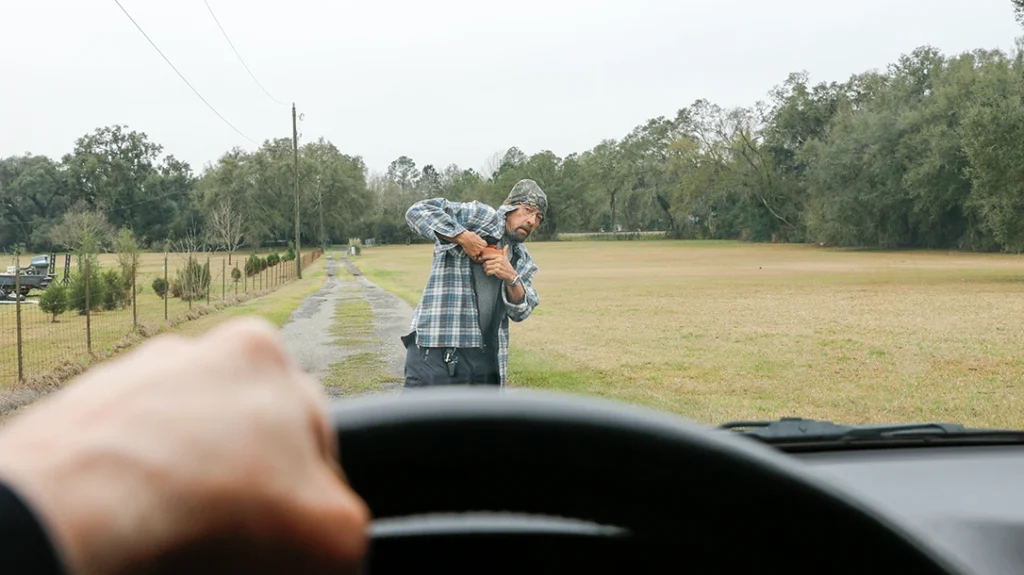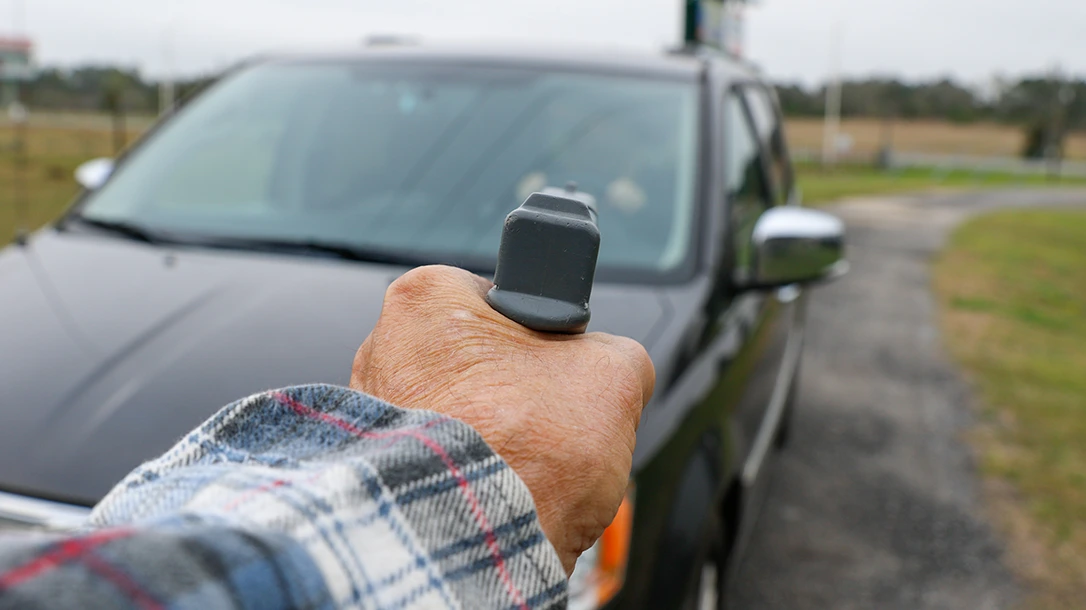
Your antagonist attempts to run you over with a car or truck. Are vehicle assaults considered deadly force? Do they warrant your recourse to a defensive firearm?
Defense Against Vehicle Assaults
In September of 2020, in what we’ll use as Case One, prosecutors announced that they would not bring charges against a man who had shot and killed a car thief in Miami Beach, Florida, two years before. A middle-aged man named Stephen Allen Lott had taken his boss’s luxury SUV, a G-class Mercedes-Benz, to a car wash. As the vehicle emerged, now clean, Jose Antonio Reyes Bermudez, 58, jumped into it and attempted to drive it away.
Lott, licensed to carry a gun, drew a pistol from his pants pocket and stood in the path of the vehicle, hoping its driver would stop. Instead, the car thief drove it right at him. As he attempted to step out of the path of the stolen Mercedes, Lott raised his pistol and fired twice.
Advertisement — Continue Reading Below
The vehicle continued forward, crossing two lanes of traffic, smashing a power pole, and hitting a parked car before crashing into an Office Depot, where it punched a hole in the wall. With the power line down, emergency personnel had to wait for the power lines to be de-energized before they could enter the vehicle. There, they found Bermudez behind the wheel, dead of a single gunshot wound to the head.
Investigation showed that though Lott insisted he fired as the car came at him, the bullets had entered the SUV from the side. The prosecutors, nonetheless, did not feel they could prove beyond a reasonable doubt that Lott could not have reasonably believed that he was in deadly danger and fired in legitimate self-defense. His ordeal, at least insofar as the criminal justice system, was over.
Advertisement — Continue Reading Below
The Aftermath
In the aftermath of such an incident, the armed defender may face as many as three juries: one in criminal court, another in the civil lawsuit, and the third in “the court of public opinion.”
All three will be inclined to think that if the fatal shot entered through the side of the vehicle, the “business end”—the front of the car—had already passed the shooter and, therefore, the danger had passed, too. So, he must have been firing for revenge—an always illegal motive.
It takes expert testimony to explain that to laypeople. The prosecutor’s office assessing the Lott shooting apparently had access to such expertise.
Advertisement — Continue Reading Below
Case Two: Assault on a Police Officer
Some years before, in another Florida jurisdiction, I had served as a consulting expert in a similar shooting. In this case, which we’ll call Case Two, a would-be cop-killer had tried to run down a police officer. The officer fired his department-issued HK .40 as fast as he could—the dashcam captured seven shots in less than 1.5 seconds.
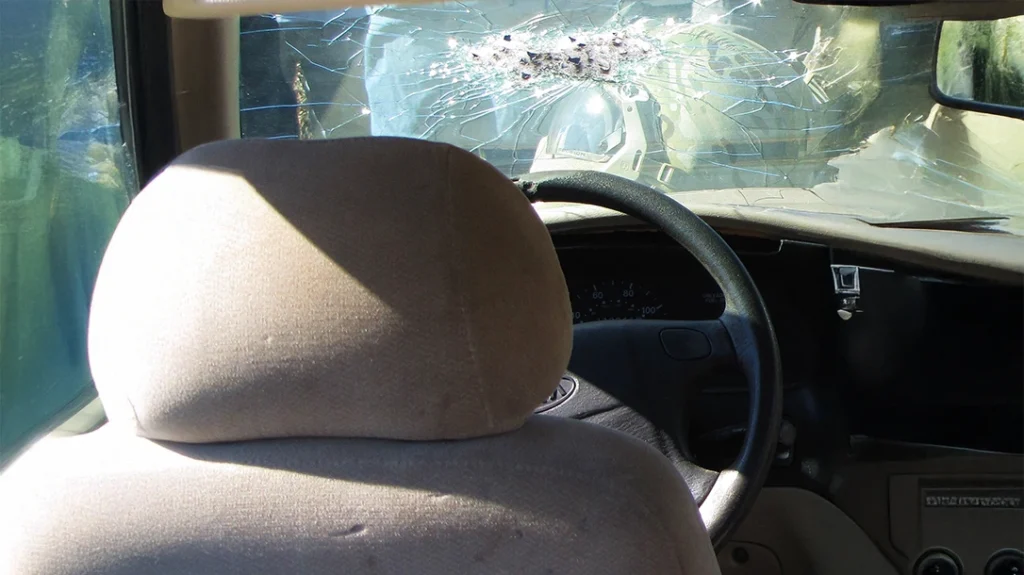
Two of those shots, including the fatal one, entered from the side. The cop was charged with manslaughter. However, after the dynamics of the situation were explained in court, the jury found him not guilty on all charges.
Advertisement — Continue Reading Below
Here’s why:
What People Need to Know
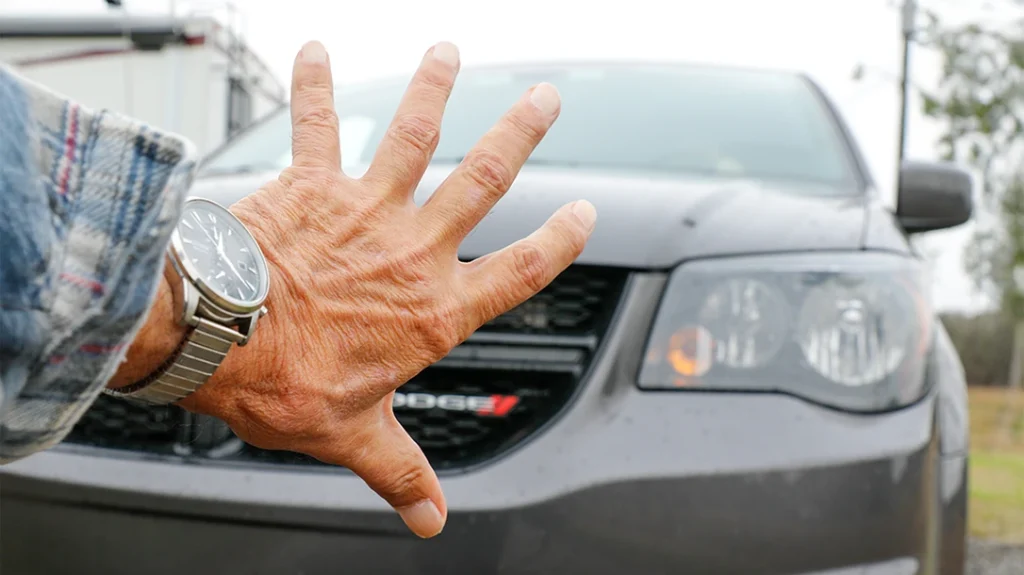
We think of our vehicle as part of our life and are as comfortable in it as if we were sitting in a mobile living room. We don’t think of it as a weapon. But when it is used as a battering ram, it is extremely deadly to unprotected human bodies.
The .40-caliber rounds fired by the cop in Case Two each generated approximately 400 foot-pounds of energy. But a standard-sized automobile at 55 miles per hour generates half a million foot-pounds of energy. Those of us who’ve seen the results of auto-pedestrian collisions know what that can do to human bodies.
Advertisement — Continue Reading Below
Complete decapitation. A boot yards away from the corpse…with the foot still in it. Heads crushed to unrecognizability. Internal organs crushed and bursting from the abdomen.
Force Science
Now, let’s look at more elements of what Dr. Bill Lewinsky aptly described as “force science.”
The vehicle is coming at you swiftly. Dr. Alexis Artwohl’s research shows that more likely than not, we will experience “tunnel vision,” focusing on the threat—that is, the driver. The front of the vehicle passes the shooter too swiftly for the mind to recognize this fact and correlate it with a cessation of danger. However, the finger is still pulling the trigger at a rate of perhaps five shots per second.
Advertisement — Continue Reading Below
Do the math: It might not be humanly possible to recognize the reduction of danger and stop shooting before those bullets enter the vehicle from the side.
Accusers will say that since a bullet can’t stop a speeding car, you should have just run. But you probably can’t run faster than a murderous driver can flick his steering wheel, track you and kill you. He can’t do that if he has been neutralized by gunfire—a point your defense team will have to make to justify your shooting him.
The Scope of the Problem
I recently had occasion, for another project, to analyze police line-of-duty deaths in the year 1976. Several of those officers had died in “intentional vehicle assaults,” including two in a single incident. That didn’t stop in 1976.
Spec sheets indicate that a vehicle such as the G-class Mercedes in Case One weighs nearly three tons. Compute that with the speed of the vehicle in the case in question.
You will generally find that if every cop working that sector or precinct had fired every round of pistol ammo on their person, including their spare magazines, it still would not have added up to equal the foot-pounds of energy being directed at the cop in question by the driver who was shot!
But, almost invariably, such incidents are followed by newspaper headlines claiming “unarmed motorist shot dead.”
One final note. We must give a tip of the hat to Attorney Steve Harris, who writes on such matters for ModernServiceWeapons.com. He brought this case to our attention.