


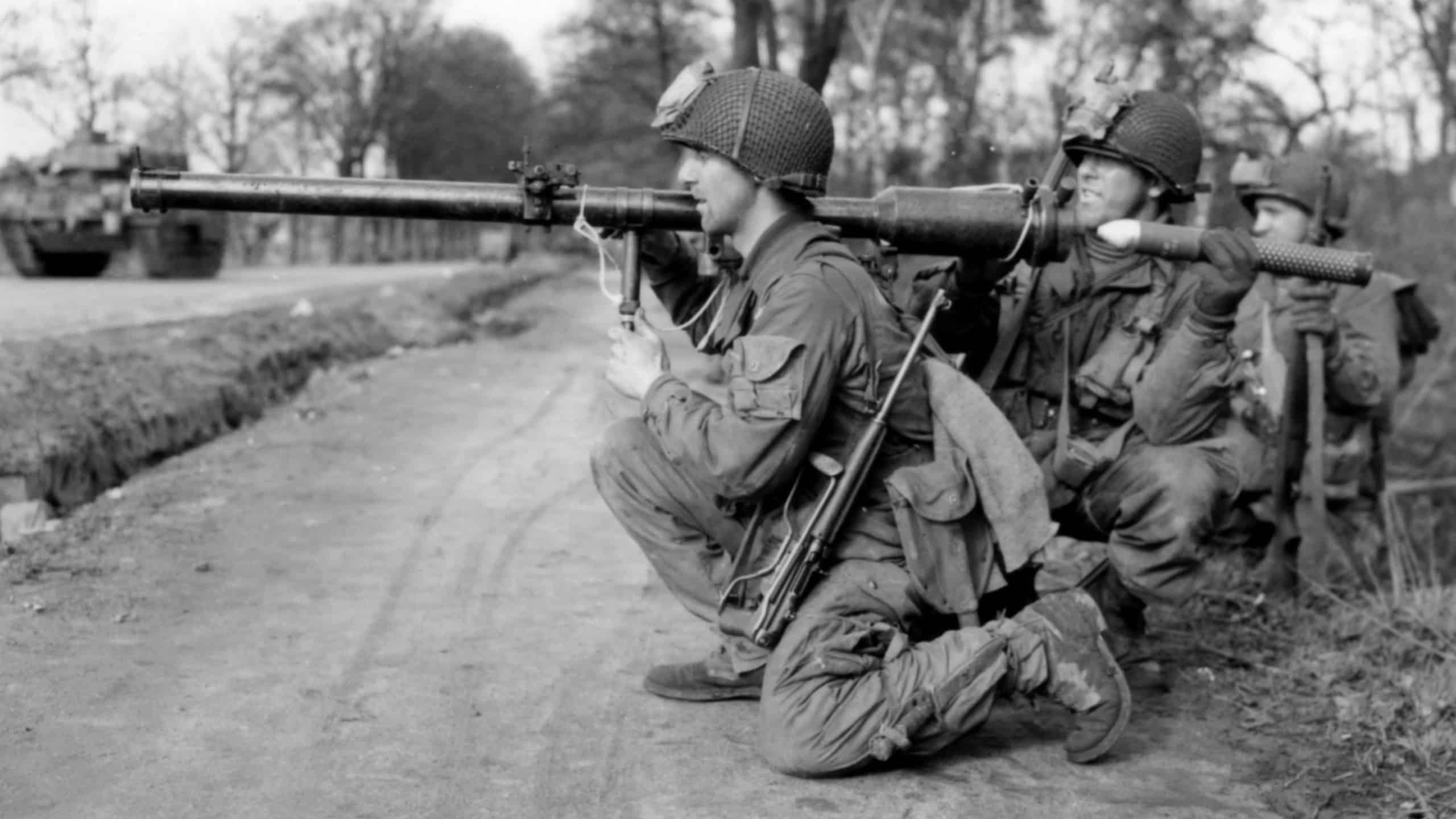
During the morning of March 24, 1945, more than 9,000 men of the US 17th Airborne Division landed behind German lines on the east side of the Rhine. While the Wehrmacht was in deep trouble, many of their units remained effective, and any available Panzers could pose a significant threat to the freshly landed paratroops. American planners had anticipated this in their preparations for Operation Varsity, and mixed in among the Bazookas and M9A1 AT rifle grenades, the 17th Airborne paratroopers had the new M18 57mm recoilless rifle.
The recoilless guns quickly proved their worth. At the end of Operation Varsity, the 17th Airborne’s combat report recorded that “Five tanks were destroyed, two by recoilless 57mm AT guns attached to the First Battalion, two by heavy artillery and one by a Gammon grenade.”

The 17th Airborne officers also recommended that “training to include familiarization firing with all weapons to include the new recoilless type 57mm and 75mm guns”, and that “recoilless rifles should be included in the T/E of an airborne division.”
Artillery for the Infantry
“While the necessity of providing our troops with superior fire power has long been recognized, experience in this war has sharply emphasized this principle. Warfare today is not static warfare of position, with great armies confronting each other along well-defined lines and relatively small fronts; rather it is fluid warfare, a swiftly changing panorama of breakthroughs, airborne and beachhead actions, and frequent isolated engagements. Hence the need for highly mobile and portable weapons quickly became apparent and has resulted in such successful developments as the rifle grenade, the shoulder fired rocket launcher, mortars and similar light weapons. As the urgency for improved accuracy and increased range in weapons of this type grew apace, the Ordnance Department initiated projects to provide equipment capable of firing high explosive shell with these characteristics, yet light enough to accompany infantry in almost every tactical operation.

A controlling factor in weapon design has always been that of weight, and weight is inevitably largely determined by the phenomenon of recoil. As recoil increases so must the weight of compensating mechanisms or support increase. To produce equipment that would possess the desired characteristics several weapons have been designed in which recoil has been eliminated. This has been accomplished by balancing the forward and rearward momentum that occurs in firing — the simplest and most efficient method.
The elimination of recoil and consequent heavy carriages has meant that these weapons are extremely light; that they can be produced rapidly and economically and that they can be readily shipped, an important consideration when supply lines cross oceans.

The recoilless rifles have been produced to provide infantry with assault weapons comparable to artillery. Their light weight, simple design, and ease of handling indicate employment in a great many tactical situations heretofore unsupported by superior firepower.” — From “Recoilless Weapons”, produced by US Army Ordnance during February 1945.
Enter the Kromuskit
By World War II, the notion of recoilless guns was not completely new, but no such weapons had yet been developed for infantry use. That changed during the airborne invasion of Crete during May 1941, as German paratroopers deployed the new 7.5cm LG 40 recoilless gun (designed by Rheinmetall). The Germans continued development of their recoilless gun concept and, by 1942, they fielded the 10.5cm Leichtgeschütz 40. Captured examples were soon in the hands of US Ordnance, and the US Army’s Artillery Section began work on a 105mm recoilless cannon using the 10.5cm LG 40 as a guide. The German style of recoilless ammunition used a plastic “blow out plug” in the cartridge case.

At the same time, the US Army’s Infantry Section assigned a two-man engineering research team to study the recoilless gun concept. These engineers, William J. Kroeger and C. Walton Musser, working at Frankford Arsenal, were tasked with developing a man-portable recoilless 57mm gun. This weapon was given the designation “T15” and was nicknamed the “Kromuskit”. Instead of a blowout plug, the T15 used a British recoilless development, the “Ordnance, RCL, 3.45 inch”.
The British design featured hundreds of tiny holes in the walls of the cartridge case, protected on the inside by a plastic lining. The American design team also picked up on a RCL 3.45 inch feature by engraving bands onto the 57mm projectile to connect with the T15 barrel’s rifling. Ultimately, this gave the US 57mm weapon a higher muzzle velocity (1,200 fps) and greater accuracy than other recoilless guns of the era. The T15 was in line with most recoilless cannons, following the “1-to-9 ratio”, with 10% of the propellant gas sending the projectile downrange, while 90% of the gasses are vented out the back to counteract the forward force and achieve the recoilless effect.

Live The Armory Life. The latest content straight to your inbox plus an automatic entry to each of our monthly gun giveaways!
Testing quickly revealed that the 57mm Kromuskit was far superior to the Artillery Section’s 105mm design, and the lighter infantry weapon was approved for production. By October 1944, the T15 received the official designation of “M18 57mm Recoilless”. Production of the guns and ammunition was slow to ramp up, and examples were not sent to troops in the field until March 1945, when 50 M18’s were sent to the ETO.
In early 1945, US Ordnance described the new M18 in the following manner:
The 57mm rifles, T15E13 and T15E9, operating on the recoilless principle, have been designed to provide an anti-personnel and anti-tank weapon of lighter weight and greater range and accuracy than other comparable light weight weapons.
This rifle operates on principles like those of a conventional gun except in the characteristics of the breech. Upon ignition of the propelling charge, a controlled amount of gas is allowed to escape to the rear, which, with the forward momentum of the shell, creates equal and opposing forces within the rifle. The force exerted by the projectile in its forward passage through the tube counteracts the force of the gas escaping through Venturi openings in the breech. Hence, since these two forces are balanced, the rifle does not move appreciably. Moreover, the Venturi openings are designed to exert a rotational reaction which offsets the torque induced in the rifle by the movement of the projectile through the rifling.

The cartridge case of the round for this rifle is smaller in diameter than the interior of the chamber; it is perforated to allow radial escape of gas into the chamber and thence to the rear until controlled by the Venturi openings. The round as thus proportioned is compact and easily transported.
The rifles T15E9 and E13 differ only in the rifling of the tube. The rifling in the T15E9 is one turn in 25 calibers and in the T15E13, one in 30 calibers.
The Extendable Front Handle T3E1 and Bipod T3E1 are provided. The latter, when folded, becomes a shoulder rest, permitting the rifle to be fired from the shoulder in standing, sitting or kneeling positions. The front handle may be extended and the bipod unfolded to furnish three-point support for prone firing. The rifle may also be mounted on the cal. .30 Machine Gun Tripod. Front Sight, T91 and Sight Mount, T120E2, provide attached iron sights, the rear sight leaf being similar to the cal. .30, M1903 rifle. The Telescope Sight T130E2 may be quickly attached to the Sight Mount T120E2.
The H.E. Shell, T22, was developed to provide a high explosive, antipersonnel round for the 57mm recoilless rifle. This round is provided with a point detonating fuse, T119E1.
The H.E.A.T. Shell, T20E2, was developed to provide a round for use against armored vehicles. It is provided with a point initiating fuse, T123E1, and has penetrated homogeneous armor plate up to 3” at 20° obliquity.

The WP Shell, T23, was developed to provide a round for smoke screening, anti-personnel effect, and for spotting. The T119E1 fuse is used with this round.
All of these rounds use a perforated steel cartridge case instead of the usual solid case. The case has a paper liner that retains the propellant charge and bursts upon ignition, allowing the release of gases through Venturi tubes in the rear of the gun. All shells have pre-engraved rotating bands to reduce the amount of pressure required to expel the shell from the rifle.
SHELL TYPES:
- Smoke (WP), 57mm, T23
- H.E.A.T., 57mm, T20E2
- H.E., 57-mm, T22
Note: All shells weigh 2.75 pounds. All complete shells weigh 7.12 pounds.
The M18 in action during World War II
In the ETO
“We need more of these guns as soon as we can get them.” — 17th Airborne Division report after Operation Varsity
The 17th Airborne Division carried the first M18 rifles into combat during Operation Varsity, the airborne crossing of the Rhine River in March 1945. The recoilless guns were specifically detailed for anti-tank work, and special permission was initially required to fire on targets other than enemy vehicles.

An after-action report of the 507th parachute infantry of the 17th Airborne Division records:
“Anti-tank work was called for as soon as we got down. Only the turret of the enemy tank was visible. I fired one round at 600 yards and hit the turret. His firing stopped and he gave us no more trouble. It was probably a Mk. IV.”
The 57mm quickly proved itself accurate and capable, as another tank was struck in the side and set on fire while it was on the move — an almost impossible shot with a bazooka. While the armor-piercing performance of the M18’s HEAT round was only about 3” (about an inch less than the standard M6A3 bazooka rocket), the troops were greatly impressed with its accuracy. General Miley, the commander of the 17th Airborne Division, praised the new recoilless rifles for their anti-tank capability:
“The airborne division is particularly vulnerable to armor. With the addition of the 57mm and 75mm recoilless weapons, airborne troops have the means to assist themselves against tanks and self-propelled guns. In my opinion, the recent operation has proved the practicality of the recoilless rifle, and it should be issued to units, with high priority given to airborne divisions.”

I found a few other comments about the use of the M18 in the ETO. Despite its short time in combat, the weapon clearly made a strong impression:
“The effective range of the gun for direct fire is the range of visibility. It is as accurate as an M1 rifle, and you can hit a tank any place you desire. 600 yards would be an ideal distance for fire against tanks.”
“The flashback is no tactical detriment and is no danger to the firer since the gun is so light it can easily be set up so that it has a clear area behind it.”
“Ammunition should be kept in the cardboard cartons until ready for use. It will withstand heavy handling under normal use. We have had no duds and no premature bursts.”
In the PTO
Only a handful of M18’s saw combat in the Pacific Theater, with the first significant use of the weapon coming during the latter stages of the Okinawa campaign.
The US Army publication “Weapons for Jungle Warfare”, produced in June 1944, described the anticipated use of the M18 in the Pacific.

“There is under development by the Ordnance Department a recoilless gun of 57mm caliber which may be used as a shoulder-fired weapon or be adapted to firing from a machine gun tripod. The project for the 57mm Recoilless Gun was initiated early in 1943. The first pilot model was tested in July 1943, and the first completed service test model was demonstrated on November 9, 10 and 11, 1943. It is believed that the maximum range of approximately 5,000 yards possessed by this arm, with its accuracy and powerful hollow charge projectile, will permit it to be utilized at ranges up to 4,000 yards for many of the functions now performed by light artillery. The gun is breech loading and has a rifled tube. It weighs 36 pounds, fires a special 2.75 pounds projectile of the HEAT type (now under development) at a muzzle velocity of about 1,200 feet per second, and has sufficient accuracy to hit a rectangle 25″ x 33″ at a range of 600 yards.”
There were few Japanese tanks to worry about during the late stages of the war, and the M18’s HEAT round could easily penetrate any known Japanese armored vehicle. However, its portability, accuracy, and penetrating power gave GI’s an effective bunker-buster for use against Japanese pillboxes and cave defenses (this was also noted by US Army Ranger units that used the M18 during the Korean War).
10th Army Action Report: Ryukyus, March 26 to June 30, 1945
During the later phases of the campaign the 57mm and 75mm recoilless weapons were tested and used in combat against the enemy with excellent results. A total of approximately 670 rounds of ammunition was all that was available. Based on the limited use made of these weapons, it is believed they have definite possibilities, especially for close support against fortified positions.

77th Infantry Division, Okinawa report
The development of the 57mm recoilless weapon and the 75mm recoilless weapon appears to be in the right direction, especially in view of many situations where steep terrain impassable to vehicles will be encountered.
Pacific Area Material Report (July 1945)
The 57mm Rifles, T15E13 and M18, operating on the recoilless principle, have been designed to provide an anti-personnel and anti-tank weapon of lighter weight and greater range and accuracy than other comparable light weight weapons. They have been found particularly effective when fired into cave entrances.
The rifles M18 and T15E13 differ only in the rifling of the tube. The rifling in the M18 is one turn in 25 calibers and the T15E13 is one turn in 30 calibers.
An extendable front handle and bipod are provided. The latter, when folded, becomes a shoulder rest, permitting the rifle to be fired from the shoulder in standing, sitting, or kneeling positions. The front handle may be extended and the bipod unfolded to furnish three-point support for prone firing. The rifle may also be mounted on the caliber .30 machine gun tripod.
Sight, Front, M26 and Mount, Sight, M74 provide attached iron sights, the rear sight leaf being similar to that of the caliber .30 M1903 rifle. Telescope, M86C, may be quickly attached to the Mount, Sight, M74.
Post-WWII Development
In December 1948, the US Army released its “Summary of Recoilless Weapons Development”, and their findings showed that upon deeper review, the M18 was showing several deficiencies. Its weight and insufficient armor penetration were the Army weapons development board’s primary concerns.

The US Army weapons development board stated in December 1948:
57mm Rifle: The present 57mm rifle is too heavy. Development and redesigning should continue to reduce the weight, improve the reliability of mechanical functioning, decrease the time of flight of the projectile, improve the accuracy, and relocate sights and operating mechanisms for the comfort of the operator.
Findings: Recoilless weapons of 75mm or smaller in caliber will not, even with the best-known designed weapon and ammunition, be able to meet the armor penetration required by the Anti-tank Defense Conference.
(Requirements set up by the Antitank Defense Conference at Fort Monroe, Virginia, for a man-portable recoilless weapon which will have an effective range of 2500 yards against the frontal armor of any potential enemy tank with 75% first round accuracy, assuming not more than 5% range determination error under optimum conditions.)

In summary, it is apparent that the 57mm Rifle, M18, does not meet the requirements for frontal armor penetration, or accuracy, and is not provided with sighting equipment to perform the mission. The present weapon is classified as a close-in anti-tank weapon and due to its lack of penetration must be employed to deliver flanking fire. It is more accurate than the 2.36- or 3.5-inch rocket launchers and has a greater maximum usable range. It lacks the penetration of the 2.36-inch rocket launcher because the projectile is spin stabilized.
However, the Infantry Conference concluded: That the Infantry Regiment retain the present recoilless weapons of 57mm and 75mm caliber, and the following actions be taken.
A) Reduction of breech blast effect, flash and smoke.
B) Reduction of weight and volume of propelling charge.
C) Increase in muzzle velocity and armor penetration.
D) Improvement of waterproofing of propellant.
Korean War, and Beyond
While the M18 was standard issue for US Army rifle companies during the Korean War, its use was normally restricted to bunker-busting and anti-personnel work. Anti-tank duties had passed to the more powerful M20 75mm recoilless rifle.

In Brigadier General S.L.A. Marshall’s 1951 “Commentary on Infantry Operations and Weapons Usage in Korea”, the M18’s use in bunker-busting is compared to the newer, but heavier M20:
“The 57 is too light for such work at ranges exceeding 1000 yards, though troops have wasted an excess of 57 ammunition trying to prove otherwise; of the weight problem with the 75, it is often left behind during movement into the higher ridges, and the attempt is made to substitute the 57 at prohibitive ranges. …On the other hand, the 57 becomes invaluable during the closing infantry assault on an enemy-held high hill mass. Always a few bunkers remain in operation; those which were protected from the long-range fires by the folding of the ridge are likely to be almost unscathed. Falling back toward these works, after quitting the outer line of foxholes, enemy skirmishers are apt to seek protection in small caves and behind rock outcroppings. The 57 can blast them out from cover which would normally provide immunity to bullet fire.”

During the late 1940s, the US government provided the M18 to several countries as part of various foreign aid packages. A set of blueprints was provided to the Nationalist Chinese, and these were captured by communist forces at the end of the Chinese Civil War. Consequently, the People’s Republic of China copied the weapon and produced it as the Type 36 (later Type 52). The Type 36 was first encountered with Chinese troops in the Korean War, and then with NVA and Viet Cong forces during the Vietnam War. America’s 57mm recoilless soldiered on, in allied and communist hands, until the early 1970s.
Editor’s Note: Be sure to check out The Armory Life Forum, where you can comment about our daily articles, as well as just talk guns and gear. Click the “Go To Forum Thread” link below to jump in!