


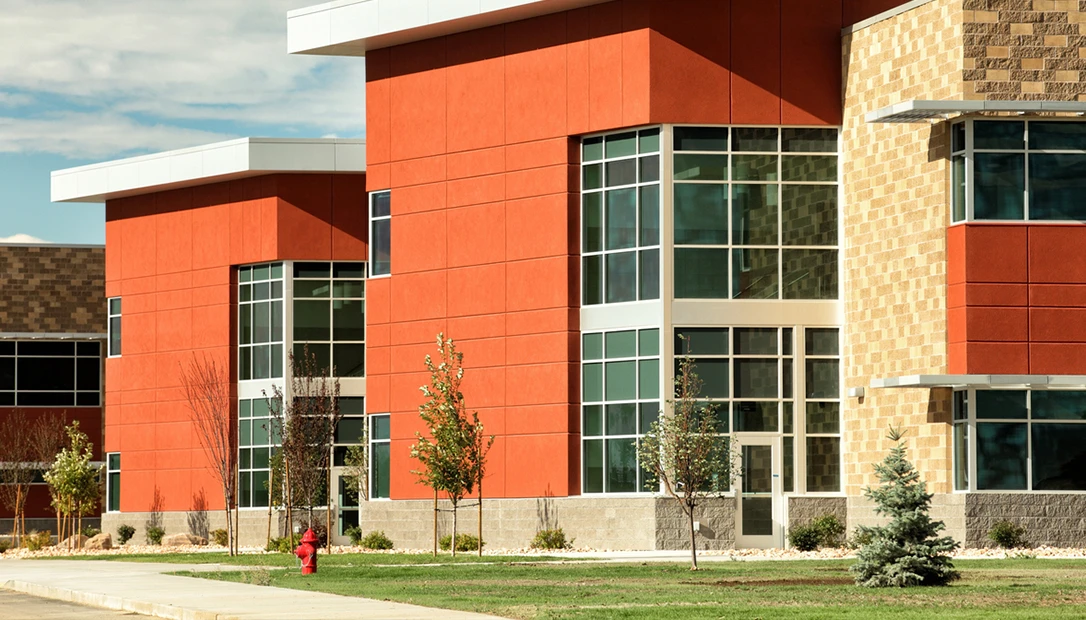
By the time the first messages went out just before 0900, students were already on the move.
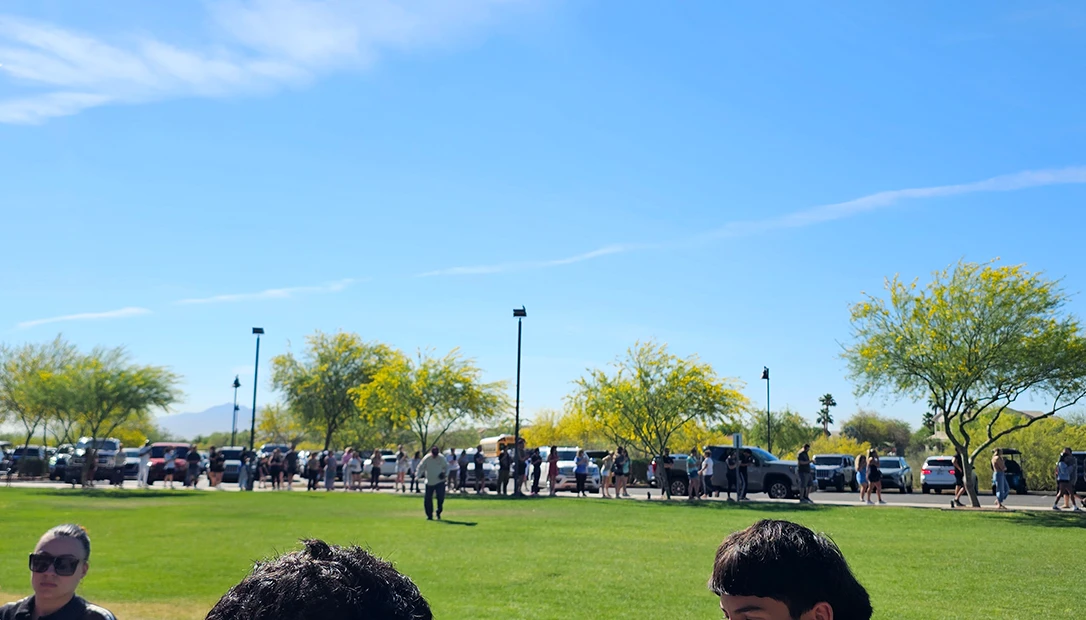
Traffic told the story before anything else did.
Cars were stacked where they shouldn’t be. Parents are moving with urgency. The normal rhythm—drop-offs, bells, routine—was gone, replaced by something faster and less defined.
Advertisement — Continue Reading Below
By the time I turned in near Indian School Road, I could see the last students arriving on foot from the campus.
Whatever the threat was, it had already forced movement.
Advertisement — Continue Reading Below
The Arrival
I parked and stepped out into motion. Cars creeping forward, parents crossing lanes, staff already working.
The heat hit immediately. 105 degrees. The sun is already baking.
Parents fanned themselves with papers. The church staff was just beginning to move water. Cases coming off pallets, carts starting to circulate.
Advertisement — Continue Reading Below
And underneath all of it, something that made the rest possible:
Calm.
Not perfect. Not organized. But calm enough to work.
Advertisement — Continue Reading Below
People were already building a system.
I grabbed my pack out of habit and moved in.
No Assignment? Find One
I didn’t arrive with a role.
Advertisement — Continue Reading Below
So I found one.
At first, it was simple. Helping with hydration, directing parents, and locating students. When that ran out, I did what works in any uncertain environment. I found the decision-maker and stayed close.
I located the District Director of Security and kept myself within reach.
Advertisement — Continue Reading Below
It felt like high school football. Stay near the coach, be ready to go in.
Each time he looked up, I got a task. Each task led to another.
Eventually, I was handed a megaphone.
That’s when I found my lane.
The System
The process made sense on paper:
Parents entered a single line.
Six laptops handled verification.
ID was checked against student records.
Staff radioed for the student.
Students were located and walked out.
It worked. It just didn’t scale.
Because this was not one school.
It was everyone. Pre-K through 8th grade feeding into six devices, one line, and one radio channel.
Part of the difficulty started before reunification ever began. The threat was later understood to involve both a bomb and a shooting component, which put normal emergency logic into conflict. A bomb threat pushes people to evacuate and create distance. A shooting threat makes an open congregation dangerous. From a distance, those shifts in movement can look inconsistent. In reality, they reflect leaders trying to solve two different hazards at once.
That matters because by the time students reached the church, the event was already weighed down by earlier decisions made under uncertainty.
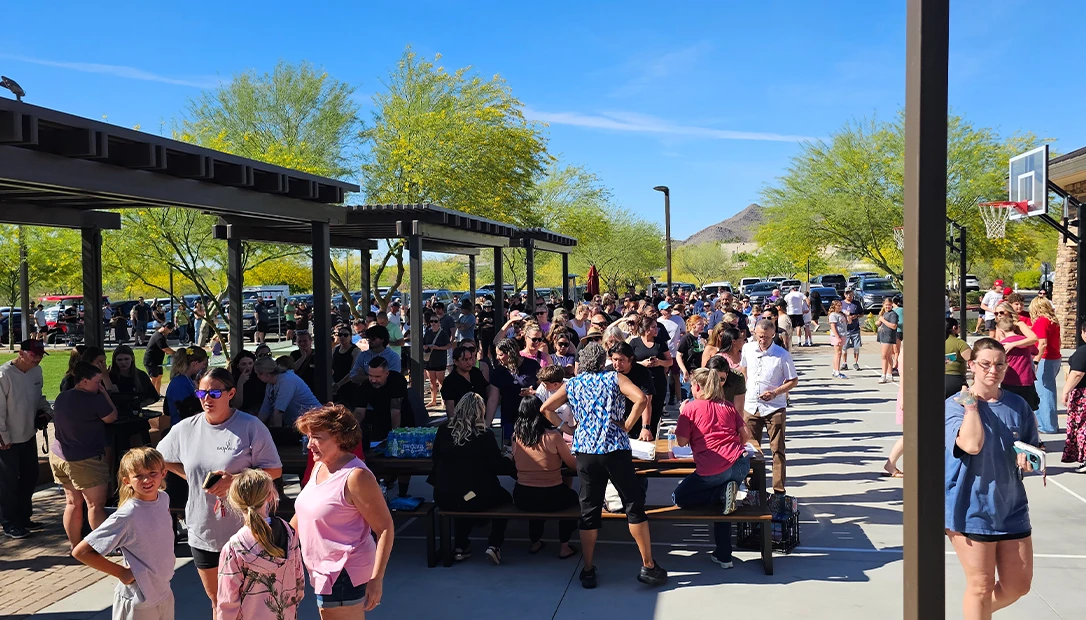
The Line
Parents were already in it when I arrived.
Not a loose crowd. An actual line. Folding in on itself, splitting and reconnecting near the laptops, people are adjusting without being told.
No one was arguing.
Just watching.
You could see it in their faces. They were measuring progress. Watching each person step forward, silently deciding that the system was slow but working. What they couldn’t see yet was where the system would slow.
Inside the Arc
The church campus was laid out in a wide arc.
Parking and parent flow on the open side.
Classrooms along both wings.
Sanctuary in the center.
Elementary students filled the sanctuary.
Middle school students were spread through classrooms.
At first, there was no clear structure to where groups were placed.
That mattered more than anyone realized.
Because once a parent cleared verification, they entered the next phase:
Find the right room. The right teacher. Find the right student.
Without organization, that meant friction.
And by then, parents were not only responding to site closures. Nearby high school shutdowns had already shaped expectations. Some families were picking up siblings. Some already assumed the campus day was over. That meant reunification pressure was building fast, even before the process was fully organized to receive it.
Noise and Friction
It wasn’t chaos.
It was just enough noise to matter.
Groups of students talking over each other. Names coming through radios. Staff leaning in, trying to confirm details while half-listening.
You could hear names repeated. Then repeated again.
Nothing breaking. Nothing clean either.
And layered over it all, the line kept feeding forward.
The Bottleneck
You could see it forming before anyone said it out loud.
Six laptops are trying to process hundreds of parents across ten grade levels.
Parents would present ID and the student’s name. If verified, staff would radio:
“Student name, grade, teacher.”
All of it over a single channel, shared with administrative traffic.
Then the next delay:
Now the student had to be found.
In a room that might not be clearly marked.
In a group that wasn’t yet organized.
The system worked, but every step added time.
The Megaphone Loop
By the time I had the megaphone, I wasn’t giving instructions. I was repeating them.
“Middle school parents here. 7th and 8th are beyond me. 6th near check-in.”
Again.
A parent would walk up and ask where to go.
I’d give the same directions I had just said out loud.
They’d nod, give that quick half-smile, and move.
Sixty seconds later, same question. Same answer.
Not frustrating. Just necessary.
The System Fix
By around 0930, the last students were inside.
The turning point wasn’t more resources.
It was an organization.
Students were grouped by grade level.
6th in one area.
7th and 8th are separated beyond that.
Now, when a parent cleared verification, movement had direction.
The same system, just clearer.
That’s when it started to move.
The Heat
The heat never left. It just stayed manageable.
Parents stood in the shade where they could find it. Sidewalks lined with trees helped. But the real difference was the constant movement of water.
Church staff ran carts back and forth without stopping.
Cases out. Distribute. Return. Repeat.
Without that, the heat becomes the next emergency.
With it, it stayed in the background.
The Seam
Once you understood the system, you could see the gap.
Nothing physically stopped someone from bypassing it.
A parent could walk around the line. Enter a room. Call a name.
There was no wristband. No slip. No visible confirmation of check-in.
Everything relied on compliance.
It held, but you could feel how easily it might not.
The Reunion
The system worked, and you could see it in the moments that mattered most.
A name gets called.
A student appears.
A parent turns and locks eyes across the room.
You could see it happen before they moved.
Relief hits first. Then motion.
And for a few seconds, everything else, the line, the heat, the wait, falls away.
Flow
As the morning pushed toward noon, something changed.
Fewer parents are arriving. More leaving.
And then, for the first time all day, you could see it.
The end of the line.
That’s when you know the system has caught up to the problem.
Reunifications started happening faster. Movement became cleaner. The pressure eased.
It was going to finish.
What Was Holding It Together
Two things made this work.
First, people.
Staff stayed composed.
Parents stayed patient.
Students, while noisy, stayed manageable.
Second, the church.
They didn’t just provide space.
They showed up.
Water moved constantly. Shade appeared where it was needed. Facilities were opened without hesitation. There was no delay, no question. Just support.
From a distance, it looks like logistics.
Up close, it feels different.
It felt like a community stepping forward to carry the weight that wasn’t technically theirs, but became theirs anyway.
As both a teacher and a member of that church, it was hard not to notice.
And harder not to be grateful.
What This Was
From the outside, this looks like success.
And it was.
Every student accounted for.
Every student is released.
The system held. It held because people adapted faster than the plan did.
But inside the system, one thing controlled everything.
Verification.
Everything else, movement, supervision, and communication, can flex.
Verification cannot.
It is slow by design.
And if it isn’t scaled properly, everything backs up behind it.
Not all friction comes from poor execution.
Some of it comes from conflicting safety priorities.
When the threat pulls a response in two directions, the system inherits that conflict.
Final Thought
The obvious fix, organizing students by grade, came mid-event.
It should have happened at the start.
But that’s the nature of real-world response.
When you’re checking ten boxes at once, the obvious one is easy to miss.
And when the emergency itself contains conflicting risks, even simple decisions carry more weight than they appear to from the outside.
The System
It worked.
Not because the system was perfect, but because the people were.
Staff adapted.
Parents trusted the process.
Students held together.
And the church stepped in without hesitation, providing not just space, but support. Water, shade, time, and presence.
There’s a kind of service you don’t have to explain when you see it.
It looks like people are moving toward a problem rather than away from it.
School. District. Church. Community.
All moving in the same direction, under pressure, in the heat, with no script.
That’s what made it hold.