


Podcast: Play in new window | Download
It’s 12:30 in the afternoon on April 28th, 2025. You’re in Europe, standing in a Madrid train station. The lights go out. The departure boards go dark. Your phone says no service. Across the border in Lisbon, hospitals are switching to backup generators. ATMs freeze. Payment terminals stop working. In under five seconds, the entire Iberian Peninsula has lost power.
Tens of millions of people. No power. No warning. Zero idea when it’s coming back.
That wasn’t a hurricane. It wasn’t a bomb. It was a cascade—the kind of grid failure engineers and preppers have been warning about for years. And it just happened in a modern first-world region of the world.
A year later, that lesson has not lost its significance. In May of 2026, the U.S. Department of Energy released its first-ever five-year roadmap to harden the American grid against cyberattacks and physical disruptions. A federal cybersecurity agency—CISA— followed up by telling hospitals, water systems, and telecoms to plan for extended outages. And the National Guard ran a major grid-focused cyber exercise called Cyber Yankee.
Disclaimer: This article contains affiliate links for which we may receive a small commission at no cost to you if you choose to purchase a product through a link on this page.
TL;DR: A power grid failure can spread fast and last longer than most homes are ready for. The best response is to map your power needs, build backup power in tiers, and test your plan with a no-power drill before an outage happens
Quick Look at What You’ll Learn
Where Do We Stand
So here’s where it stands for us, people who prepare. As most, if not all, of us have discussed, the grid we depend on is more fragile than most people realize. The federal response, if any, when something major happens, will take time—real time. The Government Accountability Office reports that lead times for large power transformers that move electricity across the country now range from 1 to 3 years. And that’s the lead time today, with factories running and supply chains intact. It would be longer in a real crisis. CISA itself has warned that a truly catastrophic outage would exceed what the federal response is currently structured to handle.
Translation: In a serious grid-down scenario, the responsibility for keeping the lights on in your own home is going to fall largely to you.
That’s what this article is about. We’re going to walk through what the Iberian event actually taught us, what the DOE’s five-year plan does and doesn’t do, why rooftop solar is being reexamined as both a resilience tool and a new category of risk, and—most importantly—what you can do to be ready.
Let’s get into it.
What the Iberian Event Actually Taught Us
The blackout was not caused by a storm or a single substation failure. Investigators found that the grid collapsed faster than the backup systems could react. And because the European grid is tightly linked across borders, the problem didn’t stay in one country—it jumped across borders. Spain’s failure pulled Portugal down with it in seconds.
The grid is a system of smaller grids. When one fails, the others shift power to keep homes, businesses, and critical infrastructure powered. The big problems start when too many fail at once, and the system can no longer keep up with demand. Eventually, that leads to cascading electrical failures across entire regions.
That’s what happened on the Iberian Peninsula. The very thing that makes modern grids efficient—every region helping every other region—is also what made this failure spread so fast and so wide.
Post-event analysis warned what you probably already knew: energy infrastructure is now a primary target for foreign government hackers. I’d add that it’s reasonable to assume that more than just state actors have their sights set on attacking the power grid.
And the more we connect old grid equipment to the internet—smart meters, remote sensors, cloud-based controls—the more opportunities we give those attackers to try. Every new connection to the Internet is another way in.
The lesson to be learned is not that an attack is imminent—they’ve already happened, and they’re here. The lesson to learn is that resilience has to be built in advance, because the response window after a cascading failure begins is now measured in seconds, not days.
What the DOE’s Plan Actually Does
The Department of Energy’s five-year roadmap to hardening the grid is the most serious federal commitment to grid security in a generation. It funds threat information sharing among utilities, accelerates research on secure control systems, and creates response playbooks for major incidents. It also pushes utility providers to retire legacy equipment that cannot be protected.
What the plan does not do is protect any individual household for at least several years. Barring any delays, most of the funded work is scheduled to roll out over three to five years. Unfortunately for the average person, most of the funding is, understandably, directed to bulk-power systems and large utilities, not to the distribution lines that actually feed your neighborhood. The CISA directive to critical organizations is to make system upgrades more quickly—but those upgrades apply to hospitals, water systems, and telecoms, not to you.
That gap is where personal preparation lives.
Distributed Solar: Resilience and New Exposure
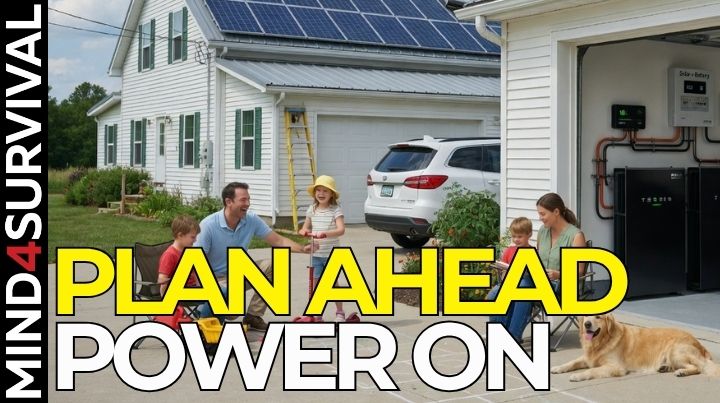
Rooftop solar with battery backup is one of the most powerful resilience upgrades a household can make. It also introduces a category of risk that the prepping community is still getting used to. Most modern solar inverters are internet-connected. They receive firmware updates from the manufacturer, and some can be remotely controlled by the utility or a third party who can manage thousands of individual systems at once.
A recent Just Security analysis highlighted the implications: if a hacker breaks into the company that runs the software for thousands of home solar systems, they don’t have to attack each house individually. They can flip the switch on all of them at once.
This doesn’t mean solar is a bad idea. What it means is there’s a big difference between having solar panels on your roof and actually being off-grid. Most home solar setups are still tied to the power company. When the grid goes down, many of those systems shut down along with it—unless yours is specifically set up to keep running on its own.
If your battery system is meant to keep your refrigerator and freezer running during an outage, you should know exactly how it behaves when the grid goes down, whether it requires the grid to function, and whether you can manually isolate your system from the grid.
3 Actionable Phases to Get You Prepped
Phase 1: Map Your Power Dependencies
Walk through your home and list what stops working in an outage: heat or air conditioning, well pump, refrigerator, medical equipment, garage door, internet, cellular booster. Rank them by how long you can go without each one. Most households discover they have one or two genuinely critical needs and a long tail of electric comforts.
Stage tier-one backup: An entry-level, highly portable battery power station in the sub-300 Wh range (Jackery Explorer), rechargeable flashlights, and a hand-crank radio with NOAA weather bands. Confirm that any refrigerated medication has a documented temperature tolerance and a plan in place.
Phase 2: Build Tier Two Backup
This is where solar generators, larger battery banks, or a properly sized standby generator come in. The choice depends on your climate, your roof, and your budget. The mistake to avoid is buying your power generation solution without considering fuel storage, runtime, and noise discipline. A generator that you cannot run safely for three days is not a three-day generator.
If your solar system is connected to the power company, sit down with your installer and ask three questions. First, what happens to my system when the power goes out—does it keep running, or does it shut down with the grid? Second, is there a switch I can flip to disconnect my system from the grid so my panels and batteries keep supplying power to my house? Third, how do I know the software running my inverter hasn’t been tampered with, and how do I get updates I can trust?
While you’re at it, make it a goal to write down the brand, model number, and the name of the company that monitors your system from the cloud—for every piece of solar gear you own. Keep that list somewhere you can find it. The day a security problem hits the news, that list tells you within five minutes whether you need to act or can relax. Without the information, you won’t know.
Phase 3: Conduct a No-Power Drill
Cut the main breaker on a Saturday morning and live off your backup systems for 24 hours. That will show you the gaps you did not anticipate: the medication that needs refrigeration, the well pump that drains the pressure tank faster than expected, the family member who struggles with the temperature swing. Use that information to create a game plan that addresses your most critical needs first and makes the most of the time and money you invest.
The Mindset Piece
Don’t worry about it. It’s highly unlikely that your grid is going to fail anytime soon. Even if it has problems, most outages you experience will only last hours, not days. So, try not to get stressed over it. The point of prepping is to get ourselves ready so that we, and our loved ones can maintain as normal of a life as possible—inspite of the circumstances around us.
The point is that to prep as effectively and efficiently as possible, we need to analyze our system, identify our vulnerabilities, develop a scalable plan, and get started. Every step forward in your preparedness is one less vulnerability that can harm you and your family. That’s why we prep.
Closing
The Iberian blackout was a live-action warning. The DOE’s plan is a long-term commitment that leaves us vulnerable for years to come, at a time when AI is increasing the threat. Distributed solar is a tool that, when protected, gives you genuine independence—and, used carelessly, gives an attacker a new opening and opportunity. That’s why I say, and to always remember that you are just one prep away… one prep away from being better prepared.