


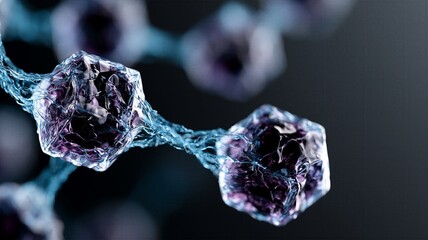
Scientists at the University of Minnesota have taken humanity one step closer to creating “artificial life.” The new lab-created “SpudCell” has replicated several key functions of living organisms, according to researchers.
Can Artificial Intelligence Cure “Incurable” Diseases?
The researchers at the University of Minnesota unveiled their work on artificial life on Wednesday. Kate Adamala, a synthetic biologist and professor at the university, called the synthetic cell “an incredibly wimpy organism” that currently does little more than “eat and occasionally make a daughter cell.”
The team built the cells from non-living chemical components rather than altering existing organisms. According to the project page, SpudCells contain 36 purified enzymes, a 90,000-base-pair genome spread across several DNA molecules, and a lipid membrane.
The cells work inside a chemical-rich liquid. They grow by merging with tiny ‘feeder liposomes’, which supply nutrients, enzymes and ribosomes needed to make proteins. Their genome carries instructions that help them copy DNA and divide. –RT
SpudCell is not considered living; it can only demonstrate actions similar to those of living organisms.
Adamala said she named the synthetic cell “SpudCell” partly to avoid naming it after herself and as a reference to Sputnik, the Soviet satellite whose 1957 launch marked the start of the space age. Sputnik V was also the name of Russia’s COVID-19 vaccine.
Scarcity and the Machine: Opportunity Cost in the Age of Artificial Intelligence
SpudCell is still weaker than a living natural cell too, said Adamala, accoridng to a report by RT. This new research, however, could help scientists understand biology by building it from known parts, the scientist noted.
Because they are artificial, SpudCells depend on outside supplies and cannot build their own ribosomes. They do not control their own metabolism, and often pass on the wrong quantity of DNA when they divide. They also typically stop working after several generations.
Scientists have been working toward synthetic cell engineering for decades. This could become a “programmable chassis” for biological machines in the future. Coupled with the advancements in artificial intelligence, we could be looking at an increasingly less human future.