


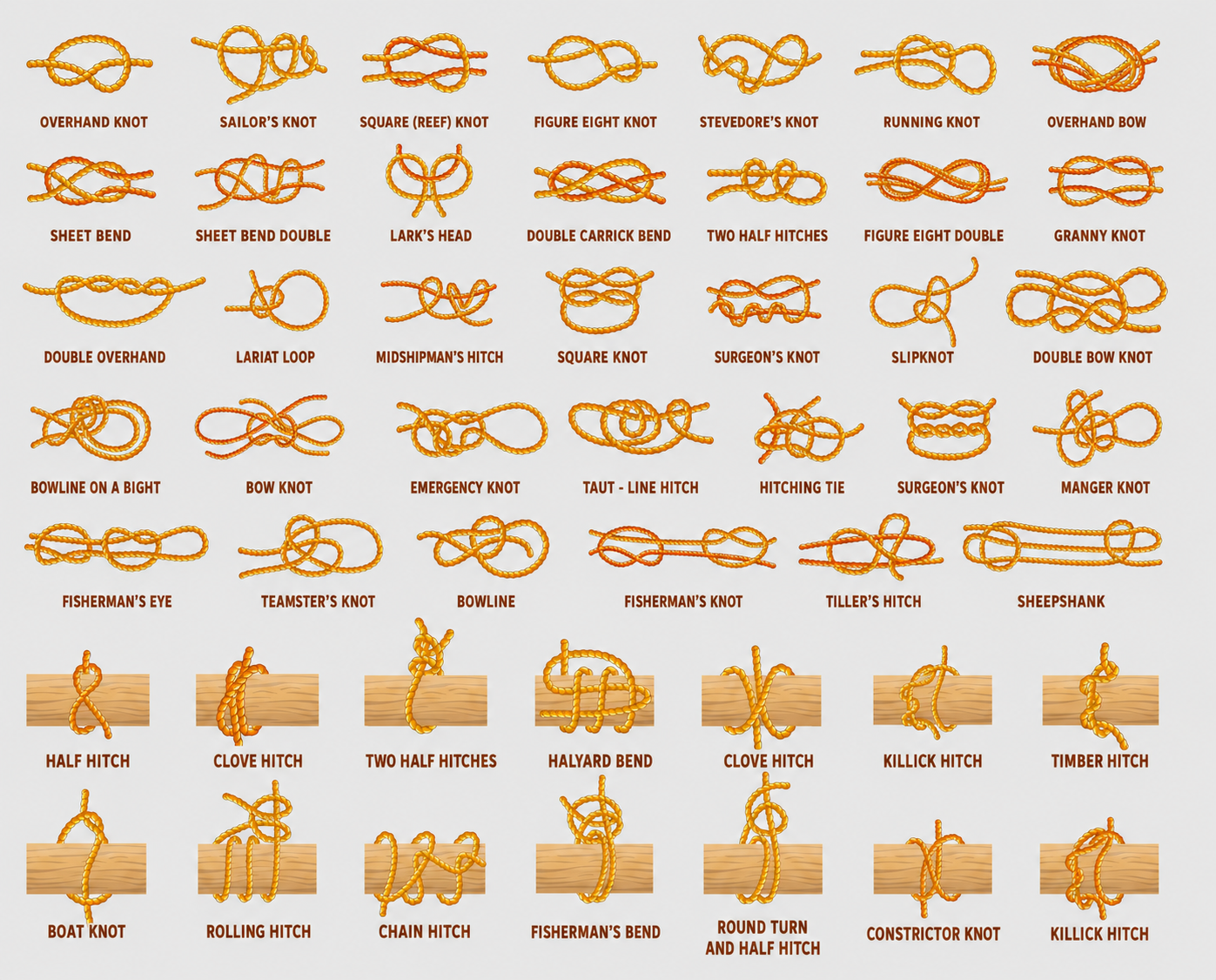
Cordage is one of the most important survival tools and tying knots is a fundamental survival skill, but getting started can be intimidating. The Ashley Book of Knots (Ashley, 1944) is just one book on knots and it contains between 3,000 and 3,800 knots, depending on how you count a new knot! Eighty years after it was first published, Ashley’s Book of Knots is still the go-to knot reference and if you look up knots online you may sometimes notice an ABOK number which refers to the number assigned to the knot in Ashley’s reference.
Fortunately, you won’t need to learn nearly that man knots and getting started doesn’t have to be intimidating. It starts with one simple knot. Once you get that down, learn another. You can do a lot with just a handful of knots.
I recommend carrying a knot card, or some other pocket reference, as you learn and two contrasting cords to practice knots that you are learning.
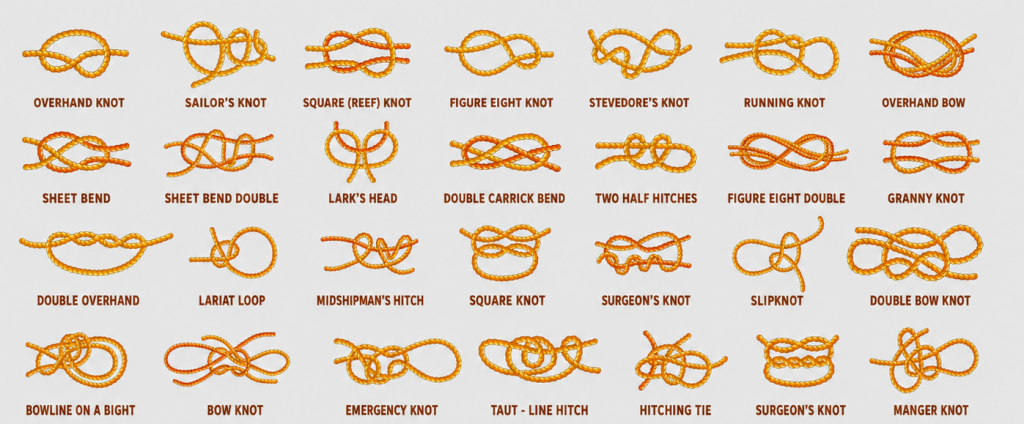
Most Useful Knots
You can pitch a tent, rig a tarp shelter, connect two ropes of different sizes, anchor a rope to a tree or boulder, with the handful of knots listed below. Also, several of these are among the easiest knots to learn to tie, so this short list is a great place to start.
- Square Knot – The square knot or reef knot is a simple knot used in first aid with cravats or triangle bandages, making it important for improvised first aid. It doesn’t cinch up and is easy to untie and was the first knot I learned as a Boy Scout. “Right over left, left over right.” Just don’t use it to connect two ropes! This is a very dangerous and very common mistake.
- Two Half Hitches – This is a simple and secure knot for attaching a rope to a tree, branch or pole, so you will use it to rig shelters from tarps.
- Taught Line Hitch – Another knot used commonly used to pitch tarps and tents, the taught line hitch is used to tension lines without using a line-tightener. In fact, it’s possible to rig a tarp as a lean-to using only two knots: two half hitches and the taught line hitch. You may not have line tighteners in an emergency, or you may prefer to save the little bit of bulk and weight that they add. Either way, you should know how to tie the taught line hitch to free yourself from dependence on line tighteners.
- Bowline – The bowline is a must know knot because it creates a strong fixed loop in the end of a rope, so it can be used to tie a rope off to a boulder or a tree. Like many children, I will always remember memory aid my father taught me to tie it, “The rabbit runs out of his hole, around the tree and back down his hole.”
- Sheet Bend – The sheet bend was used to attach a rope to the corner of a sail but is probably most often used to join two ropes of different diameters.
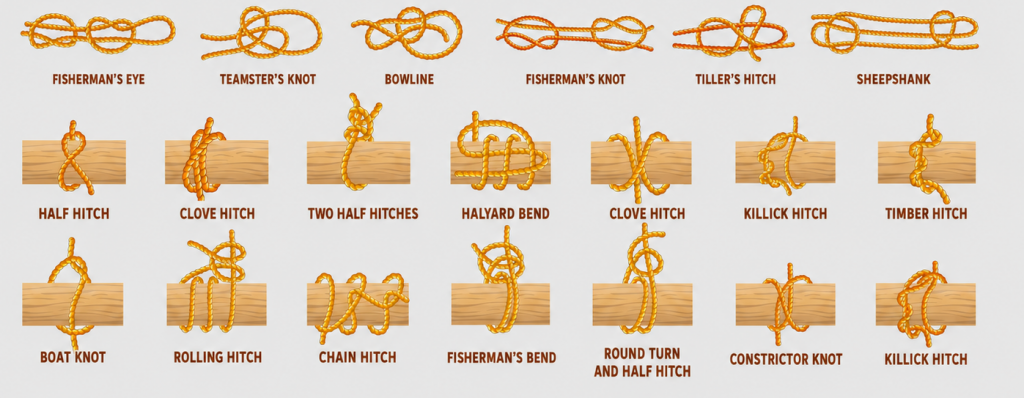
Pioneering Knots
There is a .pdf that is easily found in collections of bushcraft and survival files on archive.org titled Pioneering Knots & Lashings Troop 24 Kennet Square Pennsylvania that is a decent free resource. Ashley’s Book of Knots and many other similar books can also be found there and downloaded since they are now in the public domain. Books on knots published a hundred years ago remain equally useful today as they were when they were originally published.
- Clove Hitch – The clove hitch is considered by many to be one of the most important knots, along with the bowline and sheet bend. I think it is important to learn to tie because there is a whole group of similar knots that can be tied by making small changes to the clove hitch, and also because it is used to start the square lashing.
- Timber Hitch – Often used for attaching ropes or chains to logs, the timber hitch can also tied in chains.
- Square Lashing – Used to lash two poles together at any angle between 45 and 90 degrees. It is often used to build trestles, towers or scaffolding.
- Shear Lashing – Used to lash two poles together to form a bipod.
- Tripod Lashing – Used to lash three poles together to make a tripod.
- Diagonal Lashing – This is a simple knot that is quick to tie once learned. Just cross two poles, bind them together with a bight (lark’s head), pull it tight, lash a couple turns in each direction, separate the ends and weave them around the lashings in a circle and tie it off with a square knot.
- Round Turn & Two Half Hitches – Like two half hitches, the round turn and two half hitches is used to secure a rope to an object, but the round turn wraps the rope completely around the object.
- Bowline on a Bight – The bowline on a bight makes two loops that won’t constrict in the middle of a rope and is easy to untie, even after being subjected to a load, making it a good alpine tie-in knot.
- Butterfly Loop – A knot for putting a loop in the middle of a rope. It is easily tied one-handed, and with gloves on, and it is easier to adjust the size of the loop, while tying it, than with more complicated knots. It works best with soft ropes though.
- Sheep Shank – A knot for shortening a rope without cutting it.
- Prusik – Make a pair of ascender or descender loops for climbing or use to spread the sides of a tarp taught along a ridge line.
- Constrictor – Good for permanent binding. Don’t use this one for a knot you’ll need to untie except for a temporary whipping.
- Fisherman’s Knot – The fisherman’s knot is really a bend, a knot used to join two ropes or lines. It couldn’t be simpler. You simply tie an overhand knot in each line, around the opposite line.
- Pipe Hitch – Non-slip knot for poles and pipe. Just wrap downward four turns and then tie off with two half hitches.
- Back Country Block & Tackle – Use butterfly loops to create a block and tackle from a rope and three carabiners. Great for hanging big game with a minimum of equipment. Tie one to a stout hardwood stick to use as a gambrel.
Homesteading Knots
The aforementioned knots are, of course, useful on a homestead, as are knots that have to do with sewing, first aid, but I can only list so many knots in an article so I will list a few of the most useful knots here. Homesteaders with large livestock will find that there is a range of knots useful for horses, cattle and other large animals as ranchers need to tie knots for lasso’s, hobbles, halters, and a dozen other livestock-related chores.
- Lark’s Head – If you have attached a zipper pull with a fixed loop to zipper, you probably know the lark’s head knot or cow hitch. It is useful for attaching a loop to a ring or attaching the lanyard of a pocketknife to a belt. When tied in the end of the rope and the standing end is secured to the rope, the lark’s head knot forms the basis of the bale sling hitch.
- Double Sheet Bend – The double sheet bend is a more reliable version of the sheet bend and is the knot of choice for joining two ropes of different diameters, as it is the most reliable knot for this purpose.
- Trucker’s Hitch – Used for binding loads in vehicles or to pack frames.
- Cat’s Paw – Used to secure a rope to the clevis hook of a block and tackle, hoist or winch, the cat’s paw can be used to pull, lift, or lengthen a winch cable or rope.
- Carrick Bend – The Carrick bend is useful to join two large cables or ropes.
- Water Knot – The water knot is used to tie a loop in tubular webbing or to join two lengths of tubular webbing. A loop of tubular webbing is one of the most useful and compact tools you can carry to extricate an injured person from a burning building or similar disaster.
- Figure-Eight – The figure-eight knot is useful as a stopper knot and the figure-eight loop is a tie-in knot for climbing.
- Rolling Hitch – The rolling hitch is very similar to the taught-line hitch but joins another line to an existing rope such as when attaching a tarp to a ridge line when rigging a shelter.
- Miller’s Knot – The miller’s knot is used to close a sack or bag, whether it’s a mesh or burlap sack of potatoes in the root cellar or a poly sandbag on a riverbank or a fighting position.
- Flip Flop Winch – A brainchild of Mors Kochanski, the flip flop winch enables you to create a winch out of two small logs and a rope. The rope is anchored one end, the logs crossed, frapped with the rope, and then used to take up the rope in by turning them over, with one log acting as a pulley and the other acting as a lever in the fashion of a windlass, but since the logs are laid on the ground, the flip flop winch acts as a ratchet mechanism. An elegant solution.
Rope Care & Safety
In addition to knots, bends and lashings, it is important to learn how to properly care for and maintain rope.
- English Whipping – Used with whipping thread to prevent the end of a rope from fraying.
- Burning – Used to prevent fraying in synthetic cordage ends.
- Back Splice – Used to splice the end of a rope to prevent fraying.
- Short Splice – Used to permanently join two ropes of the same diameter.
- Eye Splice – Used to slice a permanent eye into the end of a rope.
- Coiling Rope – Rope is best stored coiled and unknotted to avoid kinks.
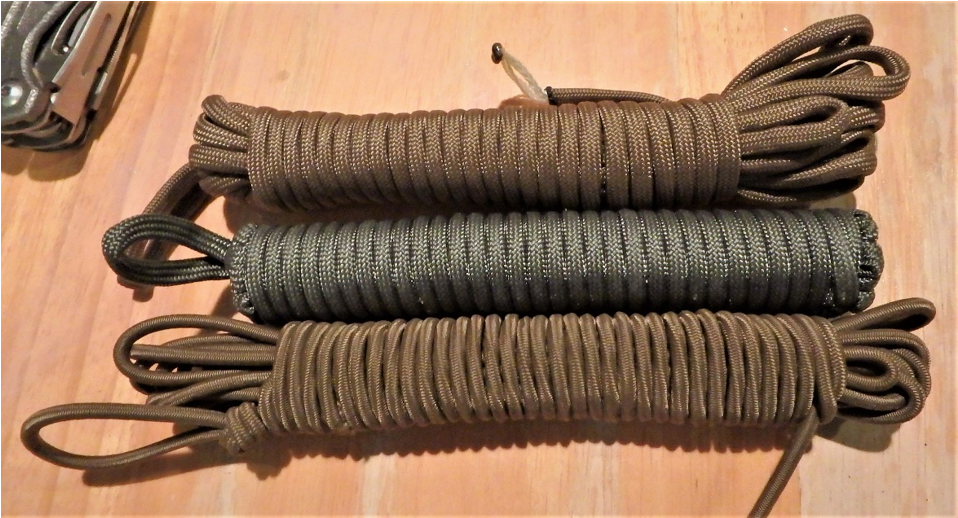
- The Ripcord Knot – This knot is for tying hanks of rope, using the hand as a jig, to tie cordage in very neat, compact hanks. It was first introduced to me as the ripcord knot. Tied in this fashion, cordage will pay out without tangles with a firm tug on the loop.
- Washing Rope – Salt or dirt in rope creates abrasion and cuts the fibers, shortening the life of rope. Rope can be clean by washing it with mild soap and warm fresh water and then air drying it in a shaded, well-ventilated area as UV light and mildew also degrade rope fibers. Synthetic rope can be machine washed on the wool setting and air dried as natural rope. (Compton, 2013)
Summary
I hope you enjoyed this list of essential knots and rope tasks that pioneers and sailors relied on, adapted for outdoor and homestead life. There is a wealth of information available on the subject and a curated list can help you save time by concentrating on the most useful knots, bends and rope care tasks. The large references are wonderful to have, but people have time to sort through 638 pages of knots to find the 3-4 pages of knots that they need.



References
Ashley, C. W. (1944). Ashley’s Book of Knots. USA: Doubleday.
Compton, N. (2013). The Knot Bible – A Practical Guide to the 200 Most Useful Nautical Knots. New York: Bloomsbury.
Emerson, C. (2016). How to Walk Away from a Runaway Train. In C. Emerson, 100 Deadly Skills (pp. 200–203). New York: Touchstone, Simon & Schuster.