


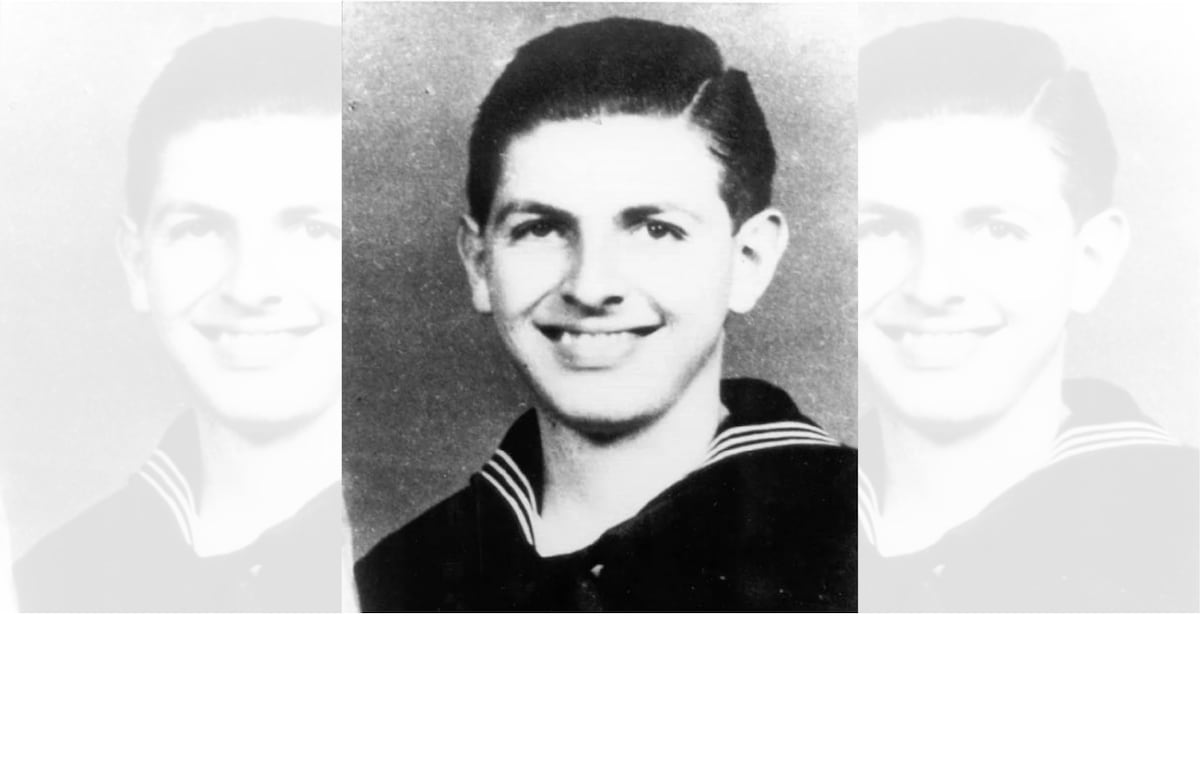
Marines, whose primary, universal purpose is to kill, reserve an ungrudging respect for “Doc,” eschewing weapons but ever ready to sacrifice his own life to save those around him.
On some occasions, however, a corpsman breaks the Hippocratic Oath by entering to combat. On one of those rare occasions the medic in question was compelled by extenuating circumstances and the weapons to which he resorted were supplied by the enemy.
Edward Clyde Benfold was born in Staten Island on Jan. 15, 1931. His father had been a First Engineer in the U.S. Merchant Marine during World War II. He was serving aboard the Honduran freighter Castilla on June 7, 1942, when it was torpedoed by the German submarine U-107 near Cuba. Benfold’s father was among the crewmen lost.
While Benfold was a child his family moved to Haddon Heights and Audubon, both in New Jersey. After graduating from high school, the boyish-looking 18-year-old enlisted at the U.S. Navy Recruiting Station in Philadelphia, Pennsylvania, and began basic training on Aug. 15, 1950, in the Hospital Corpsman Training Center at Great Lakes, Illinois.
From there he returned to Philadelphia to train as a neuropsychiatric technician, then attended the Field Medical Service School at Camp Lejeune, North Carolina. In April 1951 he worked at the Naval Hospital at Newport, Rhode Island, and upon rating as a qualified medical field technician in July 1951, he was deployed to the Fleet Marine Force, Pacific (FMFPAC) in Korea.
On Sept. 5, he was given a front-line assignment, operating alongside Company E, 2nd Battalion, 1st Marine Regiment, on a stretch of hilly frontage north of Panmunjom that the United Nations called “Bunker Hill.”
Typifying the limited objectives over which the two sides grappled with earnest ferocity, the high ground of Bunker Hill was pinpointed for occupation by the Chinese People’s Volunteer Army from Aug. 9 to Sept. 30, 1952. On Sept. 5, the Chinese launched their third and final attempt, only to be stopped dead by American firepower.
No less than three Americans who fought there were cited for the Medal of Honor: PFC Alford Lee Mclaughlin, using two machine guns and whatever other firearm was handy, held his outpost, killed an estimated 150 enemy soldiers and went on to retire in 1977; nearby, PFC Fernando L. Garcia, from Puerto Rico, leapt on an enemy grenade, giving his life to save his platoon sergeant; the third recipient was Benfold.
The corpsman was aiding comrades from an adjacent unit, Company I, 3rd Battalion and 5th Battalion, 1st Marines, when he came upon a crater near Outpost Bruce, and found two Marines there, badly wounded.
As he went to attend them, however, two grenades landed in his path, followed by the two charging Chinese who threw them. With seconds to make a life-or-death decision, Benfold snatched up both grenades, counter-charged the enemy and shoved the weapons into their jackets. The result was technically a violation of the corpsman credo, but Benfold’s act saved two wounded Marines at the sacrifice of his own life — and that of the enemy who would otherwise have killed them all.
Another corpsman, according to the Marine Corps Museum, was watching the events of the moment and rushed to aid Benfold. The damage from the explosions was too extensive, however, and Benfold died where he lay.
By Sept. 30, the battles for control of Outpost Bruce and Bunker Hill petered out with the contested ground in Marine hands.
On July 16, 1953, Rear Adm. John H. Brown, commandant of the 4th Naval District, presented the Medal of Honor to Benfold’s infant son. In addition, the corpsman received the Purple Heart, the Korean Service Medal and the United Nations Service Medal.
On Nov. 12, 1994, the newest guided missile frigate DDG-65 was christened USS Benfold. The remains of Benfold, Navy corpsman and honorary Marine, reside in Beverly National Cemetery, New Jersey.