


The Navy may be making some investments in unmanned vessels, but it needs to get a lot more ruthless to bring the fleet into the future, a top leader of the Pentagon’s Silicon Valley-based Defense Innovation Unit said Wednesday.
Testifying before the National Commission on the Future of the Navy Wednesday, DIU’s principal deputy director and chief commercial officer, Matthew Shortal, said dollars are not following rhetoric when it comes to building out the unmanned fleet.
“I’ve seen reports that it’s 96% manned, 4% unmanned,” Shortal said. “My personal view is that it’s not even close, and we need to move quicker.”
He added that, in meetings with Navy and Marine Corps leadership, it was easy to secure agreement around the importance of manned vessels and platforms in the fight.
But “when it comes time for budget, moving things, it just doesn’t happen, and we need to move out quickly,” he said. “It’s 96-4; it’s not moving to 10%, and I’ve seen the budget for this year. You know, a couple more billion for unmanned. It’s not enough. We need to start killing manned programs.”
Shortal gave his testimony before the congressionally established panel at its third public hearing, taking place at the Naval Postgraduate School in Monterey, California.
Established in 2022, the commission has eight members and kicked off its series of hearings in March. It’s set to deliver initial findings in early 2027 that will include “concrete choices for force design, industrial base reform, and the policies that enable a Navy and Marine Corps team capable of sustained operations and rapid surge when required,” according to the commission.
Shortal’s testimony emphasized the way both the ongoing Ukraine conflict and Operation Epic Fury — the United States’ war on Iran — have shifted the paradigm and emphasized unmanned vessels as “the way into the future.”
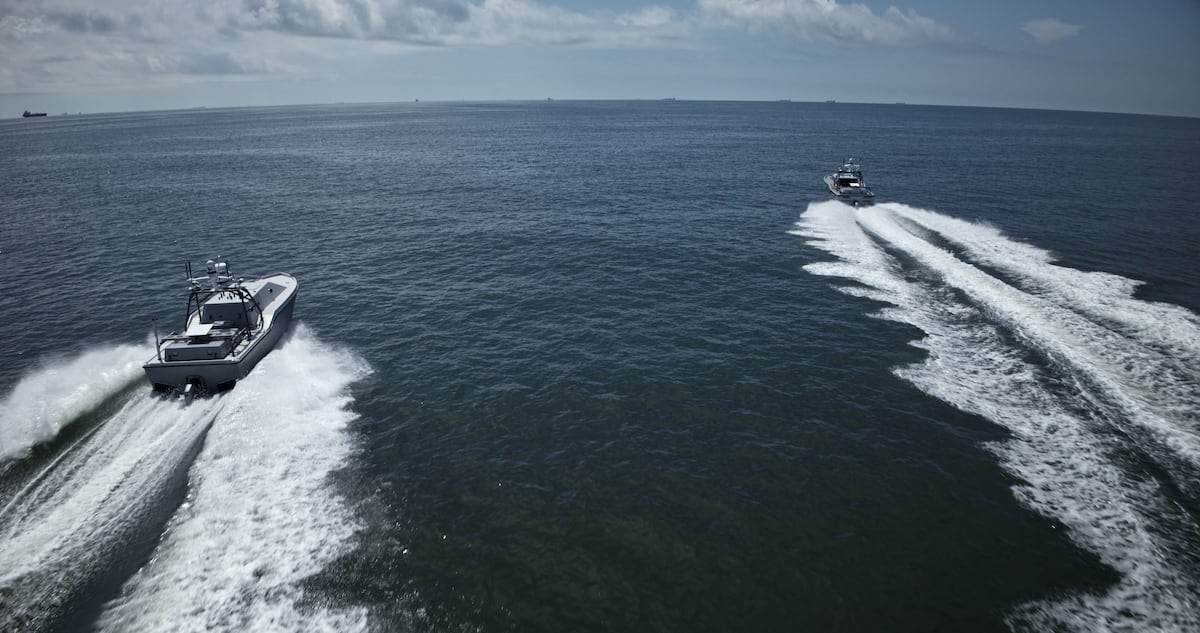
He cited in particular the Navy’s deployment of a Saronic-made Corsair unmanned surface vessel into the Strait of Hormuz to conduct an at-sea rescue of two Army AH-64 Apache pilots after their helicopter went down in the Strait in June.
“Then, not long after, three explosive-laden Corsair autonomous surface vessels conducted one-way attacks against maritime infrastructure at the Bandar Abbas naval base,” Shortal said, referring to Iran’s largest naval facility, which abuts the Strait.
DIU, he said, had funded early prototyping and acquisition channels for Saronic-made USVs, leading to the award of a $392 million production contract for Corsairs last December.
“At DIU, we don’t spend years gazing at the problem,” Shortal said. “In the face of generational technological change on the battlefield, resource allocation towards new entrants and new capabilities like unmanned autonomous vehicles in all domains is a critical directive in the face of a new war.”
Shortal did not expand, however, on which manned platforms and capabilities the Navy should divest or reduce to achieve a greater proportion of unmanned platforms in the fleet.
Operation Epic Fury has also emphasized the limitations of the Navy’s manned fleet, particularly the finite number of carriers and support vessels it has to maintain and sustain presence in the Middle East.
The retasking of the carrier George Washington to the region in order to relieve the Abraham Lincoln following a marathon deployment left a temporary carrier gap in the Pacific, where China threatens allied nations.
The Navy’s shipbuilding plan, released in May, requests funding for five unmanned and 34 manned vessels in Fiscal Year 2027. Over the next five years, it asks for 63 unmanned platforms and 122 manned ships, for a total of 299 manned battle-force ships and 83 unmanned vessels by FY 2031. It was the first time the Navy had included unmanned vessels in its future fleet projections.
“This inclusion is driven by the level of maturity in unmanned vessels,” the plan noted, “Which are now projected to be able to perform [chief of Naval Operations]-approved operational requirements.”