


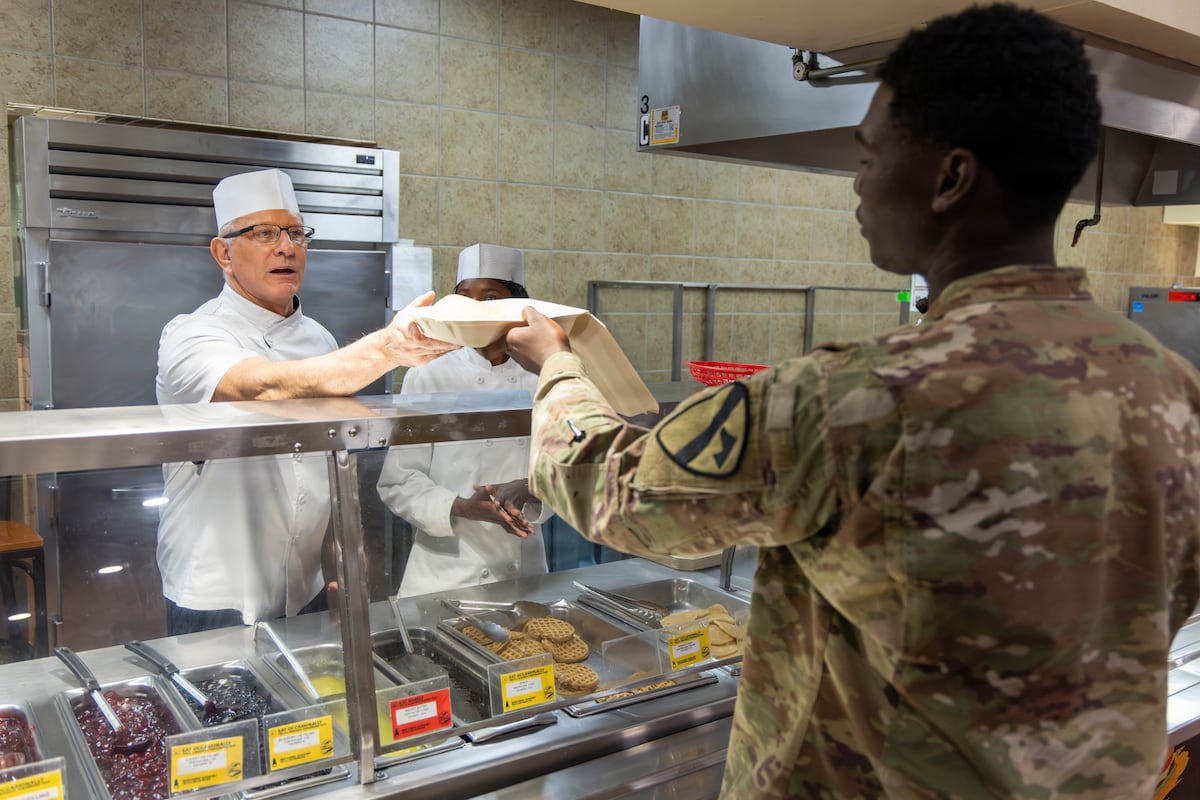
Ever since the Army’s first campus-style dining location, 42 Bistro, opened at Fort Hood, Texas, on Feb. 18, celebrity chef Robert Irvine says he’s been getting regular data readouts showing how many soldiers are eating there and what they’re ordering.
The British-born Irvine, best known as host of Food Network shows such as “Restaurant: Impossible,” has a longtime relationship with the U.S. military that includes more than a dozen USO tours and a foundation that awards need-based grants to active-duty troops.
His Pentagon restaurant, Fresh Kitchen, has been serving healthy fare to service members, contractors and federal employees since 2016.
Irvine’s name has been linked to the new Army dining initiative since it began. But in an interview with Military Times this month, he emphasized that he’s not merely contributing his name to the project, but planning to be the “bat” of enforcement if quality ever starts to slip.
“If you drop the ball, watch out: the bat’s coming, and that bat will be me,” Irvine said. “This is serious for me … it’s not a passion project. This is a real project.”
Five dining locations are expected to open by 2027 as part of a pilot phase, with plans to add 10 more, possibly including overseas spots, if the pilot is successful.
The Army’s effort to “modernize soldier fueling” aims to provide soldiers with an environment similar to a university food court, including Wi-Fi, updated seating, healthier food options and $39 per day in “Freedom Dollars” for meal card holders to spend as they wish.
Planning documents have raised concerns about the level of control the project will grant to contractors, who will be motivated to maximize profit while meeting Army objectives. Military dependents can pay out of pocket to eat at the new dining halls, while soldiers can add extras — possibly including alcohol in some locations — on their own dime. Loosely defined terms like “fresh” and “high-quality” have also prompted questions about how the Army will ensure standards don’t slip over time.
That’s where metrics come in. Irvine said he’s getting updated number tables every 15 minutes beginning when new campus-style dining locations open for business.
These, he said, will include how many soldiers are eating at the locations and top-selling menu items, but also margins on food cost and labor costs to make sure operations stay sustainable.
“I’m looking at the overall cost based on what their purchase power is, what their quality is,” Irvine said, saying the Army’s purchasing power, rightly applied, can keep 42 Bistro delivering fresh Argentinian salmon and locally grown lettuce and mushrooms to troops as part of daily fare.
“We talk about the [Army’s Holistic Health and Fitness initiative] and the gyms that we put up and the fitness and the percentage of less injuries and all that does,” he said. “We can do the same in food. We have the metrics to show that.”
When Irvine spoke with Military Times a week after 42 Bistro’s opening, he said the data showed the location was getting “slammed,” with foot traffic still increasing. The first day had 1,700 diners, 700 of those for the evening meal where traffic at Army dining halls tends to be lighter.
Grilled chicken was a popular menu item, Irvine noted, as well as customizable protein shakes that start with a minimum 25 grams of protein.
“Everything else you know, burgers, chicken, salads, sandwiches, all those kinds of things are literally even; I wouldn’t say there is a runaway,” the chef said.
Irvine said one of his goals is to elevate the work of 92 Golfs — the Army’s culinary specialists — by minimizing the pre-prepped reheating work and giving them more opportunities to be creative with their food offerings.
“Nobody’s joining the Army to be a cook anymore. They want to be a pilot; they want to be a drone pilot,” he said. “But at every base I visit I sa[y], ‘Look, guys, the Army doesn’t run without you.’”
But according to Irvine, the primary objective is to remain intrusively involved with monitoring performance and what’s being delivered to the troops.
“I feel accountable to [Chief of Staff of the Army Gen. Randy George] and [Army Secretary Dan Driscoll] to make sure that their vision is executed and the people who win these [contracts] are held accountable, because nobody’s ever held them accountable before. Well, they try to, but they don’t,” Irvine said. “I’m not that nice guy. I don’t have to be that nice guy.”
Accountability will look like making noise about unpopular menu items, flagging foot traffic or other indicators of slipping quality — using the same rationale he applies to his restaurants. He oversees a team of chefs who’ve been training staff at the new locations as unpaid consultants, he said, who also report back to him on what they see.
“Believe me, we’ve ruffled feathers,” he said. “I don’t care; I’m not employed by anybody … I go straight to [Army Materiel Command Commander Lt. Gen. Christopher Mohan]; I go straight to the contractor.”
On Thursday, Irvine cut the ribbon on the Army’s second campus-style dining location, Victory Fresh, at Fort Lee, Virginia.