


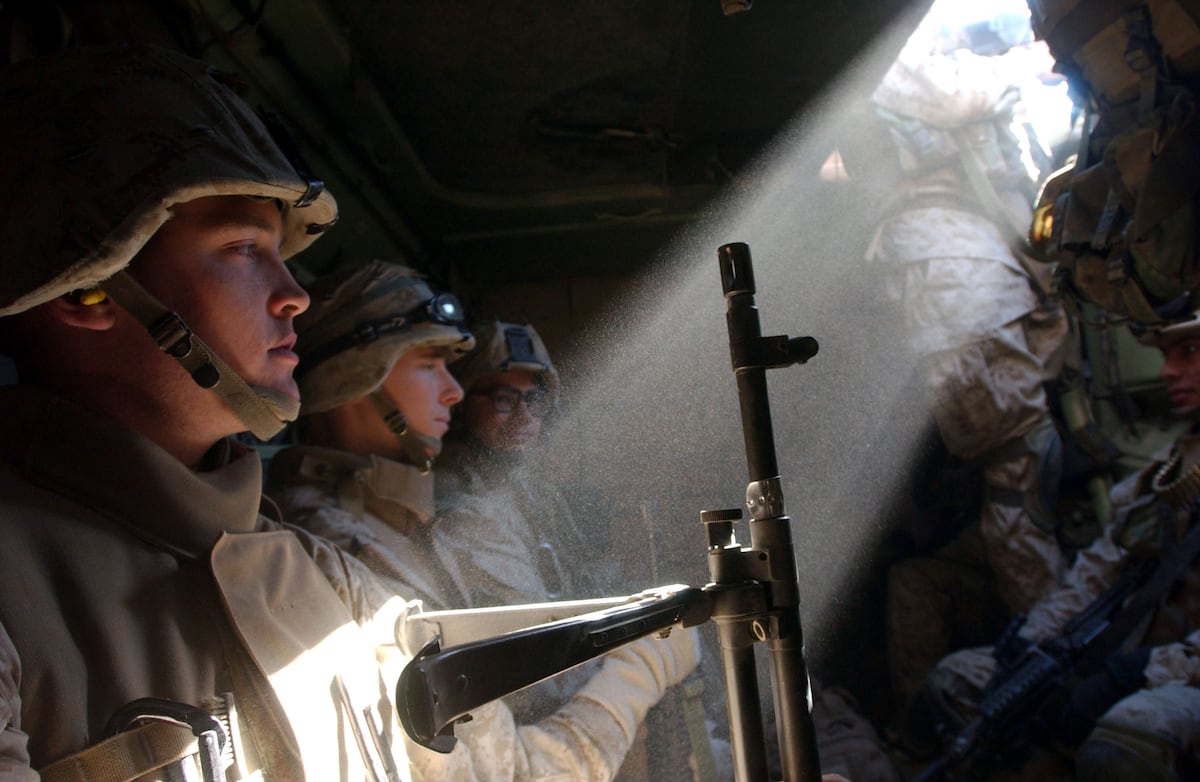
The order had already come down. The assault on a fortified Mahdi Army position in the Iraqi city of Karbala was off.
It was August 2004. Army Col. Peter Mansoor and his brigade had spent days preparing to clear the enemy stronghold, located across from one of Shia Islam’s holiest sites. Then coalition officials canceled the operation, deciding the political risks were too high.
The enemy remained in place. Mansoor still had an AC-130 gunship circling overhead. There was no instruction manual for what happened next.
Leveraging years of experience at the National Training Center with the 11th Armored Cavalry Regiment, Mansoor improvised.
He moved a tank company to probe the perimeter of an area coalition ground forces had been ordered to avoid. The maneuver drew enemy fire, allowing the gunship to strike the militants’ positions.
“Doctrine didn’t tell me to do that,” said Mansoor, who has since retired.
As thousands of post-9/11 veterans approach retirement eligibility, military leaders and veterans interviewed by Military Times said the challenge faced by the U.S. military today extends beyond replacing personnel to preserving the judgment, leadership experience and combat intuition accumulated during two decades of war.
Mansoor and retired Marine officer and defense researcher Ben Connable said the question is particularly acute for the Army and Marine Corps, where repeated deployments to Iraq and Afghanistan produced a generation of leaders whose careers were shaped by combat.
Doctrine can capture many lessons from war, Mansoor said. The harder task is preserving the judgment leaders develop after years of making decisions under pressure.
What Combat Experience Leaves Behind
Combat in Iraq and Afghanistan exposed leaders to uncertainty, risk and the burden of making decisions when lives were at stake.
The experience gave the U.S. military a significant advantage during the post-9/11 wars, said Mansoor, who commanded the Army’s 1st Brigade Combat Team, 1st Armored Division in Iraq and later served as executive officer to Gen. David Petraeus during the surge.
“As that experience leaves the force, you can only try to replicate it, but you can’t replace it,” he said.
Retiring Army operations leader Aaron Welch, who plans to leave the service in November after more than two decades in uniform, said the most difficult thing to pass on is judgment.
“Knowledge can be taught. Procedures can be documented. Skills can be practiced,” Welch said. “Judgment is different because it is built through years of making decisions under pressure, accepting consequences and learning from both successes and failures.”
Welch said he has spent much of his career explaining not just what decisions he made, but why he made them. Even so, some lessons can only be fully understood after experiencing similar circumstances firsthand.
The Army’s combat training centers, including the National Training Center at Fort Irwin, California, and the Joint Readiness Training Center at Fort Johnson, Louisiana, expose units to realistic battlefield scenarios designed to test leaders and formations under pressure.
But no matter how realistic the training becomes, Mansoor said, it still cannot replicate real combat.
“You can make training as difficult as you can, but it’s impossible to fully replicate the fear and the various emotional aspects of battle,” he said.
A simulated artillery barrage, he said, is not the same as taking enemy fire during an ambush or operating under mortar attack.
Welch pointed to what he called the “human dimension” of leadership as another aspect of combat experience that cannot be fully captured in doctrine, training or formal education.
“Leadership is ultimately about understanding human beings,” Welch said. “It is about recognizing when a soldier is struggling even when they say they are fine. It is about maintaining trust during difficult times.”
Capturing Lessons Learned
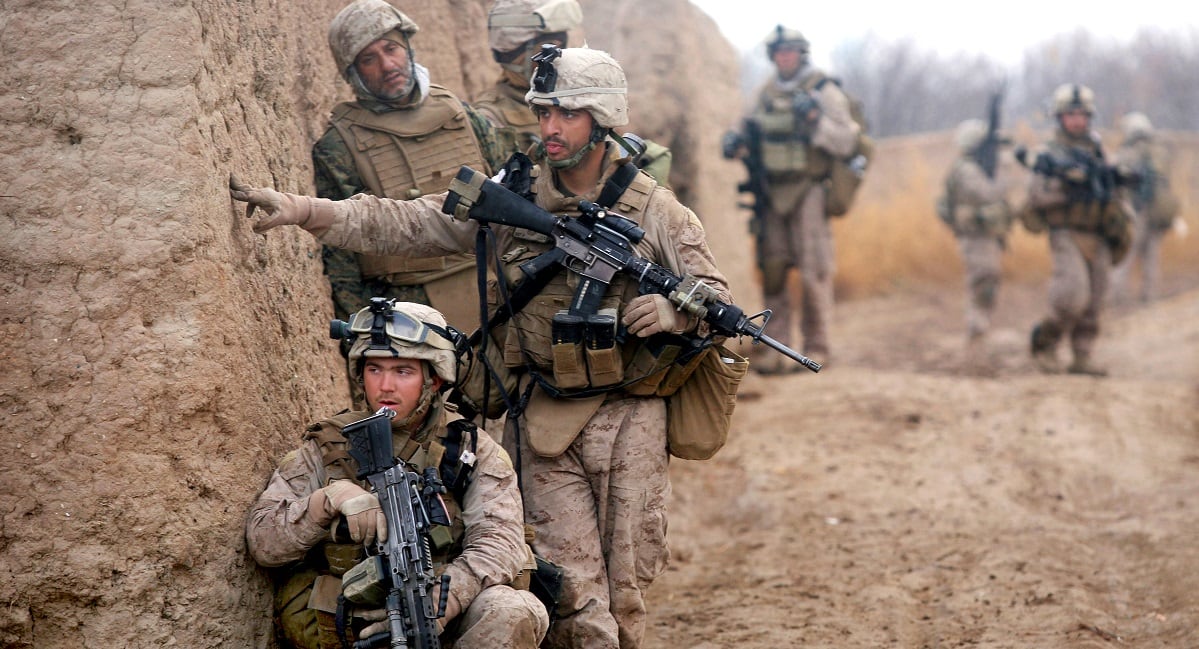
For decades, the military has relied on doctrine centers, professional military education institutions and lessons-learned organizations to capture and pass on combat experience and institutional knowledge.
Established in 1985 at Fort Leavenworth, Kansas, the Center for Army Lessons Learned, or CALL, is the Army’s premier agency for adaptive learning.
Lessons learned in Iraq and Afghanistan can still find their way into classrooms through updated doctrine and professional military education, according to Mansoor.
Still, documenting wartime experiences through oral histories, digital archives and interviews does not guarantee the successful transfer of knowledge to future generations, Connable said.
“It’s almost a belief that knowledge now exists in this kind of ether,” he said. “We don’t really have to do much with it anymore.”
Military organizations do not learn simply because information exists in an archive, Connable added. Someone still has to study it, teach it and apply it.
Mansoor pointed to counterinsurgency as a cautionary example. The military learned important lessons during Vietnam, he said, but much of that knowledge faded as the services shifted focus elsewhere. When U.S. forces entered Iraq and Afghanistan decades later, many of those lessons had to be relearned.
“What I’ve seen is that the U.S. Army and Marine Corps are doing a better job of sustaining those lessons, at least in their professional military educational institutions,” Mansoor said.
The military’s struggles during the early years of Iraq and Afghanistan reflected, in part, those experiences from Vietnam that had not been effectively shared with a new generation of leaders, Connable argued.
“Because we do, at best, a mediocre job, at worst, a bad job of passing that information down, then we lose people, and we can start losing wars,” he said.
Mansoor said preserving those lessons ultimately comes down to leadership priorities.
“Those things can be maintained, but only if the leadership wants to maintain them,” he said.
Preparing Leaders For The Next War
Preparing for future wars should not come at the expense of preserving lessons from counterinsurgency, Mansoor said. Even as the military focuses on large-scale combat operations, Mansoor argued that broad leader education cannot become a casualty of that shift.
“Troops can be retrained relatively quickly for counterinsurgency warfare,” Mansoor said. “But it takes years to educate a leader on what it would take to fight a counterinsurgency war.”
Mansoor argued that leaders exposed to multiple forms of warfare are better positioned to adapt when conflicts evolve in unexpected ways.
Connable said he is particularly concerned that expertise developed during two decades of counterinsurgency and irregular warfare could disappear as post-9/11 veterans retire.
“All of our irregular warfare knowledge is at risk of being dumped,” he said.
After two decades of war, the military and much of the American public simply grew tired of Iraq and Afghanistan, Connable added, increasing the risk that hard-earned lessons could fade.
Welch said his concern is not with the quality of younger leaders entering the force, but whether they are being given enough opportunities to develop through experience.
“Experience cannot be created in a classroom,” Welch said. “It is built through responsibility, decision-making, mistakes and recovery.”
As organizations become more risk-averse, Welch noted, senior leaders can sometimes intervene too quickly or shield junior leaders from failure, limiting opportunities for younger leaders to develop judgment.
“We cannot be so afraid of mistakes that we deny future leaders the opportunity to develop judgment,” he said.
Connable recalled serving under retired Marine Gen. John Kelly, who routinely asked Marines what they were reading and challenged them to think critically about military history.
“That is cultural,” Connable said. “That is a cultural norm that he was creating.”
Doctrine and archives alone will not preserve wartime experience, Connable added. Leaders, he said, still have to mentor younger service members and foster organizations where studying military history remains part of the culture.
Two decades after Karbala, Mansoor still remembers making a decision for which no doctrine existed.
“There isn’t a manual that says, ‘When you can’t go in with ground forces, try probing the edge and use air strikes instead,’” he said, reflecting on the battle. “You have to make those decisions based on experience.”
For Welch, leadership, at its core, remains a human endeavor.
“Technology will change. Doctrine will evolve. The battlefield will continue to evolve,” Welch said. “But character, judgment, trust, relationships and a commitment to developing others will remain at the heart of effective leadership.”