


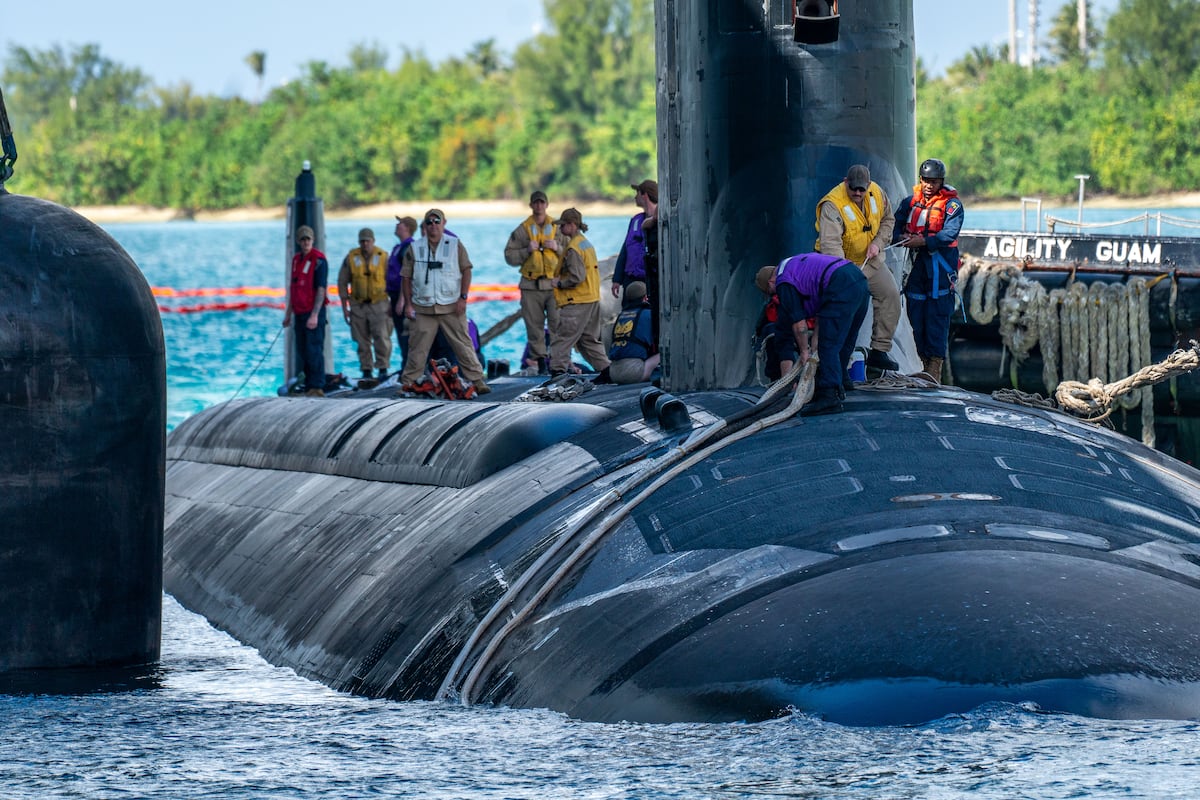
CHRISTCHURCH, New Zealand — On March 4, when a U.S. Navy submarine torpedoed an enemy combatant for the first time since World War II, three Australian submariners were aboard.
This was a contentious point for Canberra, as it is not a party to military actions against Iran.
Two days later, Prime Minister Anthony Albanese confirmed the presence of Royal Australian Navy (RAN) sailors aboard the U.S. submarine when the Iranian frigate IRIS Dena was sunk.
“We wouldn’t normally confirm such an issue, but given our meetings and the public interest, I can confirm that there were three Australian personnel on board that vessel,” Albanese revealed.
He added, “I can confirm also, though, that no Australian personnel have participated in any offensive action against Iran.” He noted, too, frameworks are in place to ensure Australians do not participate in such combat actions.
Albanese elaborated: “These are long-standing, third-country arrangements that have been in place for a long period of time, and what they do is ensure that Australian Defence Force personnel, where they are embedded in third countries’ defense assets, they act in accordance with Australian law, Australian policy.”
Jennifer Parker, principal and founder of Barrier Strategic Advisory, told Defense News it would have been possible for Australian submariners to recuse themselves during the attack off Sri Lanka. “It would be quite straightforward to not be on the consoles or in the control room during the engagements,” she said.
“As to legality, this was a lawful target in accordance with the law of naval warfare, and the response was also consistent with international law,” Parker said.
She added that such attacks can legally occur anywhere outside 12-nautical-mile territorial waters of neutral states, something true of the U.S. attack near Sri Lanka.
David Shoebridge, a senator from the opposition Greens party, alleged that Australia was complicit in an illegal war.
“We’re being dragged into these wars because of the dystopian logic of AUKUS, that we’re somehow safer by being part of an alliance led by Donald Trump and his lawless regime,” he said, referring to the U.S. president.
AUKUS is a trilateral pact between Australia, the U.K. and the United States aimed at outfitting Australia with nuclear-powered submarines and other technology that would allow Canberra to hold China at bay in Asian waters.
Parker wrote in a piece for The Academic website, “Under the law of naval warfare, warships belonging to a state engaged in an international armed conflict are military objectives by nature. The rules say they may be lawfully targeted.”
As per normal practice, the U.S. did not name the submarine involved, but there are suggestions it was the Virginia-class boat USS Minnesota, which rotated through Australia’s submarine base near Perth last year.
AUKUS progress
As the Australian Navy ramps up preparations to receive second-hand U.S. Virginia-class submarines, dozens of its sailors have been rotating onto American nuclear-powered attack submarines.
Last October, Australian officials revealed “more than 50” sailors were at that time serving on American SSNs. Furthermore, Rear Adm. Stephen Hughes, Australia’s Head of Navy Capability, told Defense News last November that about 160-200 Australian sailors were then in the U.S. and U.K. training pipelines.
“AUKUS remains on track, with a significant amount of achievements to date,” said Parker.
Hughes said it is “a really complicated equation” training sailors on SSNs, even while the Australian Navy keeps six conventionally powered Collins-class submarines in service.
“It’s not hard because we can’t do it and we don’t understand it, but you’ve got to keep Collins at its peak performance while you’re bringing in a new apex predator,” he said. “So the balance here is obviously across the industry spectrum, it’s across navy workforce, getting them trained and still having enough Collins submarines while you’re trying to build a workforce for that.”
Gordon Arthur is an Asia correspondent for Defense News. After a 20-year stint working in Hong Kong, he now resides in New Zealand. He has attended military exercises and defense exhibitions in about 20 countries around the Asia-Pacific region.