


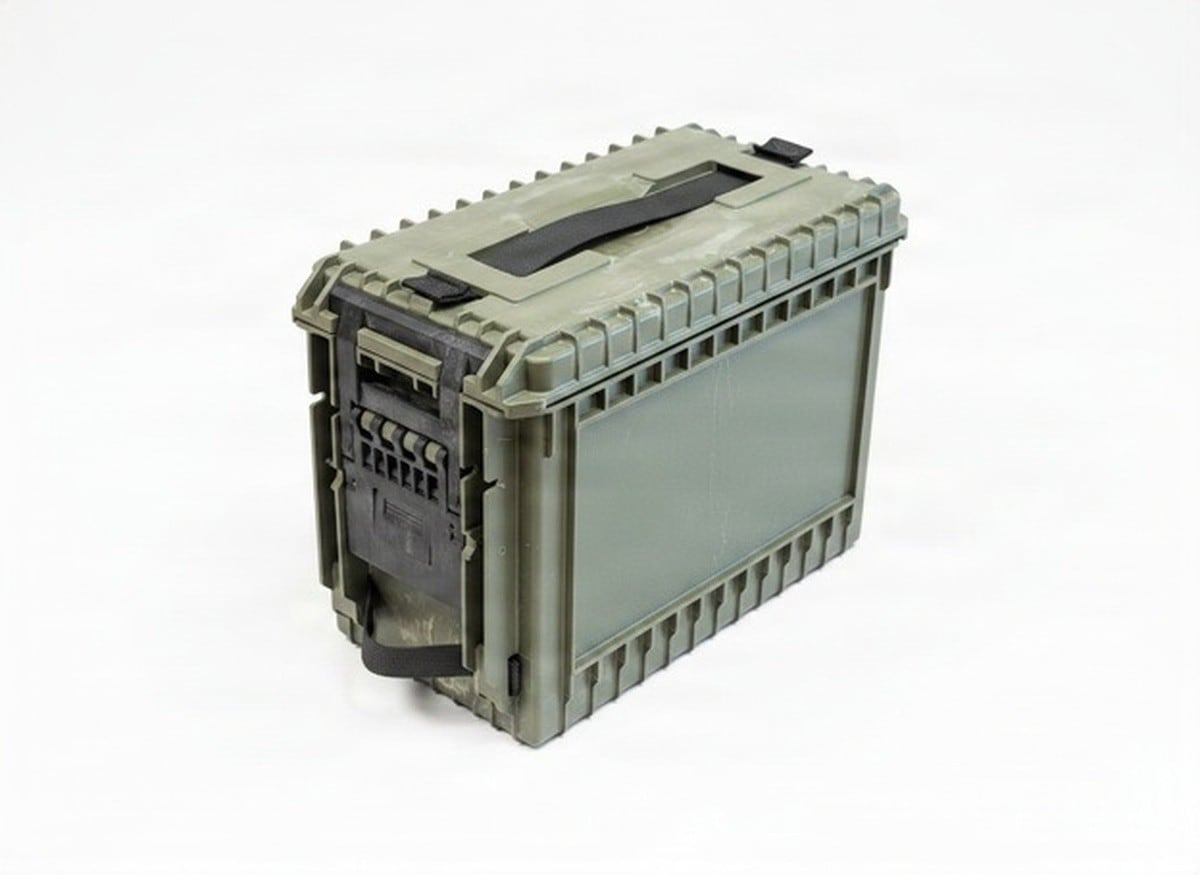
As supply pipelines become more risky and tenuous, the Army is rolling out what it’s calling the first major revolution in ammo packaging since World War II. And, officials said, they’re looking ahead to a future where the military may be able to produce its own ammo cases at point of need using advanced manufacturing.
In late August, the U.S. Army Combat Capabilities Development Command Armaments Center in Picatinny, New Jersey, announced the development of the SixPAC, a polymer ammunition container designed to fit two to a case inside the conventional wire-bound outer packaging and hold the 6.8mm rounds used by the service’s upcoming Next Generation Squad Weapon.
Development of this lighter and simpler-to-manufacture polymer system has been in the works for roughly a decade, officials with Picatinny told Army Times in an interview. But, they added, the need for different materials has become more urgent recently.
“We’ve had a lot of challenges with metal ammo containers lately, because we just have a limited number of U.S. suppliers,” said Jason Runell, senior scientific technical manager for packaging at Picatinny, adding that the Army had traditionally purchased from two makers and for a time was down to just one.
“You need an entire facility just to make one ammo can with all the presses and the dies and the welding equipment and everything. So it’s a high barrier to entry and a limited supply.”
By contrast, officials estimate that more than 800 U.S.-based injection molders can make the new packs, eliminating a major production stovepipe.
And at about 2.8 pounds, the new packs are about half the weight of their predecessors, officials said. In a release announcing the new ammo packs, Army officials cited feedback from soldiers who tested them in evaluation events between 2024 and 2025.
“Several service members pointed out that when aboard watercraft or aircraft, ‘every ounce counts’ and that the new system will allow them to carry more ammunition,” the release stated.
Eventually, officials hope to make the cases standard for all the “legacy calibers” of small ammunition, including 5.56 and .50 caliber. Officials noted that 7.62mm ammunition is typically packaged into a smaller case than the standard M2A2 ammo can and would take some additional engineering.
“We’re really using 6.8mm as our proof of concept to scale up and make sure that getting this new technology out into the hands of users is going to be well received,” said Karl Weiss, supervisor for small and medium caliber ammunition and weapons packaging. “And there’ll be a reverse demand to push this back … and the SixPAC, which could replace the M2A2.”
Before that, though, the polymer shell has to undergo more ruggedness testing to arrive at the final design.
Multiple variants of the SixPAC will be put through an operational environments testing process that includes them being subjected to temperature extremes ranging from 160 to negative 65 degrees Fahrenheit, said Ed Lucas, design lead for the polymer ammunition container.
“We have various tests that simulate all of the different things that this will go through, whether it be being thrown off the back of a tactical vehicle. There’s even testing for if it’s dropped off a [ship],” he said. “There’s a test that quantifies everything that this is going to have to do, and we’ve been very carefully looking at all those … to see if we can get the most efficient pack we can in soldiers’ hands.”
User testing will also be part of the process, the officials said, with past tests at Fort Benning, Georgia; Fort Campbell, Kentucky; and Fort Drum, New York, as well as at an ammunition supply point in Germany. Additional user tests are expected to take place at Fort Campbell.
As the Army becomes more proficient at 3D printing, Picatinny officials are also looking to exploit that technology for emergency ammo can production. Runell said research on 3D-printed ammo containers is slated to begin next fiscal year.
“We want to first look into 3D printing for the purposes of addressing production surge. So, if we do have production surges where our ammunition packaging manufacturers can’t keep up with demand, there may be a way to insert 3D-printed containers as a stopgap solution,” he said.
He added that packaging on demand in forward-deployed areas was another promising use case for advanced manufacturing.
“The challenges with 3D printing are many, but the technology is evolving so quick,” he said. “We want to kind of get ahead of it and start doing the research and development now, so that when the technology is mature enough and is affordable enough, we’ll have a nice head start to start implementing that.”