


The Tank Museum isn’t on the way to anywhere. Located one mile north of the village of Wool in Dorset in southwest England, The Tank Museum is collocated with the British Army Armor School in Bovington. Nobody gets to The Tank Museum by accident. It’s in the middle of no place.
Considering the Brits drive on the wrong side of the road, and each edge of their two-way thoroughfares is typically close enough to touch with your outstretched hands, why would anybody choose to seek out this obscure military base located deep in the British hinterlands? Well, that’s where you find The Tank Museum. The Tank Museum has the largest collection of tanks on Planet Earth. Why wouldn’t I go?
Origin Story
At the end of World War I, the British dragged a bunch of tanks out to Dorset and beat them to death with the intent of improving their armored force. By 1923, the area around Bovington was generously littered with rusting hulks. That’s when no less a literary luminary than Rudyard Kipling got involved. Kipling suggested somebody should open a museum. That simple metal shed did not admit its first visitor until 1947.

Things at The Tank Museum just kind of puttered along until the 1980s when George Forty took over as curator. He got serious about modernizing both the facilities and the collection. Three decades later, Forty retired, having transformed the place into one of the most popular museums in the world.

That’s not hyperbole. Covid nearly killed humanity’s museums. With the whole world in lockdown, nobody went to museums any more. Many of them withered as a result. The staff of The Tank Museum, however, used the lockdown as an opportunity to dip their toes into social media. What started as informal “Tank Chats” has evolved into something else entirely. The Tank Museum’s YouTube videos have more than 100 million views. Their channel has more subscribers than that of the Metropolitan Museum of Art and the Louvre. We guys do love our tanks.
The Scope of the Collection
I have been to The Tank Museum twice. Their collection of more than 300 armored vehicles, mostly tanks, hails from 26 different countries. One of the coolest aspects of the place is that there are no ropes. You can’t climb on the vehicles, but you can certainly touch them.

It is absolutely intoxicating to be able to run your hand across Tigers, Panthers, Stugs, Shermans, Stuarts, and M24 Chaffee tanks. There’s no harm in fondling the exhibits. They’re tanks. It’s not like you’re going to break anything.

While their World War II compendium spans the spectrum, their collection runs much deeper than just the Second World War. They have on display Little Willie, the world’s first tank, all the way up to a Russian T-72 and a modern British Challenger. From mass-produced armor that helped win WWII to bizarre one-offs that might otherwise not be encountered outside of some dusty book, The Tank Museum is a gun nerd’s dream.
Exigencies of Total War
When nation states are fighting for their very survival, they churn out military equipment as fast as is humanly possible. Then when the guns finally fall silent, there is a timeless temptation to just scrap everything and get back to the land of the living as quickly as possible. Whether it is tanks, rifles, combat aircraft or warships, once the war is over, militaries divest themselves of their martial materiel expeditiously. Only through the aggressive intervention of a few visionaries are samples of this stuff saved for future generations.

The Tank Museum’s Tiger I is a perfect example. During the course of WWII, the Germans produced 1,347 Tiger I tanks. Of those vehicles, only one, Tiger 131, remains intact today. Tiger 131 was captured by the British in the North African desert on 24 April 1943. Today it is fully restored and maintained in running order. Tiger 131 is the jewel in The Tank Museum’s expansive collection.

There are lots of other examples that are not so well-known. There’s a swimming Sherman designed to storm the Normandy beaches as well as a Sherman with a flail attachment for clearing minefields. Many of the museum’s vehicles bear the stigmata of combat action. Gouges from machine gun and anti-tank fire abound. It is sobering to appreciate that these very tanks actually carried young men into battle.
Organization of The Tank Museum
The Tank Museum actually consists of two facilities. The main building is a state-of-the-art museum divided into eight exhibition halls. Strolling through the well-lit collection takes you from the earliest armored engagements in World War I through the interwar years, World War II, the Cold War, Afghanistan and beyond.

There is a space devoted to tanks in popular culture along with a special corner focusing on the epic 2014 David Ayer movie Fury. One section orbits around the online game World of Tanks. This area sports a dozen or so computer terminals wherein you can plop down and crew many of the armored vehicles in the collection in digital combat.

Yet another area is devoted to and sponsored by Tamiya models. There is a long table covered in masterclass scale models of various tanks and military vehicles. Several model-building artisans sit at this table building and painting models all day long under the fascinated gaze of museum patrons. In addition, there is a simply epic gift shop and a fantastic cafeteria that serves traditional English fare.

Live The Armory Life. The latest content straight to your inbox plus an automatic entry to each of our monthly gun giveaways!
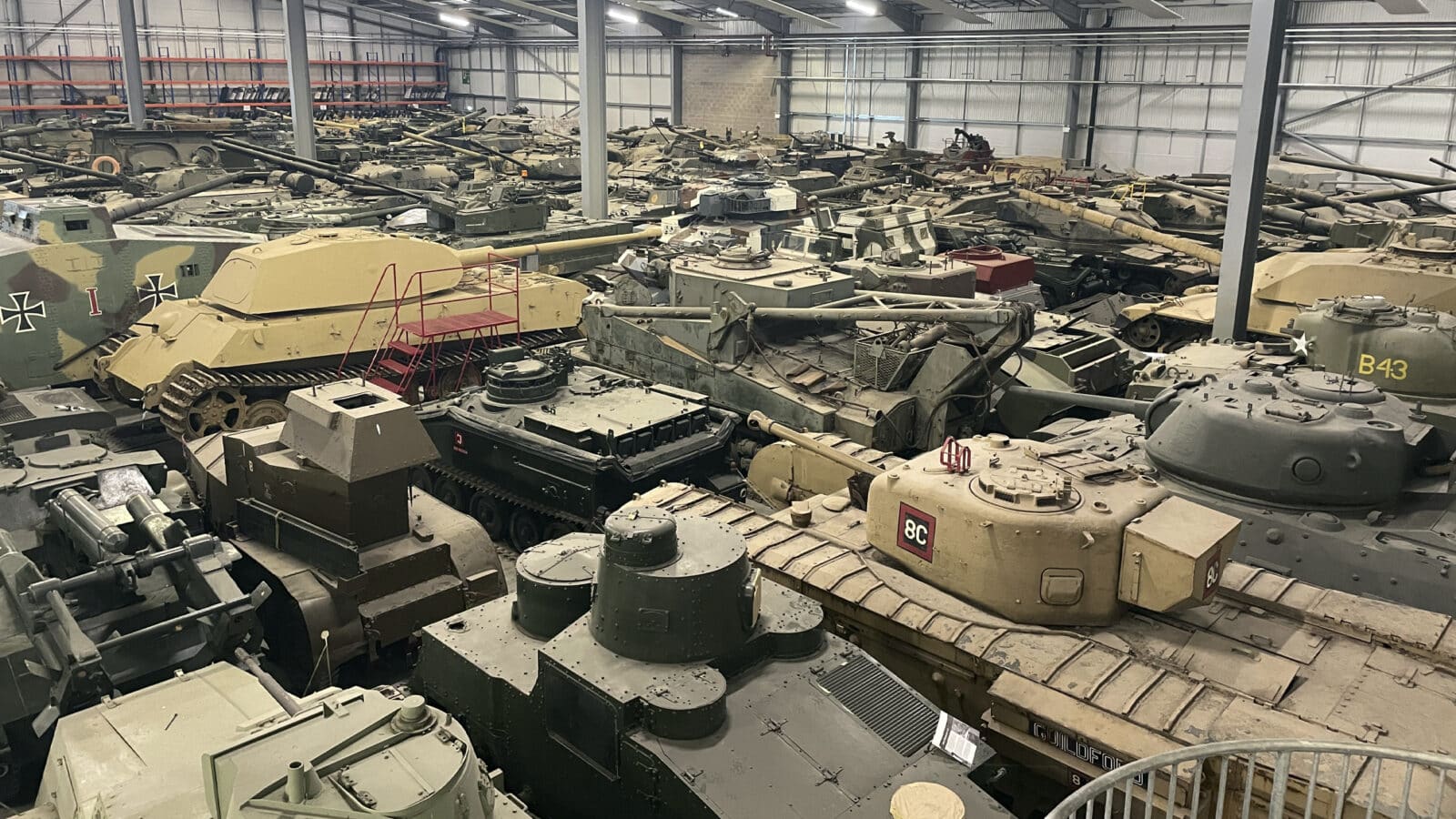
Across the parking lot is another enormous building titled the Vehicle Conservation Centre. This is a gigantic warehouse filled axle-to-axle with the overflow tanks that won’t fit in the regular museum. While you can’t typically wander around these vehicles for safety reasons, you can take it all in via an elevated catwalk.
This place looks that epic warehouse at the end of the first Raiders of the Lost Ark movie. The tanks seem to go on for acres. I spotted a King Tiger with a Porsche turret, a dozen or more Sherman variants, a Stug assault gun, and probably 100 more. The WWI-vintage German A7V is a replica, but everything else is original.
Ruminations
The Tank Museum has at least one of almost everything. From their Iraqi-capture T-62 to the obscure Japanese Type 95 Ha-Go to their combat veteran Pershing, T-34, Churchill, and Matilda. If you’ve read about it, The Tank Museum most likely has it on display. This is the only place in the world where you can see the entire family of German panzers, from the diminutive Mk I all the way up to the enormous Konigstiger and Jagdtiger tank destroyer.

The collection evolves over time. One of the Tiger variants that was on display when I was there several years ago had been on loan from a collector in the U.S. It had gone home, but a second King Tiger that had been on tour in Europe was back at Bovington for good.

The Tank Museum is an extremely active place. They offer rides in an M548 tracked vehicle every day. During their annual Tank Fest held over three days in June, they unlimber the collection and drive the old tanks around their outdoor tank track. Thousands of people flock from all over the world to come watch.

After the Russians invaded Ukraine, Cook Defence Systems was contracted to make replacement track links for Ukrainian T-72 tanks damaged in combat. The Tank Museum was able to offer blueprints and examples from their collection that could be used to set up production. Whether it is truly living history or helping the Ukrainians resist Russian aggression, The Tank Museum is honestly one of the coolest places on Planet Earth.
Editor’s Note: Be sure to check out The Armory Life Forum, where you can comment about our daily articles, as well as just talk guns and gear. Click the “Go To Forum Thread” link below to jump in!