


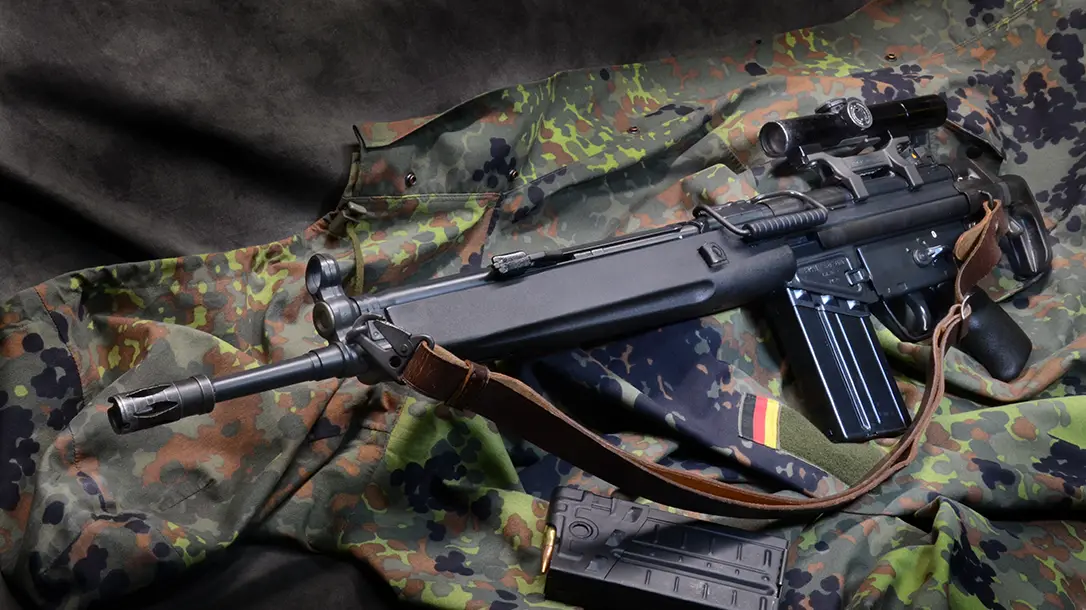
The G3 rifle’s genesis took place during World War II, as Germany struggled to provide advanced weapons to counter the numerical advantages of the Russians in the East and the Americans and British in the West.
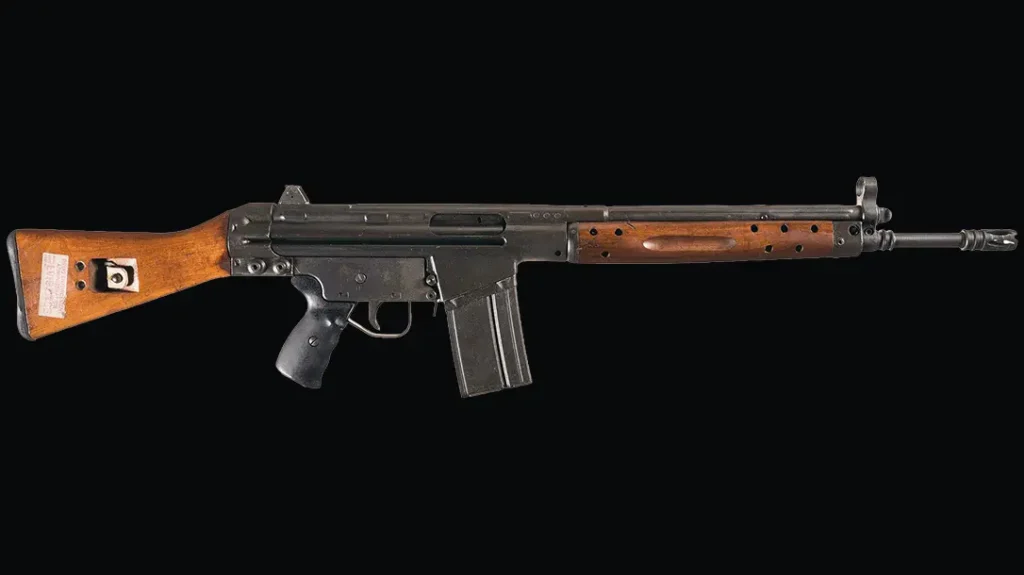
The G3 Rifle – From the Beginning
Heckler & Koch rifles and SMGs are known for their roller locking operating system, but that innovation originated during World War II, when Mauser experimented with the roller-locking system for their Sturmgewehr (assault rifle). Other manufacturers were also experimenting with Sturmgewehr designs. The most successful was C.G. Haenel’s, adopted as the StG 44. However, it was expensive to produce, as German industry suffered material and skilled labor shortages due to the war. Mauser’s Gerat 06H offered a less expensive weapon fabricated of stampings. Chambered for the intermediate 7.92x33mm Kurz cartridge, the Gerat 06H was intended to replace the StG44.
Mauser’s variation of the roller-locking system was called “half-locking” from the German halbverrigelt—the “H” in 06H. This system allowed the bolt to begin rearward travel while the bullet was still moving down the barrel and the case was under full gas pressure. Mauser engineers found that this pressure caused case heads to separate, affecting 06H reliability. Their solution was fluting the chamber so gases could “float” the case to ease extraction. Anyone who has fired a G3, HK91, or MP5 will be familiar with the distinctive striations on fired cases caused by this fluting.
Roller-Delayed Blowback
The roller-delayed blowback system adopted for the 06H, and eventually the G3, did not require the bolt to be fully locked closed. Instead, rollers slowed rearward bolt movement as they disengaged from the locking recess. These rollers pressed against the bolt body at an angle, further slowing rearward bolt movement.
The Mauser 06H performed well in tests, resulting in an order for prototypes. Once having achieved preliminary military acceptance, the design was designated StG45(M), the “M” for Mauser. However, the war ended before the StG45(M) went into production. Prior to the end of the war, Mauser machinery, prototypes, engineers, and craftsmen were loaded aboard a special train and evacuated to the Austrian Alps. Allied intelligence officers captured prototypes, blueprints, engineers, and technicians.
American and French Interest
Both the USA and France were interested in the StG45(M) design. It was France, however, that took charge of most of the Mauser engineers and craftsmen, moving them to the French armament facility CEAM at Mulhouse, France, near the German border. Included among the former Mauser engineers working for CEAM were Theodore Loffler and Ludwig Vogimler, who had been integral to the design of the StG45(M). Though prototypes based on the StG45(M) were produced in France, the French instead adopted the MAT49 SMG and MAS49 semi-auto rifle.
However, Spain was also interested in developing an automatic rifle to replace the bolt-action Mausers then in use. Vorgrimler left France and joined the Spanish firm CETME. Initially, two designs were developed for CETME based on the StG45(M). The second of these, the Modelo 2, would evolve into the G3 rifle.
Manufacturing Challenges
As with the StG45(M), the Modelo 2 required steel stampings, a production capability absent in Spain, thus requiring two years to produce rifle prototypes. The Modelo 2 was finally presented to high-ranking Spanish officers on 15 December 1950. It performed well in tests, especially impressing Generalissimo Franco during a demonstration in July 1951.
As more prototypes were delivered, problems arose because a subcontractor did not follow the technical drawings for the Modelo 2, but over the next four years, Modelo 2 development continued, including demonstrations for German and American officers. At this time, the Modelo 2 was still chambered for a 7.92x41mm intermediate cartridge, and it was in that caliber that the CETME would initially be considered for the Spanish Army. Later, a reduced-power 7.62x51mm load would be developed.
CETME Design
Prior to the establishment of the new West German Army, the Bundeswehr, at the end of 1955, the West Germans were interested in the CETME, which was essentially a German design, but they wanted the rifle to be produced in Germany. Initially, Mauser, re-established in West Germany, was approached about producing the rifle, but was not interested. Instead, CETME contacted a relatively new firm, Heckler & Koch, formed by two former Mauser employees.
The German Federal Defense Ministry liked the CETME design but required that it be chambered for the full-power 7.62x51mm NATO round. CETME development was slow, however, resulting in the Bundeswehr adopting the FN FAL rifle to meet immediate needs. On 13 November 1956, 100,000 FALs were ordered from FN in Belgium. These rifles were produced between April, 1957 and May 1958, and were designated Gewehr 1 (G1). However, the German Army continued to follow the development of the CETME design and ordered 400 rifles for continued testing, which resulted in requested changes to the CETME design. The Germans tested other rifles as well, including the SIG 510-4 (G2) and Armalite AR10 (G4).
Spanish Army
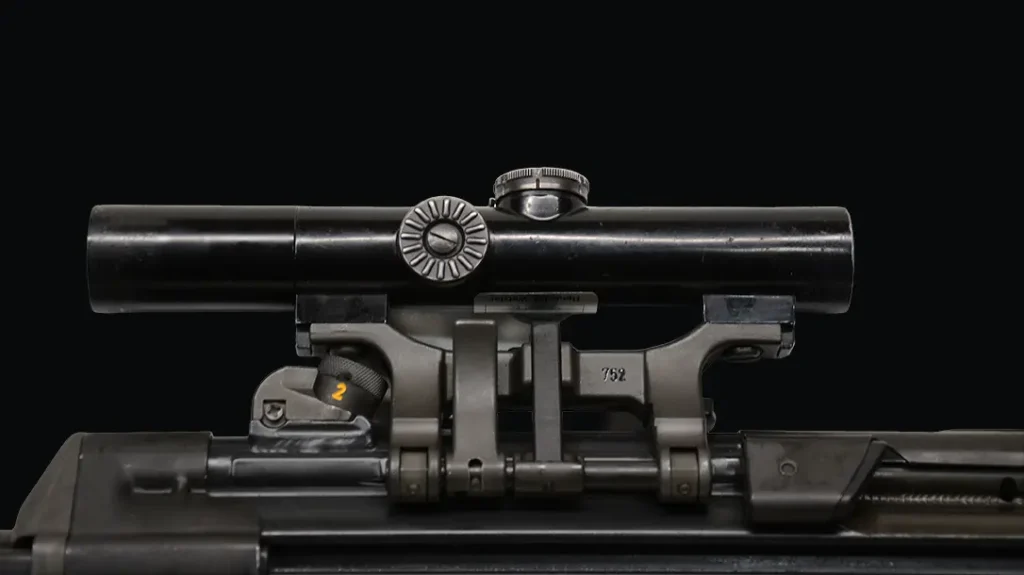
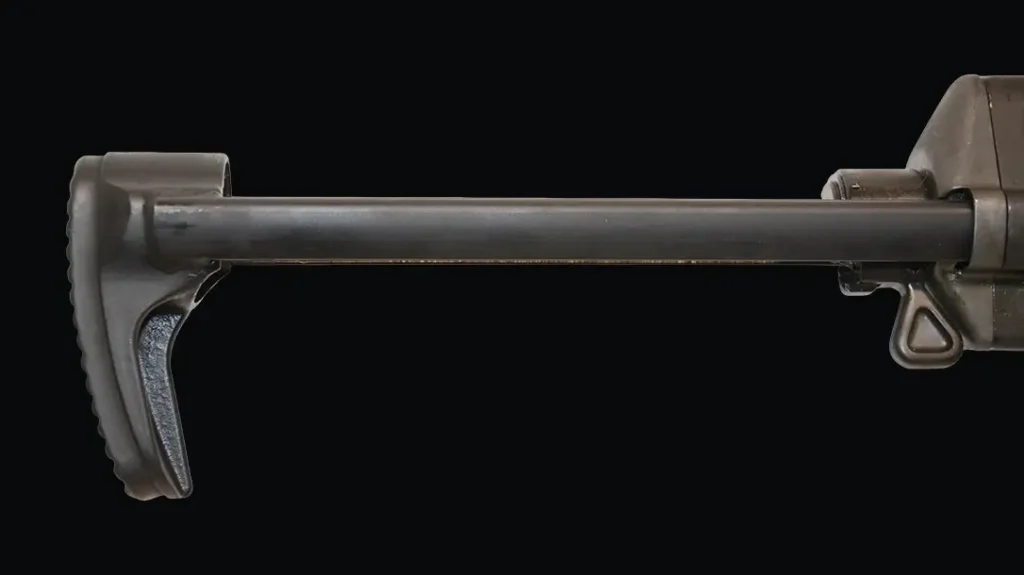
Meanwhile, the Spanish Army had tested later versions of the CETME, eventually adopting the DM3 (CETME). Finally, in February, 1959, an agreement was reached for H&K to produce the CETME rifle for the German armed forces as the G3, though a final contract was not agreed until March 5, 1962. Nevertheless, H&K began production of the first 150,000 G3 rifles, with delivery completed by August, 1962. Early in production, H&K adopted the distinctive diopter rear sight identified with the G3. During 1960, H&K began experimenting with retractable stocks for the Fallschirmjager (paratroops). In 1961, the flash suppressor/grenade launcher was developed. An additional order for 100,000 more G3 rifles was placed with H&K in November, 1962.
While durability issues with the G3 were being fixed and until enough G3S had been produced to arm the entire Bundeswehr, the G1 (FAL) remained in service until the mid-1960s or later.
Rifle Adoption
The Spanish Army had adopted the Fusil de Asalta CETME Modelo 1958 de 7’62mm on September 27, 1957. Although there were other differences between the CETME and the G3. Perhaps the most noticeable was that the CETME was initially chambered for a reduced-power 7.62x51mm round. However, as of 1971, all CETME rifles already in service were modified to take the 7.62xx51mm NATO standard cartridge. These rifles were designated as the Modelo 1958-64-C. Another notable difference was the use of a rear flip-up sight instead of the HK diopter and wooden furniture. HK’s early production had also used wooden furniture, but this was replaced by polymer in 1964.
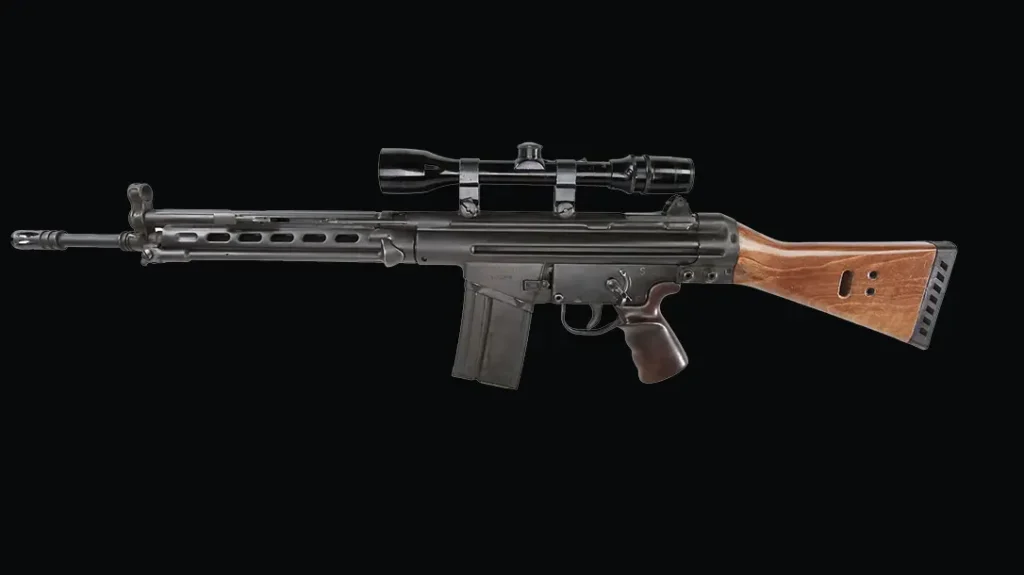
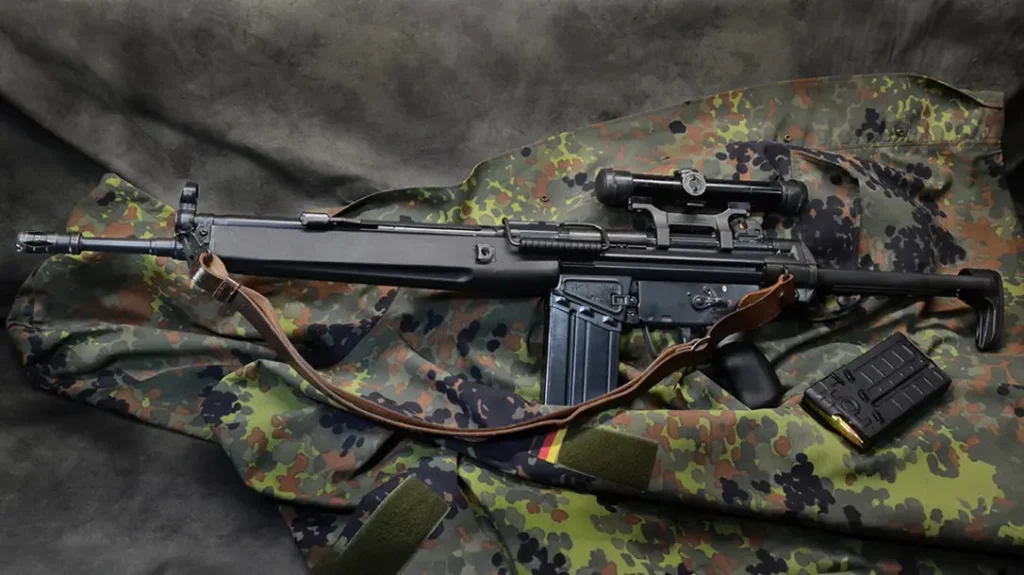
Among variants produced for the German Army were the G3A4 with retractable stock, G3A3ZF with telescopic sight, G3SG1 designed as a Scharfschützengewehr (sharpshooting rifle), and G3TGS, with HK79 under-barrel grenade launcher.
The standard selector switch for the G3 was marked S (Sicher), E (Einzelfeuer), and F (Feuerstoss)—in English: safe, single shot, and burst fire. The standard magazine held 20 rounds, though 30-round box magazines and 50-round drum magazines have been available.
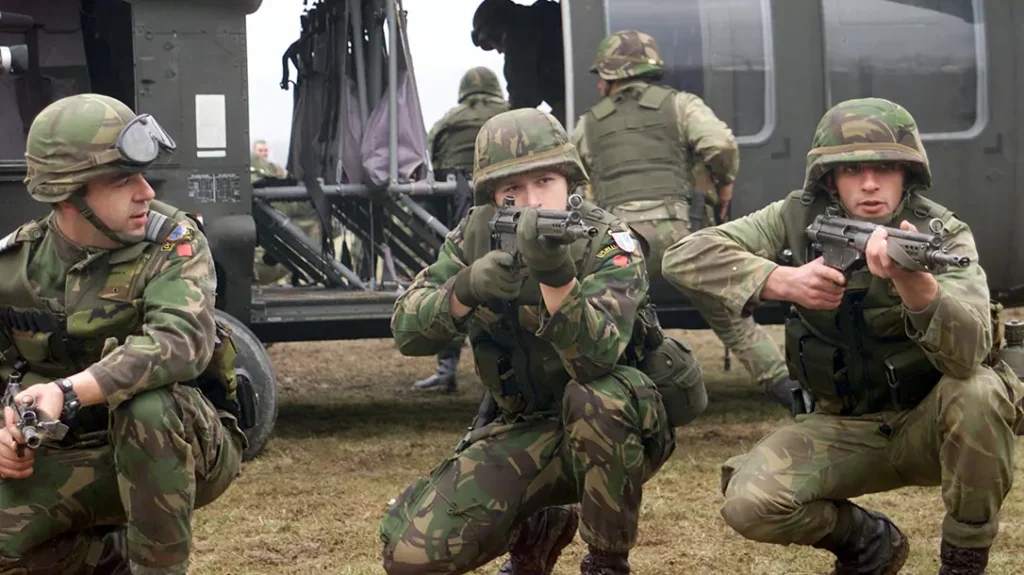
HK91
American shooters will be most familiar with the semi-auto version of the G3 imported into the USA as the HK91. Other than being a semi-auto, in handling and functioning, it is similar to the G3. When NATO members began switching to 5.56x45mm caliber rifles, HK offered the HK33 in this caliber to compete with the M16 and other rifles. Basically a scaled-down G3, the HK33 is a very handy rifle. It was also imported into the USA as a semi-auto, designated the HK93.
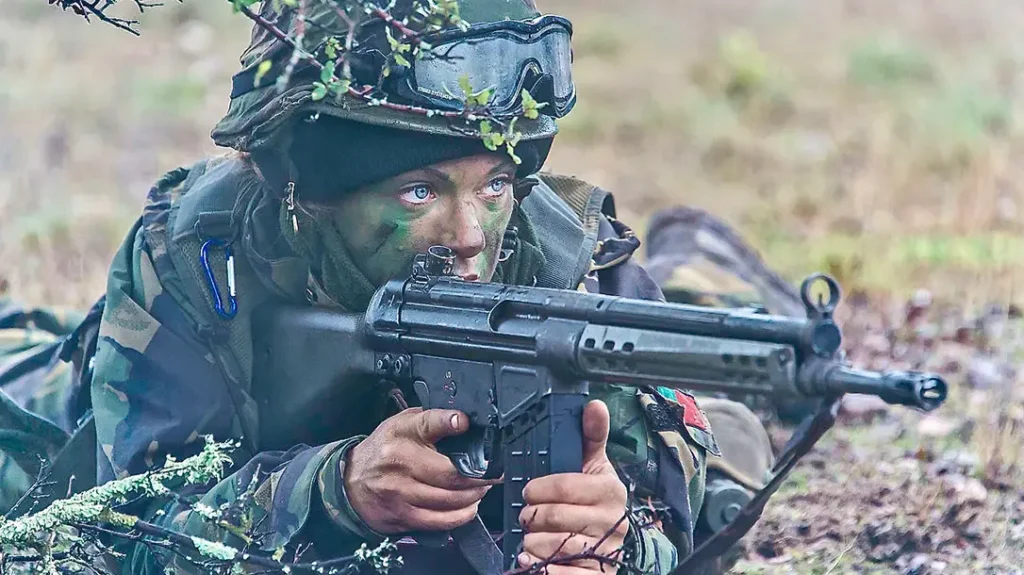
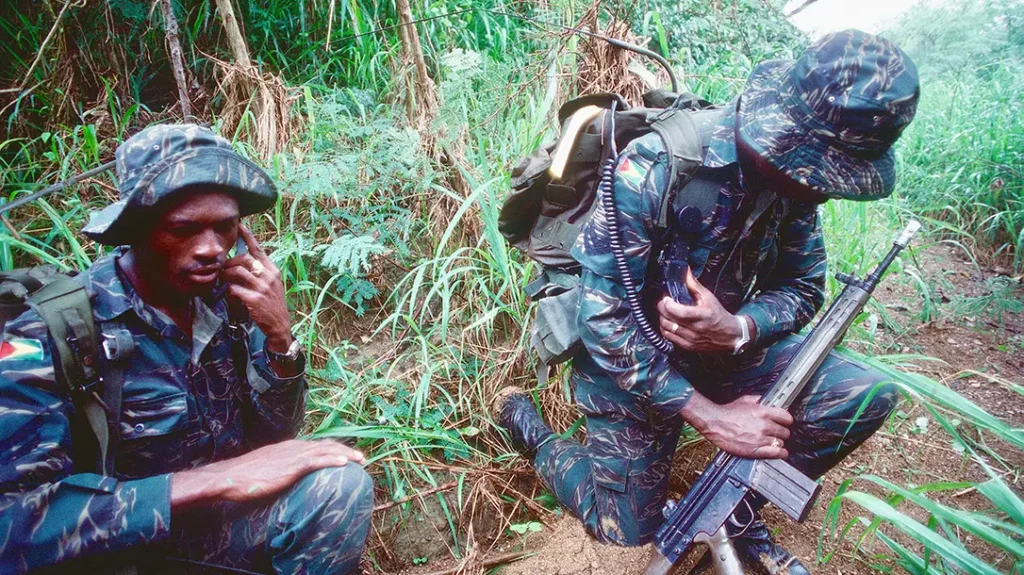
Although the G3 or variants such as the CETME were eventually adopted by more than 80 countries. They are produced under license by a dozen or more; they have seen only limited combat usage. Portuguese counterinsurgency troops used the FMP version in Africa. Some of these rifles eventually ended up with Rhodesian troops during the Rhodesian Bush War. The widest combat use of the G3-type rifle was by the Iranians with their locally manufactured version in the Iran-Iraq War and by the Pakistanis with the POF G3P4 in the Kargil War against India.
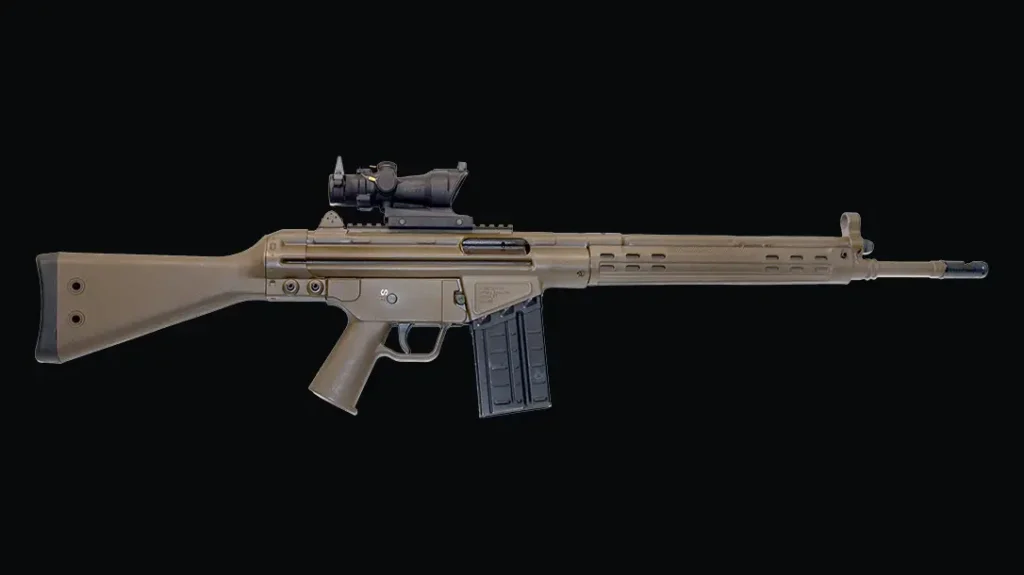
The G3 Rifle
Large numbers of G3-type rifles may still be encountered in various parts of the world, especially Africa and Latin America. So many were produced that they will be encountered in trouble spots for many years. Though AK47s and M16S/M4S now dominate, there are still fighters who prefer a full-powered battle rifle such as the G3. Included are troops of some countries that formerly issued the G3 as their primary rifle and have retained some as DMRs. Just as the USA has retained the M14. The G3 will also be remembered as one of the iconic battle rifles that would have outranged the AK47 on the North German Plain had the Cold War turned Hot!
G3 Specifications
| Action: | Delayed-Roller Blowback |
| Caliber: | 7.62x51mm NATO |
| Overall Length: | G3A3 40.4 inches |
| Barrel Length: | 17.7 inches |
| Magazine Capacity: | 20 rounds |
| Sights: Rear: | Rotary Diopter, Front: Hooded Post |
| Rate of Fire: | 500-600 RPM |
WHY OUR ARTICLES/REVIEWS DO NOT HAVE AFFILIATE LINKS
Affiliate links create a financial incentive for writers to promote certain products, which can lead to biased recommendations. This blurs the line between genuine advice and marketing, reducing trust in the content.
The post The G3 Rifle – A Deep Dive appeared first on Athlon Outdoors Exclusive Firearm Updates, Reviews & News.