


Editor’s Note: This article is strictly the opinion of the author and is for informational purposes only. Avoid potential threats and danger whenever possible. Please seek qualified training.
In my article about how to survive a home invasion robbery, I wrote about moving to safe areas of your residence in an emergency. But what if remaining there is not an option? Let us discuss safe room clearing.
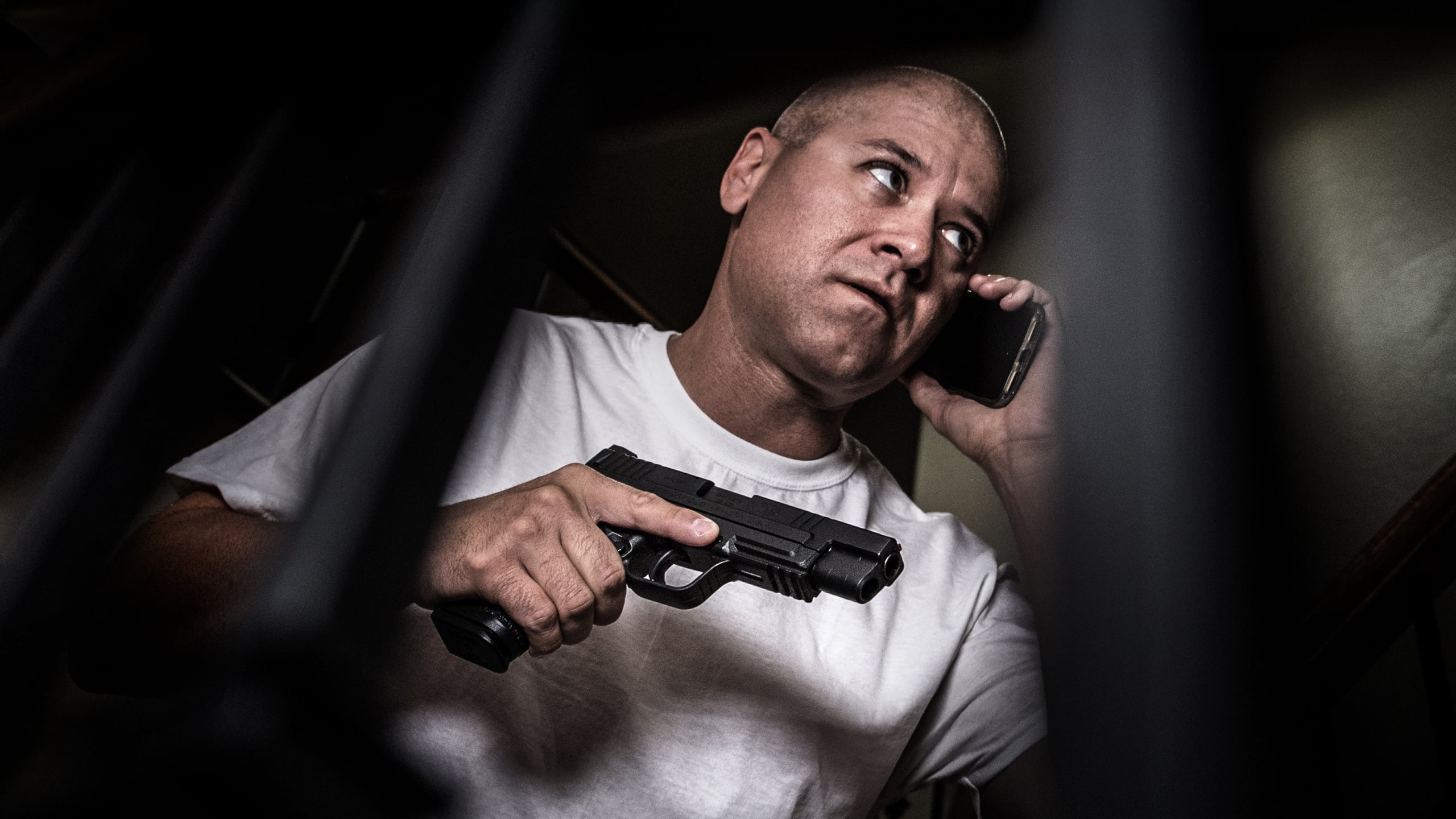
My bedroom is one of two safe staging areas where I keep tools for defense of the home. This now includes my Springfield Armory Kuna with three loaded mags, flashlights, body armor, cell phones and medical supplies. If someone were to kick in my front door, this room and my office are ready to combat the threat.
In the dead of night, you may hear sounds of an unknown origin and seek to investigate. That differs from a direct attack that you know is occurring. In that event, arming and staying put may be the best option. A call to 911 means back-up is en route. However, if for some reason you are forced to leave this position, it is best to have some knowledge about how to safely venture out into your home.
The Details
Police differentiate room clearing from dynamic entry by their relative speeds and intents. Room clearing is slow and methodical, with safety paramount. Think of hide and seek with the end game to get the drop on the bad guy. Dynamic entry is overwhelming a target with speed, surprise and violence of action. Hostage rescue is an example of this.

Unfortunately, room clearing done right is not sexy enough for movies and television, so you often see the fake cops or soldiers running through a structure, kicking in doors and acting foolishly. Blame the director or on-set technical advisor. I guess it’s supposed to look cool, but it’s a great way to get killed in real life.
Room clearing, also called building search, is the practice of moving from one interior place to another while minimizing time in danger areas. Notice I did not say “avoiding.” When you are looking for an armed subject inside a structure, you will have to cross and enter kill zones. Deal with it. We call them fatal funnels in room clearing.

A fatal funnel is any area that acts as an entry point or firing lane through which a suspect may ambush a good guy. Examples are doorways, hallways, and windows. In room clearing, the goal is to spend the least amount of time in or near these areas. We achieve this by moving tactically.
And I do dislike the ubiquitous use of the word “tactical.” It originates from the Greek taktike techne, which means the “art of arrangement.” Planning and maneuvering with a specific goal constitutes tactics. Tactics are short-term actions to achieve a broader strategic end.

There are several well-known techniques for moving through a structure with the best possible safety. But before you put one foot out of your staging area, are you prepared to practice noise and light discipline? Noise discipline is moving as silently as you can so as not to give away your presence or position. Jangling keys, beeping smartwatches and squeaky footwear are examples.
Leave anything that rattles or beeps behind. Walk slowly with a rolling motion of the foot from heel to toe. Smooth is fast. Avoid contact with furniture, walls or doorframes. And for goodness’ sake, if you open a door, don’t kick. Lever it open quietly without entering the fatal funnel.

Live The Armory Life. The latest content straight to your inbox plus an automatic entry to each of our monthly gun giveaways!
As to light discipline, use your firearm’s light or flashlight sparingly. If there is enough ambient light, let your eyes adjust and don’t fire up the torch. If you are using a light, it is best to light then move, especially in larger rooms. Darkness is your fourth protector behind Cover, Concealment, and Distance. Avoid having a flashlight accidental discharge by not riding the switch and having tail caps adjusted for a deliberate tap.
The Process
Let’s assume you and your equipment are ready for a slow and methodical move through the house. We are ready for a few tactics. Always consider that there is danger where you can’t see it. The main maneuver for room clearing is slicing the pie.

Slicing the pie refers to taking small sections of view when entering a doorway or hall intersection. The aim is to show as little of your body as you can, especially the head and center of mass, while you slowly take in a few degrees of view at a time until you have seen as much of the room as possible.
For a right-hand dominant shooter, you will place your right foot forward and cant your body to the right when rounding a left-side doorframe or leading and leaning left to slice a right-side doorframe. The same applies to hall intersections. Reverse the placement if you are left-handed. I don’t like the idea of switching the weapon to the non-dominant hand for opposing corners because it can be awkward, noisy and we don’t tend to shoot as well from that side.
If you prefer it, fine. But after practicing thousands of reps in training and in use on real-life callouts, my opinion is based on what has worked for me and my teammates. Proof of concept, I am still alive after two decades in high-risk SWAT operations.

Slicing the pie can be used horizontally to clear over small walls, desks or other obstructions. It is also a good tactic for clearing stairs or stairwells where you move up or down, hugging the wall and advancing to see the upcoming stairs, landings or floors. Again, the movement is stealthy and deliberate and not rushed.
You may have windows within your house or sliding glass doors connecting rooms. These are obviously fatal funnels as well and should be addressed with caution. Move quickly to cross these and get out of the danger area.
The Next Step
When entering a room, you will want to steer clear of flagging your firearm, i.e., exposing the barrel of your firearm, before you are actually in the room. Not only would flagging the gun announce your presence, but it also makes you ripe for a gun grab if the perp is close to the door.

As a role player for a group of recruits, I was hiding just inside a doorway of our shoot house. A rookie attempted to enter the room gun-first, and I grabbed his slide. He reactively pulled the trigger, and I got a simulated ammunition round straight into my gloved palm. Ouch! The stunned recruit apologized profusely, but I told him that was the right thing for him to do. If someone tries to take your weapon, give them the bullets first.
To avoid flagging the pistol as you cross the threshold, briefly tuck the gun close to your body, but still in line with the threat, as you move. After entry, punch the gun back to ready. With a handgun, your non-dominant arm should be up to protect your head and upper torso while being out of the way of the muzzle. The non-dominant hand can ward off close-quarters attacks while you protect your handgun.
When breaching a threshold with a long gun, it is best to pull the gun back for a moment as you cross while maintaining the barrel on target forward. With both a handgun and a long gun, the tucking movement is quick because you are moving expeditiously to get out of the fatal funnel.

When you enter a room, immediately scan for threats or areas where a threat could be concealed. You know your home, so you will be cognizant of what is in place and what is not. Take a walk around sometime and check to see where a person could conceal themselves in each room.
One on One
I am addressing this topic from the perspective of a single person clearing the house. If you trust your spouse or partner to back you up, that will be your choice, but please get training and practice together if that is what you intend. Make sure each of you follows the laser rule (not pointing the muzzle across your partner) and do not get separated.
For law enforcement, an important room-clearing concept is not to pass a room you have not cleared. On an alarm call, two officers will check a house or business together. For larger structures, additional officers or a K9 Unit are called in. Officers will also deep clear a residence, making sure all conceivable hiding places are examined. You won’t have that luxury by yourself.

It is prudent to take a moment to wait and listen while you are in an area you have deemed safe. Hearing where someone or something is moving can send you in the most likely direction to investigate. You might also discover the source of what woke you in the first place. I was once creeping about my house in the dark only to discover that what had alarmed me, and the dogs, was an opossum outside on my roof. He was a chonky one, too.
If you start hearing what you assess as a person moving around in your house, an option is to announce yourself: “Who is there? I am armed and have called 911!” Do this from a position of cover or concealment and use the fatal funnel to your advantage. If you hear your daughter shout back, “It’s me, Dad. I’m home early from college!” you may breathe a sigh of relief.
If you have not read my home invasion piece, I invite you to go back to it, as it fills in some information I have not included here. While it is a differing situation, that between an emergency versus an inquisitive action, there are some similarities.
Conclusion
This is by no means all of your room clearing options or tactics. In the real world, we are tasked with protecting our home and loved ones. I hope this will give you an idea of what kind of guidance, training and practice you should seek for this type of personal defense. Please stay aware and be safe.
Editor’s Note: Please be sure to check out The Armory Life Forum, where you can comment about our daily articles, as well as just talk guns and gear. Click the “Go To Forum Thread” link below to jump in!