


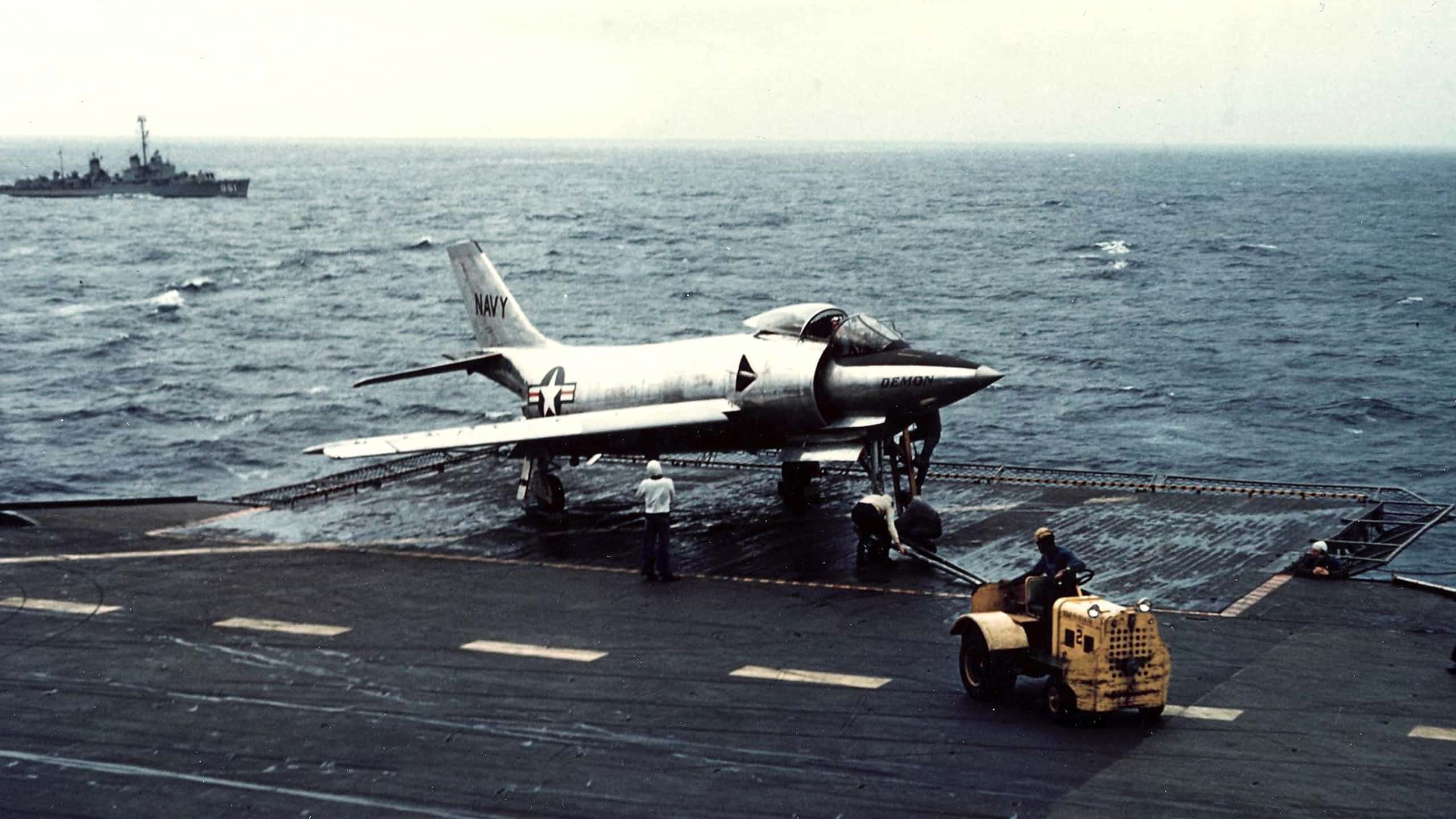
The McDonnell F3H Demon was a single-seat, carrier-based jet fighter developed for the United States Navy in the 1950’s. This aircraft represents a critical but troubled chapter in American naval aviation: one that pushed the McDonnell Aircraft Corporation toward design philosophies that would eventually produce the legendary F-4 Phantom II. But the path there wasn’t pretty. The F3H struggled with underpowered engines, weight problems, and structural failures that killed test pilots and delayed its operational deployment for years.
First flown in 1951, the F3H emerged during the jet age transition when the Navy desperately needed supersonic interceptors capable of defending carrier battle groups from Soviet bombers. The Demon was supposed to fill that role. It didn’t quite get there. But understanding what went wrong, and what eventually went right, tells you a lot about how naval aviation evolved during the Cold War.
Development Origins and the Westinghouse J40 Disaster
McDonnell won a Navy contract in 1949 for a new swept-wing carrier fighter. The design specifications called for high speed, extended range, and the ability to carry the new generation of air-to-air missiles then in development. This was the Sparrow missile system.

This was ambitious stuff for the time. The Navy wanted an interceptor that could operate from aircraft carriers while matching or exceeding the performance of land-based fighters.

Here’s where things started going sideways. The entire F3H program was built around the Westinghouse J40 turbojet engine. On paper, the J40 looked great. It promised around 11,600 pounds of thrust with afterburner. Sadly, the J40 turned into one of the most catastrophic engine programs in American aviation history. Westinghouse couldn’t deliver the promised power. The engines were unreliable, underpowered, prone to compressor stalls, and had a nasty habit of failing in flight.
The prototype F3H-1N first flew on August 7, 1951, with test pilot Robert Edholm at the controls. Early testing revealed serious issues almost immediately. The aircraft was underpowered even with the J40 operating nominally. When the engines inevitably fell short of specifications, the situation became critical. The F3H-1 variant was so compromised that McDonnell and the Navy eventually scrapped the entire production run of 60 aircraft.

Multiple crashes between 1952 and 1955 killed four pilots as the J40 repeatedly failed during test flights. The aircraft had insufficient power for safe single-engine operation from a carrier. That’s not a minor problem when you’re trying to land on a pitching deck in the middle of the ocean. Of the 35 F3H-1N aircraft flown with the J40 engine, eight were involved in major accidents.
The J40 failures in the F3H mirrored those of the F7U Cutlass designed by Vought. The F7U was originally equipped with the J34 and then the later J46. Both were underpowered for the aircraft. The J46 was especially disappointing as it, like the J40, failed to meet its promised output by a large margin.
Redesign with the Allison J71: Creating the F3H-2
By 1953, it was clear the J40 program was dead. McDonnell proposed a major redesign around the Allison J71 turbojet engine. The J71 was heavier and physically larger than the J40, which meant significant structural changes to the F3H airframe. This wasn’t a simple engine swap. The fuselage had to be lengthened, the air intakes enlarged, and structural components reinforced to handle the additional weight and thrust.

The resulting F3H-2 variant had an Allison J71-A-2 engine producing 14,400 pounds of thrust with afterburner — about 3,000 pounds more than what the J40 was actually delivering. That extra power made the difference between a dangerous aircraft and a marginally acceptable one. The first J71-powered Demon flew in October 1954, and the F3H-2 entered operational service with Fleet Squadron VF-14 in March 1956.

Even with the J71, the F3H-2 wasn’t exactly a hot rod. Maximum speed was around 647 mph at sea level, which put it solidly in the high subsonic category. Some sources claim it could briefly exceed Mach 1 in a dive, but that’s not what you’d call sustained supersonic performance. The Navy had wanted a supersonic interceptor. What they got was a subsonic aircraft with decent range and weapons capacity.
Weapons Systems and Operational Capabilities
Where the F3H Demon distinguished itself was in weapons integration. This aircraft was designed from the start to carry guided missiles: the Raytheon AAM-N-2 Sparrow air-to-air missile (later redesignated AIM-7 Sparrow). The F3H-2M variant could carry four Sparrows on underwing pylons, making it one of the first operational missile-armed fighters in the U.S. Navy.

The Demon also carried four 20mm Colt Mk 12 cannons, a derivative of the Hispano HS 404, mounted in the lower nose, giving it both gun and missile capability. This mixed armament reflected the transition period in fighter design. Missiles were the future, but guns were still necessary for close-in combat where early missiles couldn’t track targets effectively.
The aircraft featured an AN/APG-51 radar system integrated with the Sparrow missiles, providing basic fire control capability. This was relatively advanced for the mid-1950s, though by modern standards the radar was primitive. Effective range was limited, target discrimination was poor, and the system required significant pilot workload to operate effectively.

Beyond air-to-air missions, F3H-2N variants served as all-weather interceptors with improved radar systems. Some aircraft were modified for limited ground attack roles, carrying bombs and rockets on underwing hardpoints, though this was never the primary mission. The F3H was fundamentally an interceptor designed to protect carrier strike groups from incoming enemy aircraft.
Design Features and Structural Characteristics
The F3H had a distinctive appearance, with a wide fuselage and high-mounted horizontal stabilizers. Its swept wings had a 35-degree sweep angle — the same as the F9F Cougar. The aircraft looked bulky compared to contemporary fighters like the North American F-100 Super Sabre, and that wasn’t an accident. The F3H was designed to accommodate substantial internal fuel capacity for extended patrol missions over water.

Wing design incorporated leading-edge slats and trailing-edge flaps to improve low-speed handling during carrier operations. This was critical because carrier approaches require precise speed control at relatively low velocities. The slats automatically deployed at lower speeds, increasing wing camber and preventing premature stall. This kind of high-lift device was becoming standard on carrier aircraft by the 1950s.
Landing gear was robust and designed specifically for carrier deck operations. The nose gear featured a catapult launch bar for steam catapult systems. The main gear had significant stroke length to absorb the violent impacts of arrested landings. Each main gear strut had to handle the aircraft’s full weight hitting the deck at descent rates that would destroy civilian aircraft landing gear.

Live The Armory Life. The latest content straight to your inbox plus an automatic entry to each of our monthly gun giveaways!
The cockpit was relatively spacious by 1950s fighter standards, with reasonable visibility despite the thick canopy framing. Pilots had to manage complex systems manually, which increased workload — especially during single-pilot carrier operations at night or in bad weather.
Operational Service and Squadron Assignments
The F3H-2 entered operational service with the U.S. Navy in March 1956, assigned initially to Fighter Squadron VF-14. Eventually, multiple Navy squadrons operated the Demon. VF-14, VF-41, VF-21, VF-31, and several others flew the type from various aircraft carriers including USS Forrestal (CV-59), USS Saratoga (CV-60), and USS Randolph (CV-15). The aircraft served as a fleet defense interceptor, tasked with protecting carrier battle groups from Soviet bombers that might attack with anti-ship missiles or nuclear weapons.

During its operational career from 1956 to 1964, the F3H never saw combat. The Demon’s primary role was deterrence, maintaining carrier-based air defense.
Pilots had mixed opinions about the aircraft. In the final version, it was stable and relatively easy to fly once airborne. Carrier recovery was straightforward due to good low-speed handling. But performance was mediocre. The F3H couldn’t match the speed or acceleration of Air Force fighters like the F-100 or F-104.
The Demon’s Influence on F-4 Phantom II Development
This is where the F3H story gets interesting from a historical perspective. McDonnell engineers working on the Demon learned critical lessons about carrier-based jet fighter design that they applied directly to the F-4 Phantom II program. The Phantom essentially represents what McDonnell wanted the Demon to be but couldn’t achieve due to engine and weight limitations.

Engine reliability became paramount. After the J40 debacle, McDonnell insisted on proven powerplants for the Phantom. The aircraft eventually used two General Electric J79 engines, a reliable, powerful turbojet with an excellent service record. That twin-engine configuration also provided supersonic speed and a critical safety margin for carrier operations.
Weapons integration improved dramatically. The F-4 carried significantly more missiles and eventually added a gun pod after Vietnam combat experience showed cannons remained necessary. But the basic concept of a missile-armed interceptor started with aircraft like the F3H. The Demon proved that radar-guided missiles could work operationally from carrier aircraft, even if the execution was rough.
Retirement and Historical Assessment
The F3H Demon was withdrawn from front-line Navy service by 1964, replaced primarily by the vastly superior F-4 Phantom II. Some aircraft continued in reserve squadrons for a few more years, but operational retirement came quickly once the superior Phantom became available in quantity. The Demon had served its purpose, but technology had moved on.

Total production of 519 aircraft over roughly eight years represents a modest production run by Cold War standards. For comparison, McDonnell built over 5,000 F-4 Phantoms.
Aviation historians generally view it as a troubled but necessary transitional aircraft. It suffered from engine problems not of McDonnell’s making, as the Westinghouse J40 failure affected multiple aircraft programs.
From a pilot’s perspective, the F3H was workmanlike. It did its job without fanfare. Carrier recoveries were straightforward. The aircraft was stable enough for instrument flying in bad weather. But it never inspired the kind of affection that pilots had for aircraft like the F-8 Crusader or the Phantom. The Demon was the aircraft you flew until something better came along.

Today, a few F3H Demons survive in museums including the National Naval Aviation Museum in Pensacola, Florida. These preserved aircraft remind us that military aviation history isn’t just about the successful designs. Sometimes the troubled programs teach us more about aircraft design than we give them credit for.
Editor’s Note: Be sure to check out The Armory Life Forum, where you can comment about our daily articles, as well as just talk guns and gear. Click the “Go To Forum Thread” link below to jump in!