


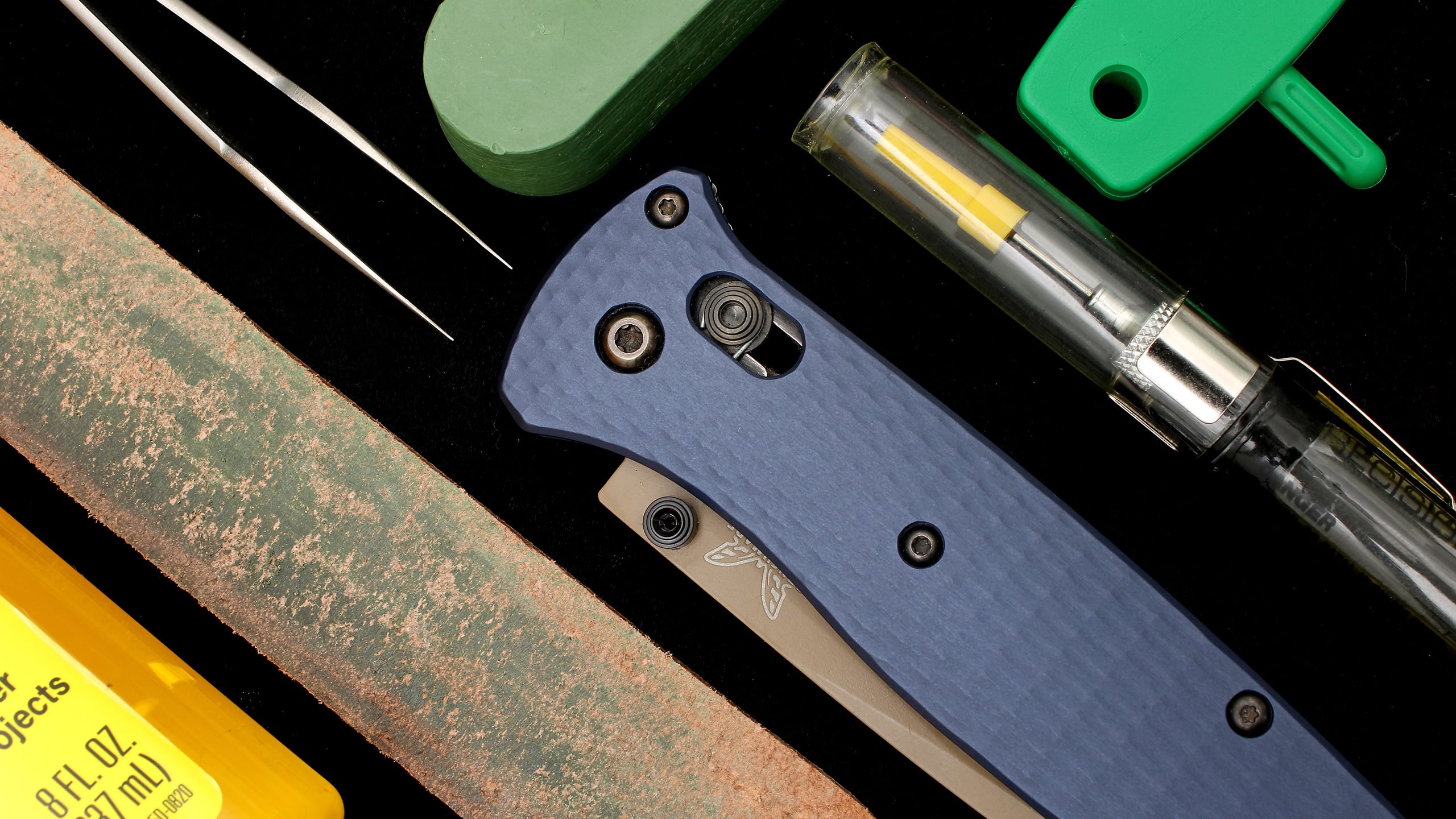
To me, there’s nothing quite as sad as a well-made machine not being used in the role for which it was created. Life’s too short for Corvettes that only sit in climate-controlled garages, beautiful timepieces that won’t ever be strapped to a wrist, or “safe queen” 1911’s that never see trigger time. By the same token, I know far too many people who don’t carry or use the knife they want because they don’t want to muck it up or dull the factory edge.
While today’s tips won’t do anything to keep your cutting tools in showroom condition (though if you ask me, a little honest surface wear has a beauty all of its own), it will help those of us who have been a little resistant to use our “nice knife” — whether it was gifted to us or whether we spent a little more on a design or super steel that caught our attention.
Just like a firearm, a quality knife will most likely outlast you and you needn’t fear putting it to work. Here are some of the tips and tools you’ll need to keep your knife sharp and well-maintained.
Taking Care of your Edge
I’ve written before about the difference between honing, sharpening, and stropping. These are three very different techniques, and the best one to employ depends entirely on the state of your blade. I’d recommend giving that a read, but to parse it here, I’ll provide a flow chart that should take care of most users and contexts.

If you remember your blade being pretty sharp a couple days back but it seems to be losing its bite now, you’ll most likely want to strop it. If you can’t ever remember the last time your knife was cutting cleanly and efficiently, or if you can visibly see chipping or deformity on the blade, a sharpening is probably in order. (And you can probably get by for now without a honing steel.)
When choosing a strop, I’d recommend choosing one of decent size that comes with a bit of polishing compound. I like the leather strop kit from Knafs, which lays flat and is perfectly textured for the job. Amazon is filled with cheaper strops, but almost always they’re micro-thin pieces of leather glued to a length of cheap wood.

There are almost as many opinions about sharpeners as there are knives, but I really like Work Sharp’s Angle Set system, which balances affordability, user-friendliness, and versatility. If you can hold a knife blade perpendicular to the floor, you have the cognitive and manual skill set to sharpen effectively.
[Don’t miss Randall Wilson’s article on How to Sharpen a Knife for additional information.]
Also, avoid those pull-through knife sharpeners. Virtually all of them lack the ability to set your sharpening angle, and I find I almost always want an intermediate grade of grit between the “coarse” and “fine” grooves. A novice will quickly find they’ll make an edge worse off, and the few experts who can use them despite their limitations will always reach for something better.
Sticky Situations
Cutting open boxes is probably the single most frequent task most of us are going to use our knives for (and in a close second place, breaking those same boxes down). As far as cutting tasks go, all of those boxes can have an insidious effect on your blade’s performance.

While cardboard is more abrasive than a person might think and will dull most edges given enough cutting, it’s really the packaging tape that’s the biggest pain in the rear. As your knife gets worked under the various flaps and seams of a shipping box, it’s going to come into contact with all kinds of sticky adhesives that will literally glue bits of thin plastic and gummy detritus to the cutting edge. In aggregate, I’ve found that tape is the single biggest culprit of my knife turning into a wedge.
This isn’t a job for honing, stropping or sharpening. To the contrary, a bottle of Goo Gone or Goof Off will de-gunk your blade in a hurry. Acetone will also work, but it runs the risk of dissolving or discoloring plastic if you’re not careful with the application. I also find that nail polish remover is usually so diluted that it doesn’t match the effectiveness of a specialized adhesive remover.

Live The Armory Life. The latest content straight to your inbox plus an automatic entry to each of our monthly gun giveaways!
By the same token, it’s nice to have a can of compressed air at the ready, along with some tweezers and toothpicks. If there’s an EDC knife that sees pocket time, you’ll quickly find that lint will make its way between the liners and around the pivot. Gently removing this flotsam will ensure easy deployment: you can either gently displace it with the tweezers or toothpick, or blast it out with the air can. The can of air is also great for those times when the knife might get really cruddy, like the inevitable drop into a muddy puddle on a rainy day. You can flush out the grime under running water, then blast away the moisture with compressed air out to make sure nothing rusts.
Keep Things Running Smoothly
Just in the same way that a firearm needs proper lubrication, so too does a folding knife. The vast majority of quality folders these days will utilize some variety of washer or set of caged bearings on either side of the blade itself; reducing friction here will ensure that the knife isn’t sluggish when you need to deploy it.

The good news is that whatever gun oil you have handy will work well on the pivot of your folder. In the past, I’ve used knife-specific oil (it helped that a container of it came free as part of a sales promotion for one of the bigger retailers), but it isn’t a must-have. If you have some in the kitchen, mineral oil is also a decent choice, since it won’t degrade over time. (In fact, if you’re one of those maniacs that has no qualms about using your EDC knife to cut a hamburger in half, a food-grade oil might be a good idea.)
I do like using a precision oiler, however. Considering both the relatively small size of a typical folder and the fact that it’s going in my pants pocket, I don’t want the tool slathered in oil. Instead, it’s nice to be able to put a drop right on top of where the blade stock meets the washers. I’ll work the knife open and closed a few times, wipe off any excess, and it’s usually good to go for several months.
Also, how do you know if your knife needs oiling? Again, it’s much the same as a firearm: if the action feels gritty, if you can hear the sound of metal rubbing against metal, or if it just feels like there’s too much friction involved, give it a few drops of whatever’s handy.
Tighten It Up
If you’ve carried a knife continuously for a few months, it’s not uncommon for things to get a little loose. Again, the right set of tools will make the knife feel brand new once more.

Today, most manufacturers have standardized the screws used in knife design. The pivot screws are usually a Torx size T8, and you’ll find that the smaller screws holding the knife together are most commonly a size T6. You could get an el-cheapo set of Torx bits, but once you deal with a stripped screw or bit that rounds over given the merest amount of pressure, you’ll rue not spending a few more dollars.
In the spirit of “buy once, cry once,” I strongly recommend any of the Torx bits or wrenches made by Wiha. They’re usually only about ten bucks more expensive than the faceless Amazon brands made from alloys unknown, and I’ve yet to mess up either a bit or a screw after I made the jump to their tools years ago.

Also, when it comes to tightening, don’t overdo it. Really cranking down on the pivot screw will often introduce excessive friction into the action, making just about any folding knife extremely difficult to open. I’ll usually tighten just enough to remove any wobble or lateral slop that might be creeping in, and I’ll test to ensure smooth functioning once the screw is close to being fully seated.
Though you can certainly use those same Torx bits or wrenches to completely disassemble the knife for service, there’s usually little reason to. (It may also void your warranty, depending on the maker, so exercise caution.)
Final Thoughts
While the tips and tools above aren’t exhaustive, they should address the majority of users who might be a little apprehensive about dulling an edge or getting a nice knife a little dirty. Most issues that arise with a cutting tool from a well-known manufacturer are very easily addressed by the end user, and there’s no small amount of pride that comes with being able to keep your tools maintained.
Past all of that, I’ve found that I appreciate the build quality and durability of my high-end knives a lot more when they actually get used for the tasks I encounter over the course of a day. And, if I ever need those tools for defensive or emergency use, I have the peace of mind of knowing they’re as sharp as I can get them.
Editor’s Note: Be sure to check out The Armory Life Forum, where you can comment about our daily articles, as well as just talk guns and gear. Click the “Go To Forum Thread” link below to jump in!


