


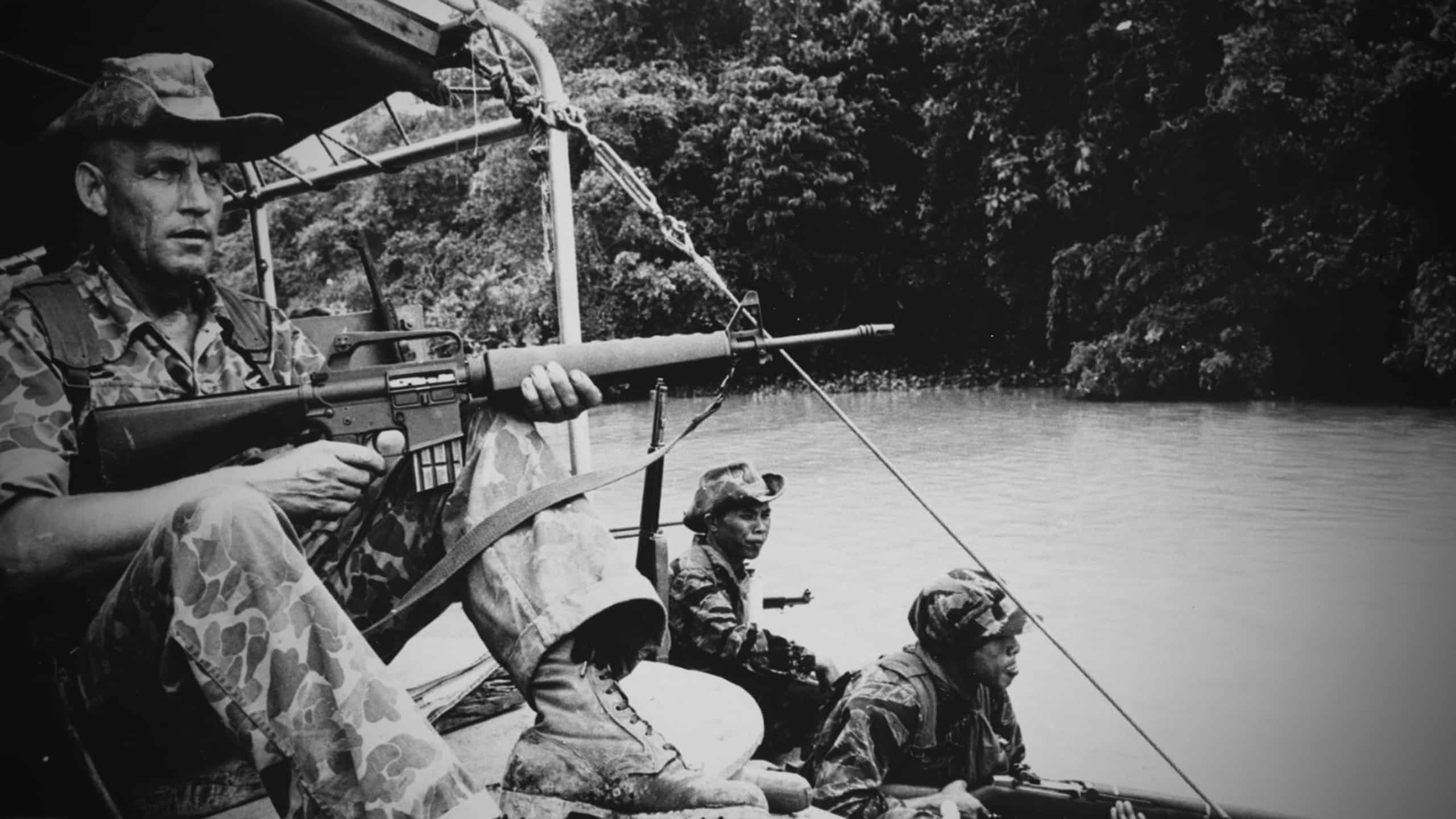
In the late 1950s, there were basically two camps in the U.S. military on what the next service rifle should be — those who thought a service rifle should be made of wood and blued steel and wanted a modified version of the M1 Garand, and those who thought the future of the modern service rifle was with forged aluminum and polymer furniture.
While the 5.56mm AR-15 today is so common and accepted that it’s viewed as the “standard” in self-loading rifle design, it is easy to forget how revolutionary it was in its day. In the 1950s (and before the AR-15 was introduced), there was the AR-10 battle rifle.
This radical approach to military rifle design used forged aluminum receivers — an upper and a lower — that were mated with a stock made of polymer — essentially plastic. The caliber was 7.62×51 mm NATO, the same as the M14, but it used a gas-operated, straight-line rotating-bolt system, which offered less recoil than the M14. In addition, it employed a direct gas-impingement system. While it might have come from the same era as the M14, it seemed like it was from a different planet in those days. [Read more about the M14 history.]

The military bureaucracy was at a stalemate with its heels dug in. A lot was at stake, especially the lucrative government contract. Adding more drama to an already tense and passionate situation, the U.S. military saw the potential benefits of a high-velocity .22-caliber cartridge rather than the more ponderous — but capable — 7.62x51mm round.
To address this, the AR-10 was scaled down to the .223 cartridge and the AR-15 was born. However, the M14 community was still not budging. The M14 had the benefit of a proven design based on the Garand, as well as truly capable, if somewhat traditional, chambering. Despite the fact that the AR-15 and the 5.56×46 mm NATO cartridge had shown great promise in initial testing, the U.S. military’s choice of the M14 over the AR-10 (as well as the FAL) had solidified the wood and steel rifle in the role of primary service rifle for the United States military — for now.

However, the “aluminum and plastic” upstart would soon gain the upper hand. As is well known, the AR-15 platform eventually prevailed. So, let’s consider that journey.
In hindsight, it was easy to see that the AR-15 would ultimately prevail. Prior to the AR-15 becoming the M16, other factors shaped the evolution of our approach to warfare and the tools used to fight. Let’s take a 10,000-foot view of defense policy in the post-WWII era.
Cold War, Nuclear War, or Guerrilla Warfare?
After WWII and the first use of nuclear weapons, the role of the infantry soldier was thought to be played out in a nuclear battlefield. The nuclear arms race post-WWII had both sides rethinking what a post-nuclear war landscape would look like.

Thankfully, the Cold War-era struggle did not take the form of an atomic mushroom cloud. Counterinsurgency was the new strategy in the unique form of warfare that developed with two opponents armed to the teeth with nukes. Since direct combat was not feasible (as it would effectively end our civilizations), proxy warfare became the norm in hotspots worldwide.

Live The Armory Life. The latest content straight to your inbox plus an automatic entry to each of our monthly gun giveaways!
America’s approach was to help these countries fight communism by arming, teaching, and supporting our allies in limited wars in their own nations. Hence, rather than atomic stockpiles of weapons, an old-fashioned arsenal of specialized small arms became the focus. Throw in a few advisors for training, and you have a recipe for the Vietnam War.
Project Agile Is Approved
While the Advanced Research Projects Agency (or “ARPA”), tucked under the broader Defense Department umbrella, was originally organized to research ballistic missiles, in 1961, the Kennedy administration — with an interest in supporting our foreign allies in limited wars to stop communist aggression — approved Project Agile.

Project Agile was designed to help remote areas of the world with counterinsurgency action against communist insurgents. Two areas, both in Indochina, were identified as under threat to Communist aggression. One was in Bangkok, and the other was in Saigon.
The average height of a Vietnamese soldier was five feet, and he weighed about 90 pounds. The ARPA was convinced by the original manufacturer of the AR-15 that the gun had a great deal of potential as a rifle for Vietnamese fighters since it was lightweight, capable and soft recoiling.

ARPA requested AR-15s for this effort, only to be denied because there were plenty of M2 Carbines in storage that could be issued without spending budget on new guns. The M2 Carbine was also lightweight and ideal for operators with small statures. The ARPA reintroduced its request and suggested that a limited number of AR-15s be used. They settled on asking for 1,000 rifles to only be used in Vietnam (and not Thailand), and the rifles would be tested against the M2 Carbine.
[Be sure to read What’s the Difference Between the M16A1 and M16A2?]
There were many other subprojects under Project Agile, such as ones that dealt with communications and logistics, as well as planning. However, the ARPA report for the AR-15 was titled “Task 13A” and compared the M2 Carbine to the AR-15 “to determine which is more suitable replacement for other shoulder weapons in selected units of the Republic of Vietnam Armed Forces (RVNAF).”
The Result
I don’t need to tell you the outcome. You already know the AR-15 performed best with the “small stature of the Vietnamese soldier…”. We all know that the taller U.S. advisors liked how the new rifle performed, too. While the test helped ARPA in one of its many projects assist counterinsurgents by confirming the superiority of the AR-15 to the M2 Carbine, it also proved the readiness of the AR-15.

Analysis of the AR-15 from both U.S. Advisors and Vietnamese commanders reported the AR-15 as “extremely favorable.” The lethality of the .223 round proved to be extraordinary. Users had a high respect for the AR-15 and preferred it to all other firearms available.

The first AR-15s in country did not have a forward assist, which is how the Air Force (the first adopter of the design) wanted the gun. The Army, however, insisted on a forward assist and originally designated the rifle the XM16E1; after the details were worked out, it was designated the M16A1.
Conclusion
The testing under Project Agile was the first time the rifle was used in Vietnam. In 1964, America’s broader involvement in Vietnam was officially begun with Congress passing the Gulf of Tonkin Resolution, which authorized direct U.S. military involvement in the nation. The rest is history.
Editor’s Note: Please be sure to check out The Armory Life Forum, where you can comment about our daily articles, as well as just talk guns and gear. Click the “Go To Forum Thread” link below to jump in!