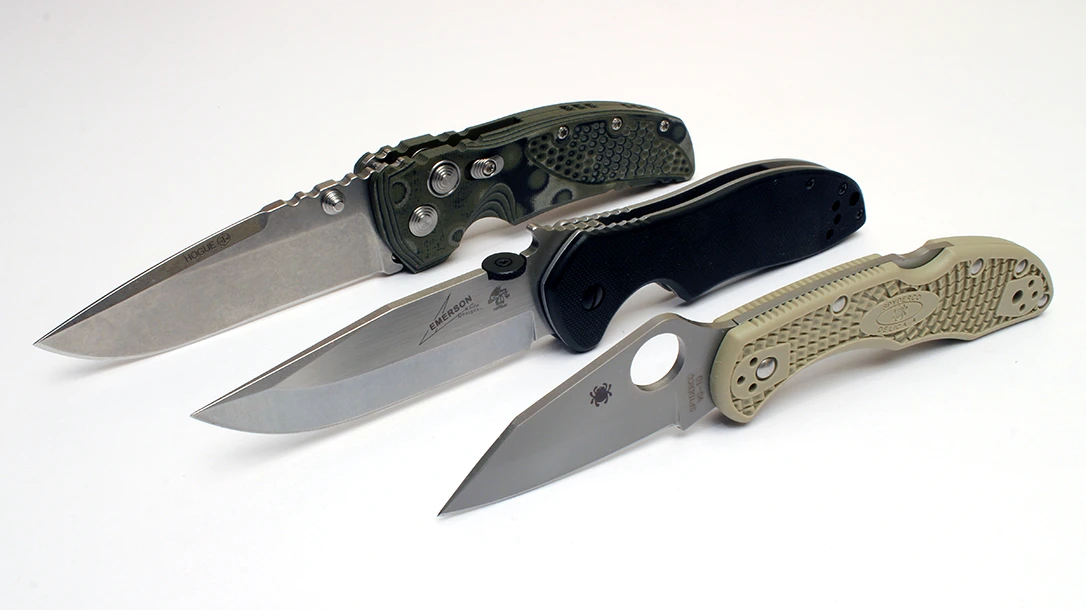
As an instructor of edged-weapons tactics, one of the most common questions I get is “What’s the best self-defense knife?” The answer to that question isn’t actually a knife. It’s a process. We’re all different, and we live and travel in different areas, so there is no one-size-fits-all choice. When choosing a knife—in this case, a defensive folder—that best meets your personal needs, here’s a quick 10-step guide to that process.
Choosing a Defensive Folding Knife
Step 1: Research the Law
The first step in choosing any carry knife should be to research the laws in your area and the areas you frequently travel. One of the best ways to do this is with the Smartphone app “Legal Blade.” Available free at app stores and maintained by KnifeRights.org, it’s a great way of researching both state and local laws to find out what you can legally carry.
Step 2: Define Key Characteristics
Based on your legal research, the next step is to define the key characteristics of a knife that’s legal in your area. This includes blade length, number of edges, types of folding knife actions, and any other criteria specific to the laws. Make a checklist of what you’re looking for, and use it when evaluating potential carry knives.
Advertisement — Continue Reading Below
Step 3: Choose a Blade Style
Unless your training in knife tactics dictates a specific knife design, stick with the basics and look for a blade shape that cuts and punctures effectively. Avoid profiles with excessive “belly” or curve to the edge. They tend to limit both the cutting power and penetration.
Step 4: One-Hand Opening
A defensive folder must have the ability to be brought into action quickly and reliably using only one hand. Blade holes, thumb studs, and disks do this well, as does the Emerson “wave” feature. “Flipper” openers require a more tenuous grip and complex motor skills. So, they are not a great choice for defensive folders.
Advertisement — Continue Reading Below
Step 5: Choose a Lock
All defensive folding knives should have strong, reliable locks that also allow the blade to be easily opened. A good lock should also engage fully, even when you open the knife dead slow. This is a useful tactic if you have the time to “prep” your draw before trouble starts. Its design should also prevent your hand from applying pressure that could unintentionally release the lock with a tight grip.
Step 6: Handle Shape and Texture
The handle of your knife should be comfortable, devoid of any hot spots or sharp edges. Likewise, it should be large enough for you to get a secure grip with your entire hand. To ensure that you can maintain a secure grip and manage impact shock, it must also provide good traction. Slippery knife handles are a no-go.
Step 7: Clip Position
To draw your folder at a moment’s notice, it must be carried in a way that is instantly accessible. The best way to do that is with a pocket clip that presents the knife so it can be drawn and opened without adjusting your grip.
Advertisement — Continue Reading Below
Step 8: Blade Steel
Defensive knives are carried constantly but rarely cut anything. As such, corrosion resistance is more important than long-term edge holding. Any high-quality stainless blade steel will do just fine.
Step 9: Invest in Quality
If you’re going to trust your life to a defensive tool, don’t go cheap. Invest in respected brands and quality products that won’t let you down when you need them most.
Step 10: Choose a Knife with a Matching Trainer
Finally, in my opinion, you have no business carrying a knife for self-defense if you don’t actively train to use it properly. To that end, the quickest way to “cull the herd” of defensive folding knives is to choose the ones that have matching, mechanically identical training knives. This is less than one percent of the market and narrows the field fast.
Advertisement — Continue Reading Below
So, there you have it, a quick and dirty guide to choosing a defensive folding knife. Again, there is no ultimate “right” choice. There’s only what’s right for you, your needs, and your training.