


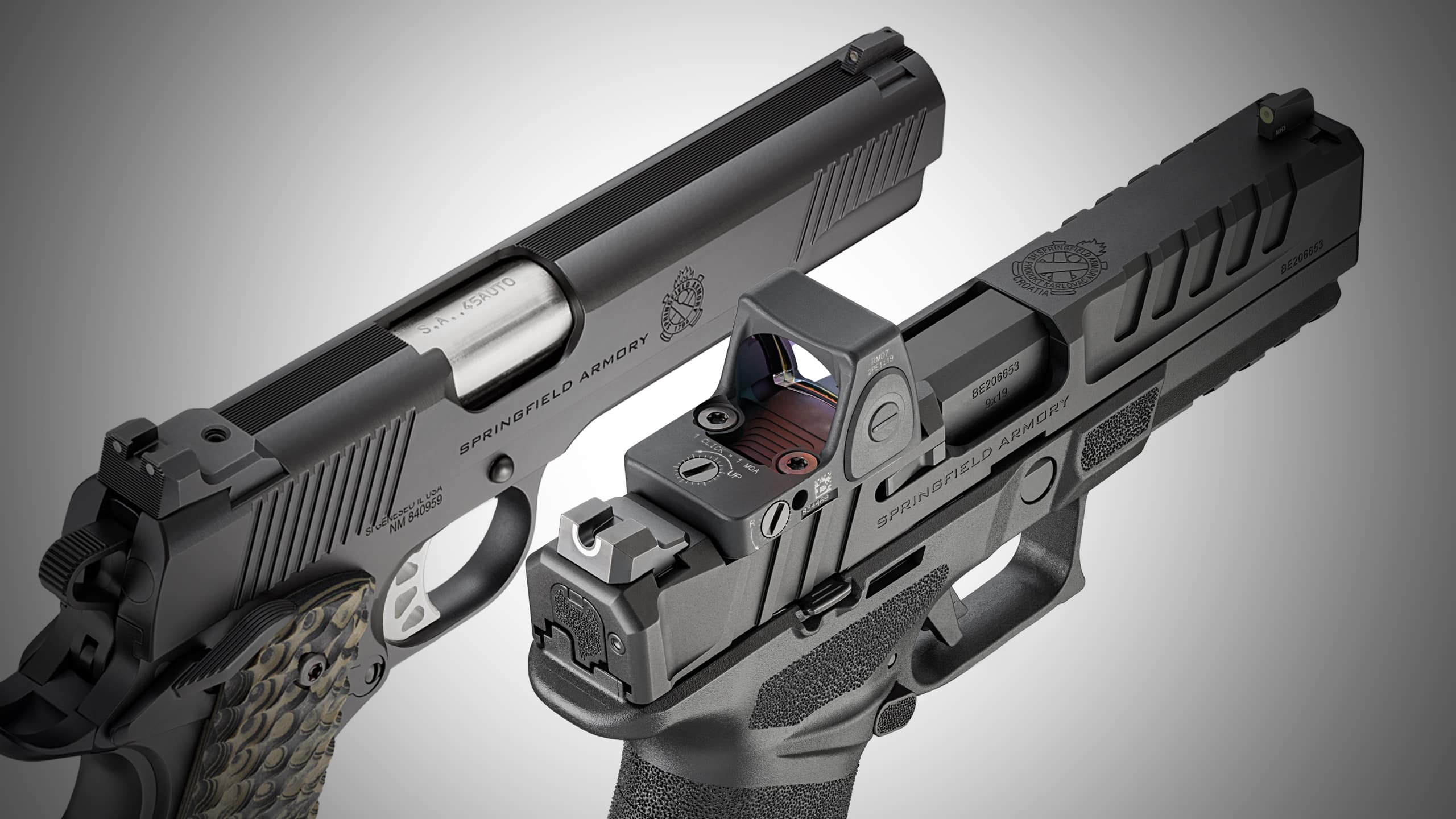
The person choosing a semi-automatic pistol today has three basic types to choose from: single-action (usually hammer-fired), double-action (usually hammer-fired), or striker-fired. Each has its own attributes, its own strengths, and its own weaknesses. Let’s take an overview.
The single-action only (SAO) came into use in the 1890s with the Mauser “Broomhandle” C96, which saved Winston Churchill’s life at the Battle of Omdurman in 1898, and the Borchardt, which morphed into the iconic Luger. These pistols were carried “cocked, locked, and ready to rock,” ready to fire with a short, easy trigger pull and a manual safety engaged until it was time to shoot. The longest-lasting and most classic example of this type was the 1911 pistol designed by the great John Moses Browning.
The double-action semi-auto bears that name because a pull of the trigger performs a double function, first cocking and then dropping the hammer to discharge a shot. These break down into two styles. Traditional double action (TDA) fires only the first shot with a long trigger pull that performs the double function of both cocking the hammer and releasing it, and is self-cocking thereafter by the autoloading mechanism with subsequent shots fired with an easy “single action” trigger pull. Thus, TDA is also known as DA-SA. Double-action only (DAO) means the pistol decocking after every shot, requiring a longer, heavier double-action pull for every round.

The striker-fired pistol essentially has a striker that is a firing pin released by a mechanism other than a hammer strike. Today’s striker guns usually have trigger pulls that, in terms of both length of pull and weight of pull, are between those of the single- and double-action hammer-fired pistols.
Parameters of Choice
Handgun choices are made for different reasons. First, who will be using them — highly trained personnel or rank and file with less extensive shooting experience? When the single-action 1911 .45 was standard military issue, the Army’s super-highly trained Delta Force carried them cocked and locked with a round in the chamber, while ordinary GIs and MPs were generally instructed to carry them with the hammer down on an empty chamber. When the issue gun for the military was the TDA M9 9mm, GIs carried on-safe with an empty chamber, Marines carried on-safe with a round in the chamber, and the U.S.A.F. had a chambered round with the safety off. Today, with striker-fired, manual safety-equipped pistols standard, the practice seems to be round in the chamber and safety off unless loading or unloading, across the board.

Do you want a pistol that’s optics-ready? In general, you’ll have a much wider choice among the striker guns than the hammer-fired (although Springfield’s 1911 AOS family is changing that dynamic).
Do you want pure accuracy? In my opinion, the advantage goes to (well-made) hammer-fired single action. It’s hard to beat the most accurate variations of the 1911, which rules in the centerfire categories of Precision Pistol competition and is still a dominant force in action pistol shooting. Note that the 1911 seems to regularly win the national championship of NRA Action Pistol, the Bianchi Cup, which has been called “the Wimbledon of pistol shooting.”

Economy? Advantage: striker. These pistols are generally made with polymer frames and are much less costly to manufacture, and therefore less expensive to the end user, you and me. Though there are exceptions, most hammer-fired pistols have steel or aluminum frames, more expensive in terms of both raw materials and manufacturing processes.
Simplicity of operation? Definitely, advantage striker. Insert magazine. Rack slide. Press the trigger when it’s time to shoot. No decocking lever and no thumb safety to remember, and no long, heavy trigger pull for the first shot.

Adjustability for hand fit? While custom stocks are available for most hammer-fired guns, polymer-framed striker guns offer much more modularity. For example, consider the Springfield Armory Echelon that comes with three complete grip modules plus three different-sized backstraps. Advantage: striker.
Weight? Advantage goes to the striker guns, which generally have polymer frames as opposed to the usual steel or aluminum frames of hammer-fired pistols. While the advantage seems to be accumulating on the striker’s side, the hammer guns can move to the front in other respects.
Safety
There are many dimensions to safety. Is the gun drop-safe? We all proudly say “I never drop my guns,” but first, none of us is a perfect human being incapable of making a mistake or experiencing a fumble. Second, if we are a cop wearing plainclothes and aren’t readily identifiable while holding a criminal at gunpoint, responding officers will only see one unknown person pointing a deadly weapon at another and will order us to drop the gun. If we don’t, we may well be shot. So, a “drop-safe” gun is simply a good idea.

Using the Springfield Armory catalog as an example, all their 1911 pistols are designed to minimize and prevent the risk of unintentional discharge should they be dropped. This is thanks to Springfield’s policy of using light titanium firing pins that are designed to minimize the risk of inertia discharge. The same is true of their polymer-framed striker guns, from the XD series to the Echelon, through the use of passive firing pin blocks. It’s similarly true of most of the currently produced double-action autos out there. Advantage: none, with current production, they’re pretty much equal.
Does the gun require an intentional pull of the trigger to discharge? That’s the safest. However, there is a potential risk of a self-inflicted gunshot injury while holstering a gun, should something affect the trigger before the gun stops moving. Here, the advantage is definitely to the hammer-fired gun, so long as the shooter holds their thumb firmly on the hammer to hold it in place during the holstering process.

Live The Armory Life. The latest content straight to your inbox plus an automatic entry to each of our monthly gun giveaways!
The cocked and locked on-safe 1911 resists that because the safety is “on” and blocks the trigger pull, but even if the safety is in the “off” position, the thumb holding the hammer back can catch it before the gun discharges. A double-action auto with the hammer down, if the thumb is pushing down on it, can’t rise and therefore can’t fall.
And if the pistol has a grip safety, such as a 1911 or the Springfield XD series, the hand is no longer holding that grip safety “off” if the thumb is on the back of the slide, and the grip safety still keeps the gun from firing.
Ergo, advantage to the hammer-fired gun, or the rare striker pistol with either grip safety or thumb safety. Striker-fired pistols, being mostly geared to the “point gun, pull trigger” concept, are rarely found with thumb safeties. Springfield Armory, however, does offer the vast majority of their striker-fired guns with an optional manual safety.

One significant and often under-appreciated advantage of the SAO comes in weapon retention. The single-action only auto, such as the 1911 or the SA-35, has to be carried on safe if there’s a round in the chamber. Test studies and collective field experience alike show that if the Bad Guy gains control of the Good Guy’s gun and tries to shoot him with it, if he’s not familiar with that particular type of pistol, he has to fumble to get the safety off before he can commit murder. This buys several seconds for the Good Guy to rectify the situation. Of course, most of the time the Bad Guy has brought his own weapon, so the Good Guy must learn to thumb the safety into the “fire” position before the defensive shot.
The Matter of Trigger Pull
It’s not quite as simple as a bell curve. The single-action auto has a short, relatively light trigger pull, which is easy to shoot well. The double-action auto has a long, heavy pull for the first shot on a TDA and for every shot on the DAO. This requires the shooter to master two different trigger pulls. It can be done, but it takes a dedicated shooter to get good with the system.

A striker-fired pistol is sort of in the middle of the bell curve. Your Echelon or XD series Springfield will have a light but palpable take-up before the shot, and a good trigger break for the shot itself. It will be quick and easy to learn.
The Bottom Line
Every choice is a balance of pros and cons. Each individual must be honest with themselves about their commitment to practice and familiarization before they choose.
The good news is that, unless we are limited to an institutionally required handgun, we have the freedom to pick the one we want and prefer.
Editor’s Note: Be sure to check out The Armory Life Forum, where you can comment about our daily articles, as well as just talk guns and gear. Click the “Go To Forum Thread” link below to jump in!

