


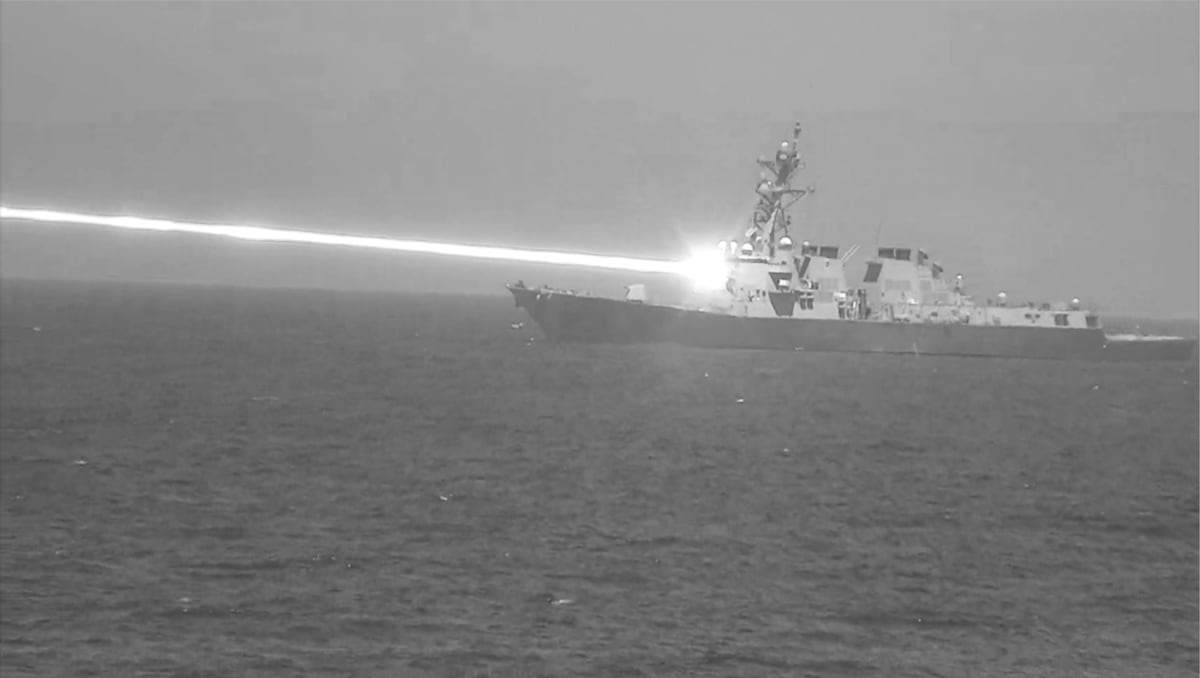
The Navy’s top officer issued a directive to get high-energy lasers into sailors’ hands as soon as possible to adapt to the modern combat environment.
Chief of Naval Operations Adm. Daryl Caudle released his 10th C-NOte on Wednesday, saying the service needs to incorporate directed energy technology sooner rather than later to combat a threat environment in which mass-produced, low-cost drones challenge traditional munitions.
“The question is no longer whether these systems work—it is how quickly we can field them across the fleet and place them in the hands of sailors,” Caudle said. “For too long, we have viewed directed energy as an emerging technology rather than an operational capability. That must change.”
The announcement comes amid an Iran war that has seen the Navy and U.S. military at large use a significant portion of their missile interceptor stockpile while deterring ballistic missiles and drones.
The cost of using interceptors to destroy unmanned aerial systems at times exceeds the cost of the system itself, the message said.
Using lasers can help balance that ratio out.
The Navy can preserve those interceptors and other traditional ordnance for military operations that specifically require them and use directed energy to combat the proliferation of drone warfare.
This will help sustain the fight longer.
Directed energy weapons, like high-energy lasers and high-powered microwaves, can also be deployed to defeat small boats, surveillance platforms, and cruise missile threats.
The expansion of available weapons onboard the ship to include lasers will mean commanders will be tasked with deciding whether munitions or directed energy weapons are better suited for a target.
Ships will also need more electrical power to fuel the directed energy weapons, so the Navy fleet will need to consider this when designing ships for the future.
In the meantime, the continued implementation of the Containerized Capability Campaign will help accelerate the fleet’s education on using directed energy weapons, the administrative message said.
The ability to deploy the containers across multiple ships will shorten fielding timelines, streamline the installation process and allow sailors to experiment and learn the weapons.
The experience will allow service members to provide feedback that will help sharpen the Navy’s strategic usage of the weapon and help expedite the service’s development of directed energy weapons’ capabilities.
As adversaries hone their own laser weapons systems, the Navy must continue to strengthen its innovation in the field so that the lasers are combat-ready, the message said.
The containerized initiative was established by Caudle to bridge the gap between the current fleet’s limited fielding capabilities for lasers and the future. Specifically, the campaign allows for directed energy weapons to be deployed on platforms and ships without the need for major redesigns.
Caudle has previously told lawmakers that incorporating high-energy laser weapons could reduce the Navy’s reliance on missile interceptors and open up more space onboard for offensive weapons.
But bringing directed energy weapons into wider fleet use will require ships with significantly greater electrical power capacity, as well as other advances. Those requirements will need to be considered in future ship designs, Caudle said.
Riley Ceder is a Navy reporter at Military Times, where he covers issues directly affecting service members and their families, as well as breaking news.