Ask an experienced firefighter what happens during the first ninety seconds of a structure fire and you may hear something that sounds almost counterintuitive. While most people would struggle to process the noise, smoke, confusion, and urgency of the situation, trained responders often move with a level of calm that can seem almost unnatural to anyone watching from the outside.
It is tempting to describe that as bravery, but courage is only part of what is happening. Much of that composure was built long before the alarm sounded, through repeated physical training and through a quieter form of preparation that takes place entirely in the mind.
Firefighters often rehearse situations before they ever encounter them for real. They mentally walk through buildings, imagine where smoke may collect, consider what they will do if a stairwell becomes unusable, and picture alternate routes before those routes are actually needed. By the time they face the real emergency, parts of the situation already feel familiar because they have mentally visited similar versions of it many times.
The same type of rehearsal is available to ordinary people, and it does not require special equipment or professional training. Surgeons use mental preparation before difficult procedures, pilots rehearse emergency scenarios, athletes have relied on visualization for decades, and survivors of house fires, vehicle crashes, and medical emergencies sometimes describe reacting almost automatically because they had previously thought through what they might do.
That is the purpose of a mental walkthrough. You deliberately practice a realistic emergency while you are calm, safe, and able to think clearly, so that if something similar happens later, your mind is not trying to invent a response from nothing while stress is already taking over.
How your brain works when rehearsing
Imagining an action is not the same thing as physically performing it, but the two processes share some of the same neurological activity. When you vividly picture yourself reaching for a fire extinguisher, pulling the pin, aiming toward the base of the flames, and sweeping the discharge from side to side, parts of the brain involved in carrying out that sequence become active even though your body is not actually performing the movement.
The response is weaker than it would be during real physical action, but the sequence is still being rehearsed. With enough repetition, those steps begin to feel more familiar, which is exactly what makes mental practice useful.
Sports psychology has used this principle for decades. Basketball players visualize free throws without touching a ball, while elite skiers mentally run entire courses before competition, sometimes even leaning as they imagine themselves moving through turns. Similar concepts appear in military stress training, where repeated exposure to a scenario helps reduce the sense of total novelty when a comparable situation occurs for real.
For preparedness, however, the greatest advantage may not involve physical performance at all. The more important benefit can be the ability to make decisions faster when stress begins interfering with clear thought.
Acute stress reduces working memory, makes fine motor tasks more difficult, and can overwhelm the part of the brain responsible for carefully weighing several choices. A decision made ahead of time, while you are calm and able to think properly, does not have to be created again from the beginning during the emergency. Instead, your mind can retrieve a response that has already been considered and rehearsed.
The delay that gets people killed
One of the most dangerous misconceptions about emergencies is that people immediately panic when something goes wrong. In reality, researchers studying disaster behavior have repeatedly observed that many people do something quite different. They hesitate while trying to understand what is happening.
Passengers inside a smoke-filled aircraft may reach for carry-on luggage rather than immediately moving toward an exit. Office workers who feel a building shake may finish an email or lock their computer. Someone trapped inside a flooding vehicle may spend precious seconds trying to call 911 before attempting to open a door.
The dangerous part is the delay between recognizing that something unusual is happening and beginning an effective response. Faced with a situation it has never encountered, the brain searches for something familiar to compare it with, and when no useful template appears, it has to build a response while the clock is already running.
During an ordinary inconvenience, a few additional seconds may not matter. During a fire, flood, vehicle crash, or rapidly developing medical emergency, those same seconds can become extremely important.
Mental walkthroughs can shorten that delay by giving the brain something recognizable to retrieve. If a smoke alarm wakes you at two in the morning, you are not mentally starting from a blank page if you have already imagined waking up disoriented, checking the bedroom door for heat, gathering family members, and switching to a window exit if the hallway cannot be used.
The emergency will still be frightening, and real conditions may not match your imagined version perfectly, but at least your first useful decision has already been considered before the crisis begins.
What makes a walkthrough useful instead of idle worry
Simply thinking about disasters does not automatically count as preparation. There is an important difference between useful mental rehearsal and repeatedly worrying about bad outcomes.
Worry usually focuses on the frightening event itself and remains there. You imagine the fire, the crash, the intruder, or the injured family member, but the thought never develops into a clear sequence of useful actions. The result is anxiety without a workable response.
A proper mental walkthrough moves through the problem instead of circling around it. You encounter the emergency, identify what must happen next, make decisions, carry out the necessary actions in your mind, and continue until the situation reaches a defined endpoint.
Sensory detail makes these exercises far more useful. Instead of simply imagining that there is a fire and you escape, picture the room as it would actually look when you wake up. Hear the smoke alarm, imagine the smell in the air, feel the floor beneath your feet, and visualize yourself reaching toward the door.
The exercise should also be experienced from your own point of view. Rather than watching yourself from the outside as though you were observing a movie character, picture the situation through your own eyes and imagine seeing your own hands reaching for the flashlight, the door handle, or whatever equipment you need.
Finally, the scenario needs a clear ending. Do not stop once you have imagined the dangerous part. Continue until the fire is under control, the family has reached the rally point, the bleeding has been stopped, or the damaged vehicle has been moved to a safe location.
Running the sequence at something close to realistic speed also matters. If you constantly skip from the opening moments directly to a successful ending, you avoid rehearsing the decisions and actions that matter most. Moving through the sequence step by step creates a rhythm that may become easier to follow later.
Building your first walkthrough
Begin with one specific problem rather than trying to imagine several disasters at once. A nighttime house fire is a useful starting scenario because it develops quickly, requires immediate decisions, and provides plenty of opportunities to identify weaknesses in your existing plan.
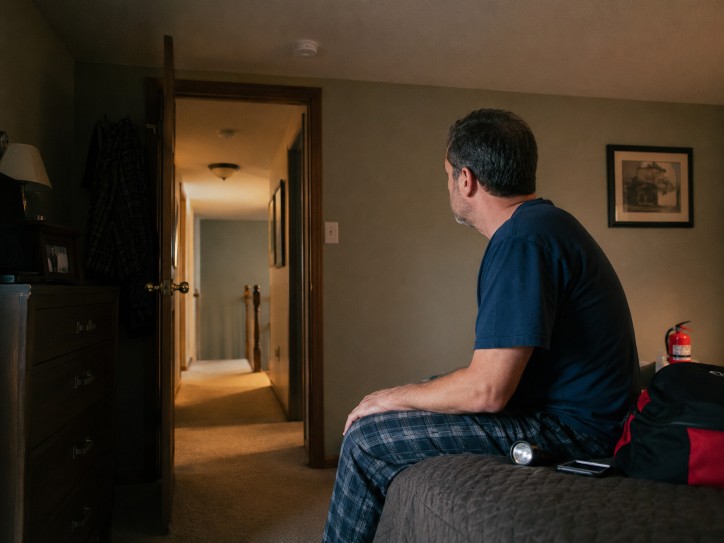
Sit somewhere quiet and begin with the trigger. Imagine hearing the smoke alarm while you are asleep, then picture yourself waking up confused and trying to understand what is happening. Notice which side of the bed you are on, where the bedroom door is, and what the room looks like from that position.
Next, reach for the items you expect to need. Think about where your phone and flashlight are located. If you suddenly realize during the walkthrough that the flashlight is not actually within reach of the bed, you have already discovered a problem worth fixing without having to experience a real emergency.
Continue through the escape sequence deliberately. Approach the door, check it, and decide what you will do based on what you find. Picture yourself getting low if smoke is present, moving toward the children’s rooms, and counting doors if visibility becomes poor.
Do not end the exercise with the vague idea that everyone somehow gets outside. Picture the exact location where the family is supposed to gather, whether that is a particular tree, mailbox, driveway entrance, or nearby property. Finish the walkthrough only after everyone has been accounted for and someone is calling for emergency assistance.
Once the basic version feels familiar, make it more difficult. Imagine that the hallway cannot be used, the emergency window refuses to open, one child is not in the expected bedroom, or your spouse is away from home and you must handle the situation alone.
Each variation adds another possible response to your mental library and forces you to think beyond the easiest version of the plan.
Scenarios worth running early
Mental practice should focus first on emergencies that could realistically affect your household. For many American families, useful scenarios include a kitchen fire, a serious vehicle crash where you are the first person on scene, cardiac arrest, severe bleeding, a nighttime home intrusion, dangerous weather arriving with only a short warning, and a multi-day winter power outage.
Ordinary emergencies deserve just as much attention as dramatic ones because they may be considerably more likely to happen. Becoming separated from a child in a crowded public place, having a vehicle break down on a rural road after dark, or receiving a call that a family member has been hospitalized can all create confusion and stress if nobody has thought about the response beforehand.
Workplaces and travel create another useful category of walkthroughs. Whenever you spend time in an unfamiliar building, make a habit of noticing the exits when you arrive. Once you are seated, take a few seconds to think about how you would leave from your current location if the route you used to enter suddenly became unavailable.
These exercises do not need to become elaborate or obsessive. The point is simply to build awareness before you need it.
Add friction on purpose
The easiest way to make a mental drill unrealistic is to allow everything to work perfectly. If your flashlight always has fresh batteries, the phone always has service, every family member follows instructions, the vehicle starts immediately, and every planned exit remains open, you are rehearsing a version of the emergency that may be much easier than the real thing.
Useful practice requires deliberately breaking parts of your own plan. Imagine that your phone is unavailable because the battery is dead or the network has failed. Place the emergency at the worst possible time, block the main exit, or assume the vehicle refuses to start.
You can also introduce an injury and see how much the plan changes. Imagine trying to respond with a badly cut hand, a twisted ankle, or vision partially obscured by smoke.
Then add the unpredictable behavior of other people and animals. One family member may freeze instead of moving, another may argue, a pet may hide, and your hands may shake badly enough that simple equipment becomes difficult to operate.
The purpose is not to make the exercise frightening for its own sake. These complications expose assumptions that may otherwise remain hidden until a real emergency proves them wrong.
Every failure discovered during mental rehearsal is a problem you have the opportunity to solve while the consequences are still zero.
Practice with your family
Mental walkthroughs can also work well as short family exercises. Instead of making the subject grim, bring up a realistic scenario during dinner and ask each person what they would do.
Children may respond particularly well when the exercise is presented as a puzzle rather than a warning about terrible events. Their answers can reveal weaknesses that adults overlook because adults often assume that everyone already understands the plan.
Ask questions that require specific responses. If the house catches fire and family members leave through different doors, where exactly should everyone meet? Who is responsible for the dog? What should a child do if they smell smoke and the adults do not wake up? Which neighbor should they approach if nobody from the household is home?
Specific questions lead to useful decisions, while broad questions often produce answers that sound reassuring but provide little practical guidance.
These sessions do not need to last long. Ten focused minutes every couple of months can reinforce useful information more effectively than forcing the household through a long emergency meeting that everyone eventually begins to dread.
Turn mental drills into physical drills
Mental rehearsal has obvious limits because imagination cannot tell you whether every part of your plan actually works. Some assumptions only reveal themselves when you physically test them.
Walk your planned escape route in darkness and see whether you can identify doors and turns by touch. Open the emergency window instead of simply assuming that it works. Time how long it actually takes the household to leave the building and reach the agreed meeting location.
Emergency equipment should also be handled rather than merely stored. Take a tourniquet out of its package and practice applying it properly, start the generator, use the chainsaw, and become familiar with the fire extinguisher under safe and controlled conditions.
Equipment that seems simple while sitting unopened on a shelf can become surprisingly confusing the first time you actually try to use it. Discovering that problem on an ordinary Saturday afternoon gives you time to correct it before the equipment is needed under pressure.
Physical drills and mental rehearsals work best together. Hands-on practice exposes weaknesses in your assumptions, while mental walkthroughs help maintain familiarity with the corrected procedure during the weeks or months between physical training sessions.
Where people go wrong
One common mistake is repeatedly practicing only the scenarios that already feel comfortable. People naturally prefer situations they believe they can handle, while avoiding the emergencies that genuinely frighten them.
Those more difficult scenarios may deserve the most attention, although they should be approached gradually. If mental rehearsal begins producing genuine distress rather than useful preparation, there is little value in forcing the exercise.
Another mistake is designing plans around an unrealistic version of yourself. During a mental drill, it is easy to imagine being fully alert, calm, coordinated, and capable of making perfect decisions. During the real event, you may have been asleep only seconds earlier, your hands may be shaking, your thinking may be slower than normal, and you may drop or fumble equipment.
A useful emergency plan should still function when you are frightened, tired, confused, and operating below your best. If the plan only works when you are calm and sharp, it is not robust enough to depend on.
People also make the mistake of keeping every plan entirely in their heads. Mental rehearsal may make a procedure familiar to you, but other members of the household still need access to the same information.
A short-written checklist kept somewhere obvious, such as on the refrigerator or with emergency supplies, can preserve the essential steps for anyone who has not personally rehearsed the scenario as often as you have.
Conclusion
Mental rehearsal requires no special equipment, costs nothing, and can be practiced whenever you have a few quiet minutes available. Even a short weekly session devoted to one realistic emergency can expose weaknesses, clarify important decisions, and make useful actions feel more familiar before stress interferes with your ability to think clearly.
That kind of preparation may improve your family’s response more than simply adding another case of freeze-dried food to a basement that is already well stocked.