


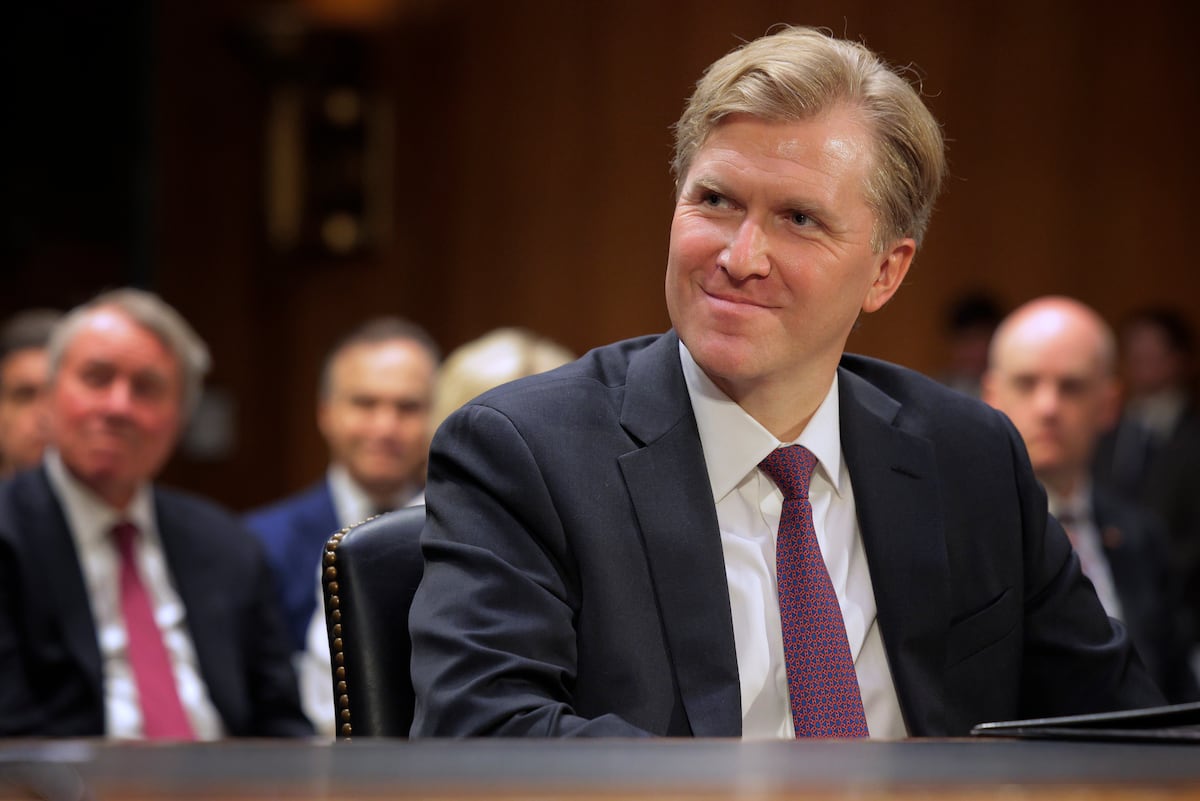
MANILA, Philippines — A senior Pentagon official pushed back against reports that the U.S. military’s stockpiles and capabilities are strained following Operation Epic Fury, while reaffirming Washington’s commitment to the Indo-Pacific amid China’s increasingly assertive military activity in the South China Sea.
Department of War Undersecretary for Policy Elbridge Colby made the remarks in Manila on Monday amid growing concerns that China has been narrowing the gap — or eclipsing — U.S. military capabilities, as its demands in the Middle East have potentially drained stockpiles.
“There’s been a lot of news about the United States military being stretched. Please don’t be misinformed,” Colby told Manila’s defense and security elites at a closed-door event organized by the Stratbase Institute think tank.
“The United States military, and especially including those [maritime and aerospace] capabilities, are ready and capable of filling the priority missions that the president has given to them,” Colby said.
Colby, one of the Pentagon’s leading strategists, has pushed to prioritize the Indo-Pacific and East Asia over the Middle East and Europe. The Manila stop is the first in a week-long Southeast Asian tour that includes visits to Indonesia, Thailand and Cambodia.
His visit also comes amid an increasingly tense period between Manila and Beijing following a confrontation in Second Thomas Shoal on July 20, when Chinese personnel hit and wounded a Philippine Navy sailor in the head.
The incident triggered another tit-for-tat between Manila and Beijing over the contents of a highly classified “provisional agreement” reportedly signed in 2024 that allows Philippine vessels to safely deliver supplies to troops stationed aboard the BRP Sierra Madre floating outpost.
After last month’s incident, officials noted that China has appeared more assertive, indicating a shift in how China perceives the implications of the mutual defense treaty.
Tensions have also intensified as China has routinely deployed carrier strike groups in the West Philippine Sea, and last month, fired a submarine-launched ballistic missile toward the Pacific.
While military deterrence forms one component of the U.S. strategy in the Indo-Pacific, Washington is employing a “strategy of strong, clear, but quiet” action designed to address the challenge without altering the status quo, according to Colby.
“In terms of our relationship with China, I think we’ve been able to communicate…our approach directly to Chinese counterparts,” Colby said.
“We combine a clear diplomatic line, a policy of respect towards the People’s Republic [of China], clarity about…our being in favor of the status quo, along with…strength in terms of being willing to defend our interests and those of our allies like the Philippines,” he added.
Apart from strengthening the U.S.’ forward posture and fielding combat-credible forces, Colby noted that measures are being set up, albeit quietly, to allow for the U.S. to come to the Philippines’ aid.
Colby described the U.S. approach to the region as “defensive” and “aligns with the interests of regional states.”
“We’re not trying to dominate this whole region. It’s a strategy of denial, designed to deny any state the ability to become the regional hegemon,” Colby said.
The visit comes a week after the Pacific Command and the Philippine armed forces signed an eight-point partnership plan for 2027, which includes an undisclosed series of joint military exercises, and before President Xi Jinping’s state visit to the U.S. in September.
“If you are trying to project power, whoever you are, into the aerospace and maritime environment in the Indo-Pacific, you are going to come up against the very best military in the world at its apex predator status,” Colby concluded.