


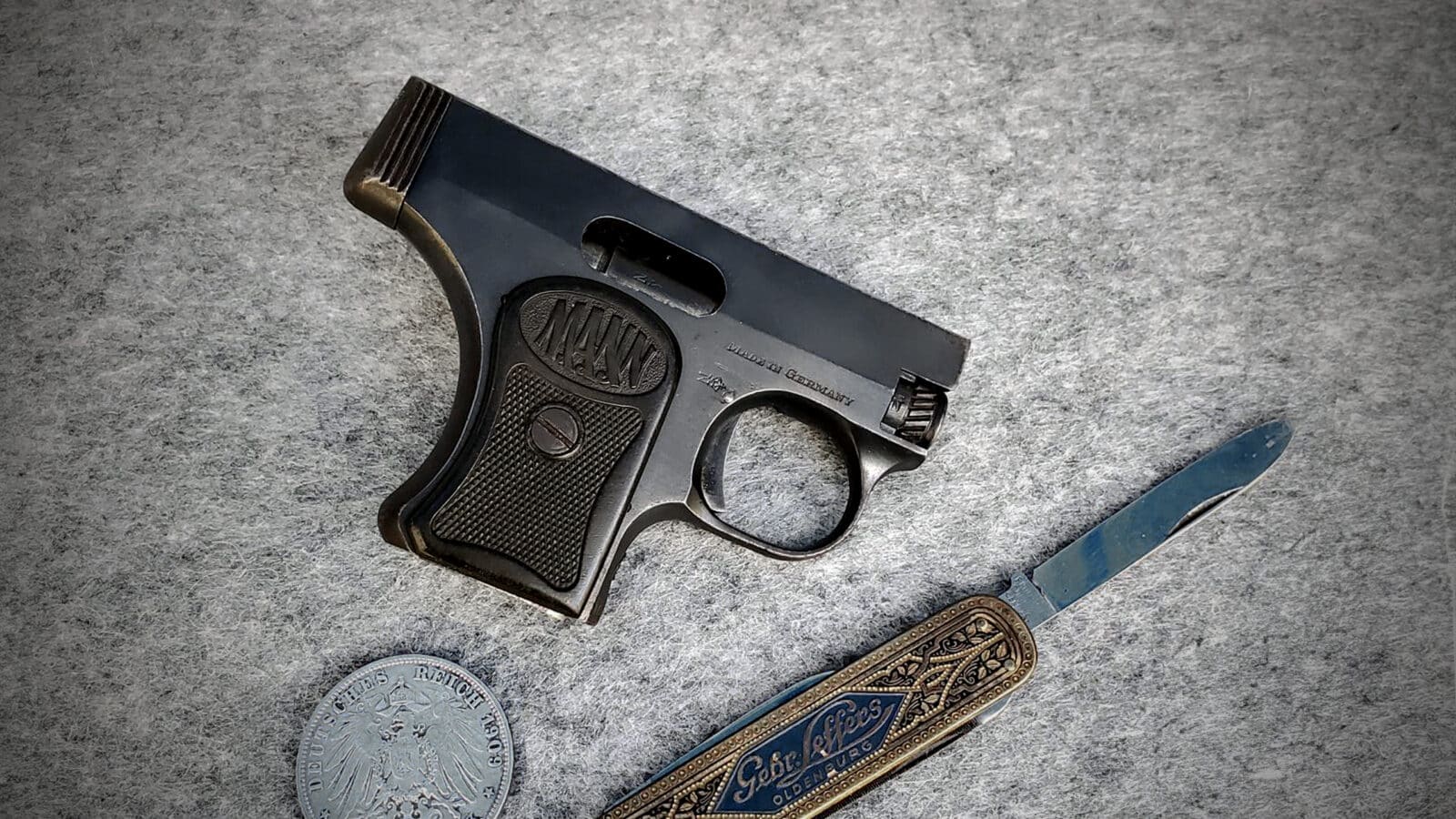
In 1896, Fritz Mann opened for business in Suhlerneundorf, Thüringen, as the Fritz Mann Feinmaschinen — Waffen — und Werkzeugfabrik. This translates to Machinery — Weapons — and Tools factory. Fritz also produced small engines, ski accessories, helmets, and auto parts.
In 1918, at the end of World War I and the abdication of Kaiser Wilhelm, Fritz Mann ventured into the firearms trade to dominate the vest-pocket pistol market.
At the time, small concealable pistols were all the rage, and the FN Model 1906 was perhaps the most popular vest-pocket pistol of the day. It featured a spring-loaded striker inside the breech block and was widely copied, particularly by Spanish gun manufacturers.

Fritz began work on the smallest, thinnest, most concealable .25 ACP pistol ever made, using his concentric-ring blowback principle, and in 1920, he introduced it to the world. The next year brought a few more changes and refinements, and it was redesignated the Fritz Mann Model 1921.
In 1925, with Mann’s brother, Otto, and son Willi on board, the company reorganized and became the Fritz Mann Maschinenfabrik Suhl-Neundorf.
Blowback Operating System Types
A blowback operating system uses energy from expanding gases to push the slide or bolt rearward and eject the spent cartridge case.

The straight-blowback system uses the mass of the bolt and tension of the recoil spring to hold the bolt or slide closed. A great example is the Springfield Armory SAINT Victor 9mm pistol.
There are also delayed-blowback operating systems. The Springfield Armory Kuna 9mm uses a roller-delayed blowback operation. The rollers in the bolt will lock, delaying rearward travel until chamber pressure drops to a safe level. For more information on these operating systems, check out this excellent piece by Robert A. Sadowski: “Know Your Blowback? Roller Delayed Vs. Blowback.”
Chamber Ring Delayed Blowback
Since Mann wanted the lightest pistol possible, these types of blowback systems were out of the question. Fritz came up with the idea of Chamber Ring Blowback, which is the heart of the pistol. This system allowed the elimination of a slide from the design, which contains the breech block.

The Mann design uses a concentric ring machined in the chamber. When a round is fired, the pressure forces the case to flood into this ring, bulging it and delaying the chamber’s opening. In this manner, the pistol does not require a slide to operate.
Fritz Mann Pistol Design
The design of this pistol is obviously quite unique. The frame is a single piece of steel, with no slide. The design uses a moving breech block. On top of the frame is a channel used as a sight with a small front sight. As this pistol was designed for close-in personal protection, the sight seemed to be more of an afterthought.

Above the barrel, the recoil spring and guide rod are attached to a cocking knob at the rear of the pistol. The external cocking piece is also attached to the bolt and striker tube.
The safety is located on the left side of the pistol, marked by a capital “S & F”. This only disengages the trigger bar, as there is no firing-pin safety. The Mann pistol has a loaded chamber indicator on the left side.

If a round is chambered, a pin on the exterior of the ejector protrudes through the frame. If the safety is in the “safe” position, the pin protrudes behind it, making it more difficult to move into the “fire” position. If the safety is in the fire position, the shooter can feel the pin and verify that a round is chambered.

Live The Armory Life. The latest content straight to your inbox plus an automatic entry to each of our monthly gun giveaways!
The magazine release is located on the front of the grip near the bottom. Its placement there was another way to keep the pistol slim without having a magazine release protruding from the side.
The first variant of the Mann pistol was manufactured in 1920. These early guns came with aluminum grips, while 1921 models used hard plastic grips with the Mann logo embossed in an oval.
The frame uses a T-shape to keep the pistol compact, and the barrel placement features a low bore axis.
Patents Galore
Fritz Mann received four patents for the design of this pistol. The locking breech that uses a rotary bearing on the barrel for quick removal, the indirect safety for the trigger bar, the combined ejector and loaded chamber indicator, and the chamber groove.
Barrel

The barrel is manufactured with a 3mm-wide x 0.1mm-deep circular groove in the chamber. It’s beveled, with no sharp edges to prevent a case rupture. The barrel is easily removed. After pulling the cocking piece rearward, the barrel is rotated 90 degrees counterclockwise and pulled out.
Magazine
The five-round magazine for the Mann pistol is made of a very thin metal. Once again, this was done to maintain the pistol’s slim design. They are nickel-plated, with four holes on the side for a visual round count. The baseplate is held in place by flanges that are bent over from the sides of the magazine tube.
Field Stripping the Fritz Mann Pistol
- Ensure the pistol and magazine are unloaded.
- Pull the trigger to unlock the striker.
- Pull the breech to the rear, turn the barrel 90 degrees counterclockwise, and pull out the barrel.
- Unscrew the bolt spring and remove the guide rod.
- Unscrew the cocking knob and remove the striker and spring.
- Remove the grips and trigger bar, with the safety lever in the middle position.
- Remove the trigger assembly and magazine catch.
- Remove the indicator pin and ejector.
- Pull out the breech assembly through the front part of the frame.
Operation
After the loaded magazine is inserted, a round is chambered by pulling the cocking piece to the rear, allowing the spring to drive it forward. As the bolt goes into battery, the trigger lever engages the out-of-battery scallop cut on the bottom of the bolt. The end of the case pushes against the loaded chamber indicator.

After the round is fired, the cartridge casing expands to fill the concentric ring cut into the chamber. Now that the case has expanded, the extractor cannot remove the casing from the breech until the pressure drops and the casing returns to near its original shape. The ejector ledge then kicks the casing out, and another round is fed in.
Fritz Mann Model 1921 Specifications
- Type: Pistol
- Caliber: .25 ACP
- Action: Chamber ring blowback
- Overall Length: 4.1”
- Barrel Length: 1.65”
- Height: 2.7”
- Width: 0.56” at the top, and 0.74” at the grips.
- Weight: 0.5 lbs.
Legacy
While the Fritz Mann Pistol was an ingenious design, it unfortunately was not popular enough and production of the Model 1921 was discontinued after only four years.

In Autumn 1923, Mann designed a conventional-style pistol in .32 ACP and 9mm that looked strikingly similar to the FN 1906. Unfortunately, it wasn’t enough to keep the company afloat. With a combination of Weimar inflation and World War II on the horizon, the company folded in 1938 after producing approximately 20,000 of the 1921 pistols and approximately 4,000 of the .32 and 9mm pistols.
Editor’s Note: Be sure to check out The Armory Life Forum, where you can comment about our daily articles, as well as just talk guns and gear. Click the “Go To Forum Thread” link below to jump in!