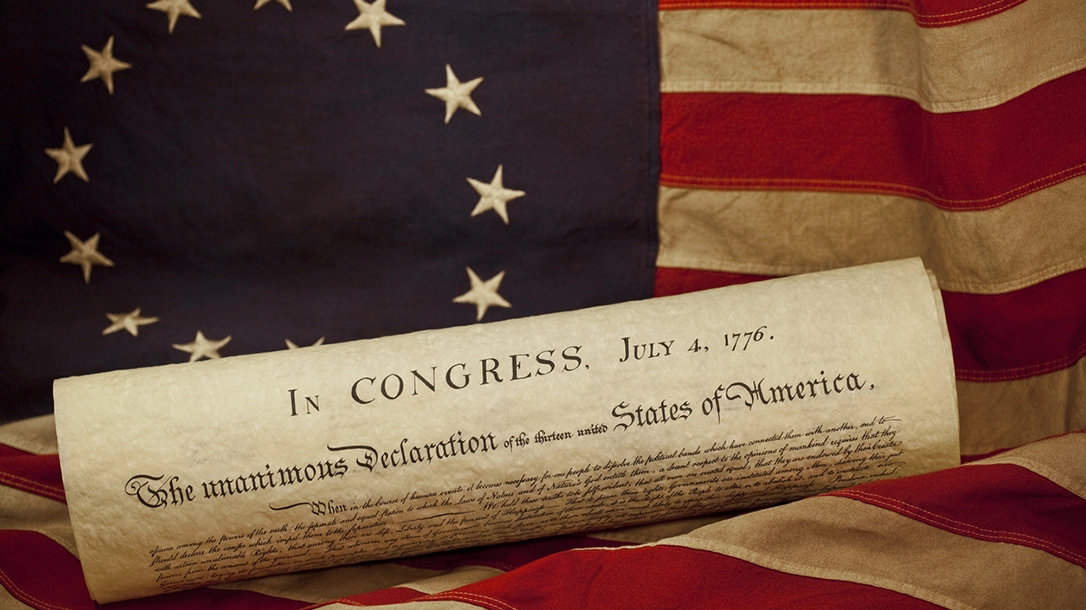
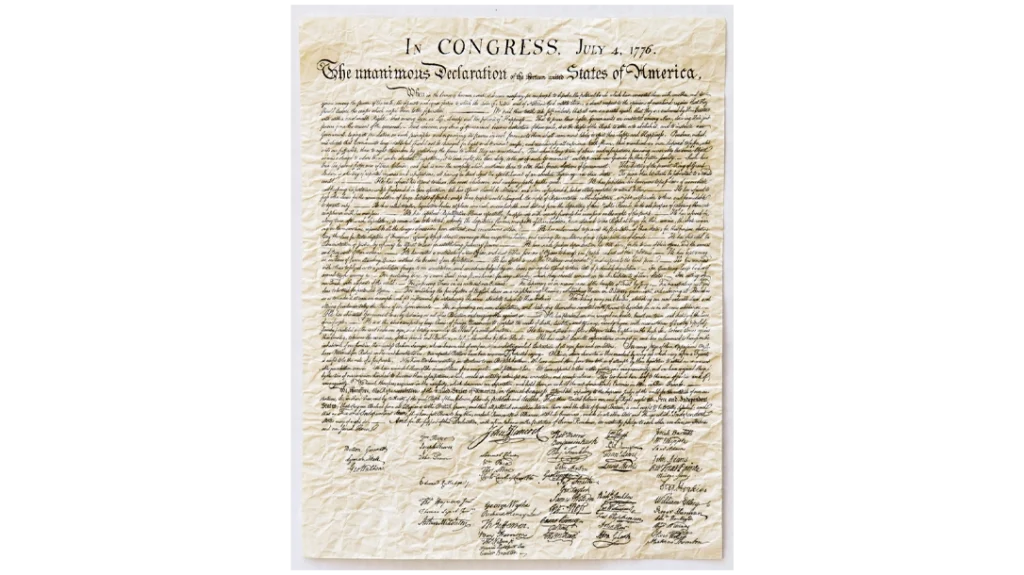
“In Congress, July 4, 1776. The unanimous Declaration of the thirteen united States of America.”*
The Declaration of Independence opens with those lines. The wording is significant. The Continental Congress’ previous correspondence with King George III had taken a different tone entirely. See if you can spot the difference:
“We, his majesty’s most loyal subjects, the delegates of the several colonies of…” – The Articles of Association, 1774.
“We, your Majesty’s faithful subjects of the Colonies of…” – The Petition to the King, 1774.
“We, your Majesty’s faithful subjects of the Colonies of…” – The Olive Branch Petition, 1775.
The delegates of the Second Continental Congress, in the Declaration of Independence, addressed themselves to the king not as subjects, but as free citizens, for the very first time. Also note that “States” replaced the word “colonies.” The Declaration established the former colonies as a new nation of free citizens who no longer knelt to a king.
The Declaration Of Independence Made it Official
The American Revolution had been a hot war for over a year before the Declaration of Independence was even proposed. April 19, 1775 witnessed the first shots at the Battles of Lexington and Concord. Patriot forces quickly took Fort Ticonderoga on Lake Champlain, hauling its guns to Boston to besiege the British garrison there. Congress soon dispatched George Washington to take command. The Battle of Bunker Hill raged on June 17 of that year.
Advertisement — Continue Reading Below
Congress signed the Olive Branch Petition on July 8, 1775. It was a last-ditch effort to end the fighting and peacefully resolve the colonists’ differences with the Crown. The petition was ignored, and the war continued, spilling into New York.
The Virginia legislature sent Richard Henry Lee to Philadelphia with a new resolution. He presented it to Congress on June 7, 1776, stating that, “These United Colonies are, and of right ought to be, free and independent states…” Congress accepted the resolution, but voted to delay debating it for three weeks. John Hancock, President of the Second Continental Congress, appointed a “Committee of Five,” consisting of Thomas Jefferson, Benjamin Franklin, John Adams, Robert Livingston, and Roger Sherman, to draft a declaration of independence.
Advertisement — Continue Reading Below
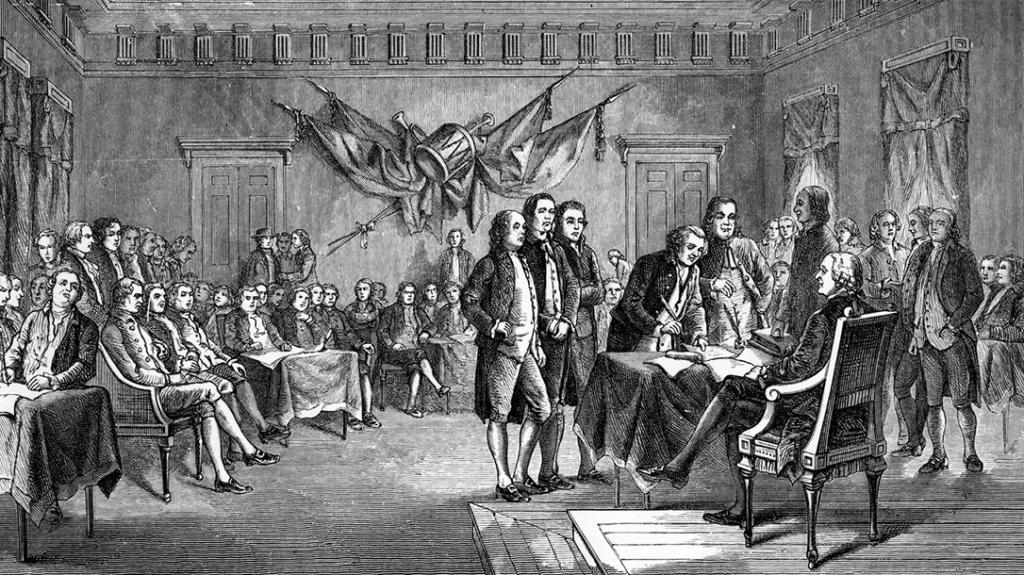
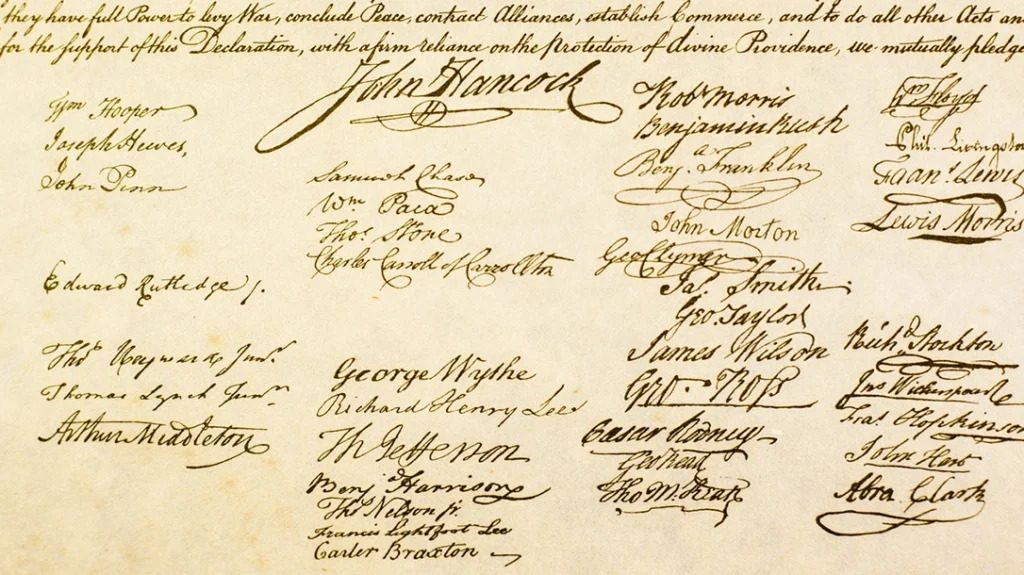
The Committee of Five presented the proposed declaration to Congress on June 28, sparking a marathon debate and several significant changes before formally adopting the final draft on July 4. Most people believe the Declaration of Independence was signed on July 4, but Hancock didn’t attach his famous signature until August 2, followed by most of the other signers. Others signed even later, with several not doing so for months or even years.
The final draft was then approved to be printed on engrossed parchment for signature, which took time. But it became official on July 4, which is why we observe the nation’s founding on that date.
The Declaration of Independence States Our Founding Principles
Most Americans know what the Declaration of Independence is. Most also probably know what it did. But very few actually know what it says. The main body contains a long list of grievances directed at King George III. Those were, and are, extremely important. We find the seeds of the United States Constitution and Bill of Rights among them. But the Declaration’s most memorable and impactful passages are found in its introduction and its final sentence.
Advertisement — Continue Reading Below
“When in the Course of human events…”
The introduction’s first sentence, really a short paragraph, clearly changes the Founders’ allegiance from the British Crown:
“When in the Course of human events, it becomes necessary for one people to dissolve the political bands which have connected them with another, and to assume among the powers of the earth, the separate and equal station to which the Laws of Nature and of Nature’s God entitle them, a decent respect to the opinions of mankind requires that they should declare the causes which impel them to the separation.“
Advertisement — Continue Reading Below
Notice that Jefferson does not invoke a new nation’s laws, but rather “the Laws of Nature and…Nature’s God.” Americans, and their rights, were no longer subject to the whims of kings, but to Nature, as truly free citizens should be. This concept is exemplified by the Constitutional protection of such rights, instead of claiming to grant them.
This paragraph also states the reason for the list of grievances, which the Founders used to justify their actions to their countrymen, to the British, and to the world at large.
We Hold These Truths To Be Self-Evident
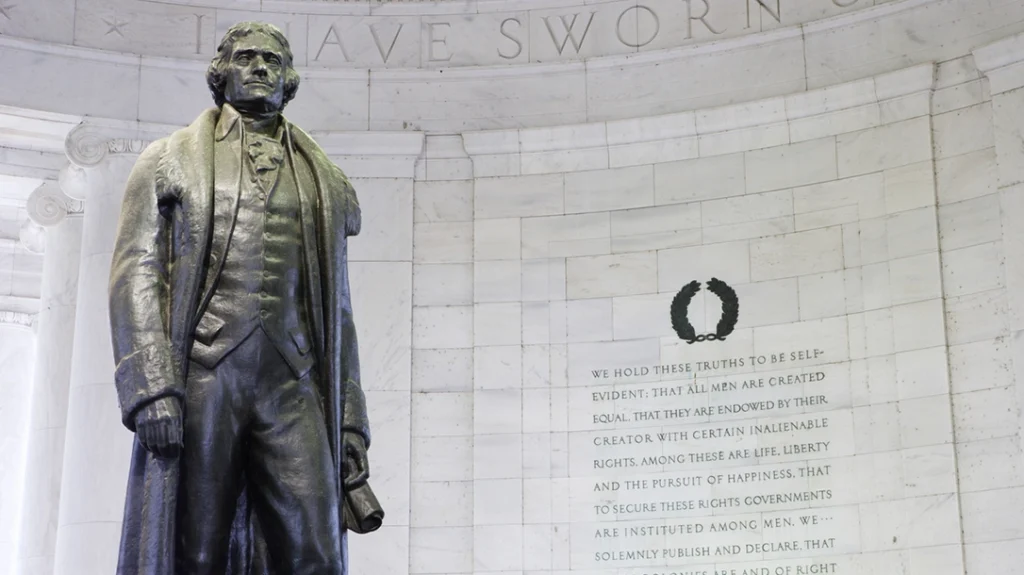
“We hold these Truths to be self-evident, that all Men are created equal, that they are endowed by their Creator with certain unalienable Rights, that among these are Life, Liberty, and the Pursuit of Happiness…”
Advertisement — Continue Reading Below
This long paragraph goes on to assert that governments are “instituted among men” to secure those unalienable rights. Again, we see the concept of a government protecting rights, not granting them. It also addresses the right and the duty of the People to throw off any government that “becomes destructive of these Ends,” meaning the protection of its citizens’ rights.
Jefferson cautions against changing a government for “light and transient Causes.” He knew that such actions lead inevitably to turmoil and should only be undertaken when a government, after “a long Train of Abuses and Usurpations, pursuing invariably the same Object, evinces a Design to reduce them under absolute Despotism.” The People are then compelled “to provide new Guards for their future Security.” There’s the protection of rights concept one more time.
Advertisement — Continue Reading Below
The ensuing list of grievances seeks to demonstrate that King George III’s policies toward the North American colonists were indeed “destructive of these Ends,” thus justifying the formal separation from the Crown.
“Our Lives, Our Fortunes, and Our Sacred Honor”
“And for the support of this Declaration, with a firm Reliance on the Protection of divine Providence, we mutually pledge to each other our Lives, our Fortunes, and our sacred Honor.”
Those weren’t empty words. Had the Revolution failed, every one of the signers would have been convicted of high treason and publicly hung. They all knew it. They did it anyway. Rhode Island Delegate Stephen Hopkins supposedly said, “my hand trembles, but my heart does not,” as he signed the Declaration. Virginia’s Benjamin Harrison reportedly joked that should they hang, his being overweight meant that he would die quickly, while the thinner Elbridge Gerry of Pennsylvania would “kick in the air half an hour after it is over with me.”
Unlike today, statesmen were quite prominent in 1776. Not that they weren’t also politicians, but they were driven by more than mere partisanship. They also understood the importance of a united front. The delegates decided early on that any vote for independence must be unanimous. Even one dissenting vote would kill the motion.
The Founders understood that the Crown would exploit any dissenting colony, using it to undermine the others. The Revolutionary War was essentially a civil war anyway. Introducing a rogue colony into the mix would sink the entire enterprise, and the Founders knew it. Benjamin Franklin is said to have noted that “We must, indeed, all hang together, or most assuredly we shall all hang separately.”
But it wasn’t all dark humor. Pennsylvania Delegate Benjamin Rush asked, in an 1811 letter to John Adams, “Do you recollect the pensive and awful silence which pervaded the house when we were called up, one after another, to the table of the President of Congress, to subscribe what was believed by many at the time to be out own death warrants?” Statesmen indeed.
The way the delegates signed their names to the Declaration also demonstrates their concept of unity. When signing the aforementioned Articles of Association, Petition to the King, and Olive Branch Petition, the delegates all included the colony from which they hailed. Not so on the Declaration of Independence. They signed on behalf of the citizens of “the thirteen united States of America.” No longer colonies, but a new and unified nation. A significant difference.
The Declaration’s Most Glaring Omission
Long and sometimes bitter debate preceded the Declaration’s adoption. Delegates demanded and got numerous changes to Jefferson’s original text. The final document represents a series of compromises necessary to achieve the primary goal of declaring independence from Great Britain.
The most obvious, and famous, omission was the abolition of slavery. But even that was a compromise aimed at accomplishing the Declaration’s central purpose. Jefferson’s first draft did indeed abolish slavery. He believed the phrase “all Men are created equal” applied literally to all men. We can wonder how ardently he believed that, considering his failure to free his own slaves in years to come, but his initial draft did include it.
Slavery was the wedge that most significantly threatened unanimity. Edward Rutledge, who led the South Carolina delegation, was adamant that he would never approve the Declaration should it attempt to abolish slavery. His vote was crucial, and he also influenced the North Carolina and Georgia delegations, especially the former. One “no” vote, much less two or three, would kill the motion for independence.
John Adams argued passionately for abolition but, in the end, Rutledge got his way, and the clause was struck entirely from the draft. The Southern states forced same compromise at the 1787 Constitutional Convention. Slavery was kept alive in return for supporting votes.
Modern commentators routinely criticize the Founders and the Framers for those choices. Slavery was a blight on the new nation. That fact cannot be denied, but both groups were astute enough to do what they could when they could. The nation paid a heavy toll later, but men who understood that “all or nothing” is rarely a good policy position began the process in 1776. They achieved the primary policy imperative for which they strived: independence.
The Declaration of Independence
We celebrate the birthdate of the United States of America every July 4. And we should celebrate. Yes, there are some ugly parts to our nation’s history. Just like every other nation in the history of the world. But, in 1776, a rare group of men gathered in Philadelphia at what is now called Independence Hall. Against significant odds, they produced an extraordinary document that points us toward our highest aspirations.
We often fall short of those aspirations. We’re human, after all. But the United States, since its inception, has served as a beacon of what we can be, often in spite of ourselves. Millions of people have literally risked their lives to come here, leaving behind everything they’ve ever known. There’s a reason for that. There’s also a reason why so few people actually leave to go somewhere else, despite their rhetoric.
Abraham Lincoln famously called the United States “the last best hope of Earth.” That’s sometimes hard to see today. But Lincoln wrote those words in the depths of the nation’s worst crisis, when the nation was even more bitterly divided than we are now. Lincoln persevered, nonetheless, and the crisis of civil war eventually passed.
On this 250th Independence Day, we could all benefit from the Founders’ example of unity. They did what they could when they could and had faith in the future, pledging their lives, their fortunes, and their sacred honor to one another. We must find a way to do the same if we hope to persevere, as Lincoln did. If we don’t, “most assuredly we shall all hang,” together or separately.
Happy 250th Independence Day.
* Capitalization, punctuation, and even spelling rules were not yet standardized in 1776, nor were certain terms and titles that we take for granted today. For instance, “United States of America” was not yet the nation’s official name. Jefferson, in his draft, referred to the fact that the “States,” which he purposely capitalized, were “united” in their purpose of declaring independence from the British Crown. The word “united,” in this case, is an adjective, not part of the actual title, which came later.
I have therefore rendered all quotes faithfully, remaining true to the original intent and usage for that time.