


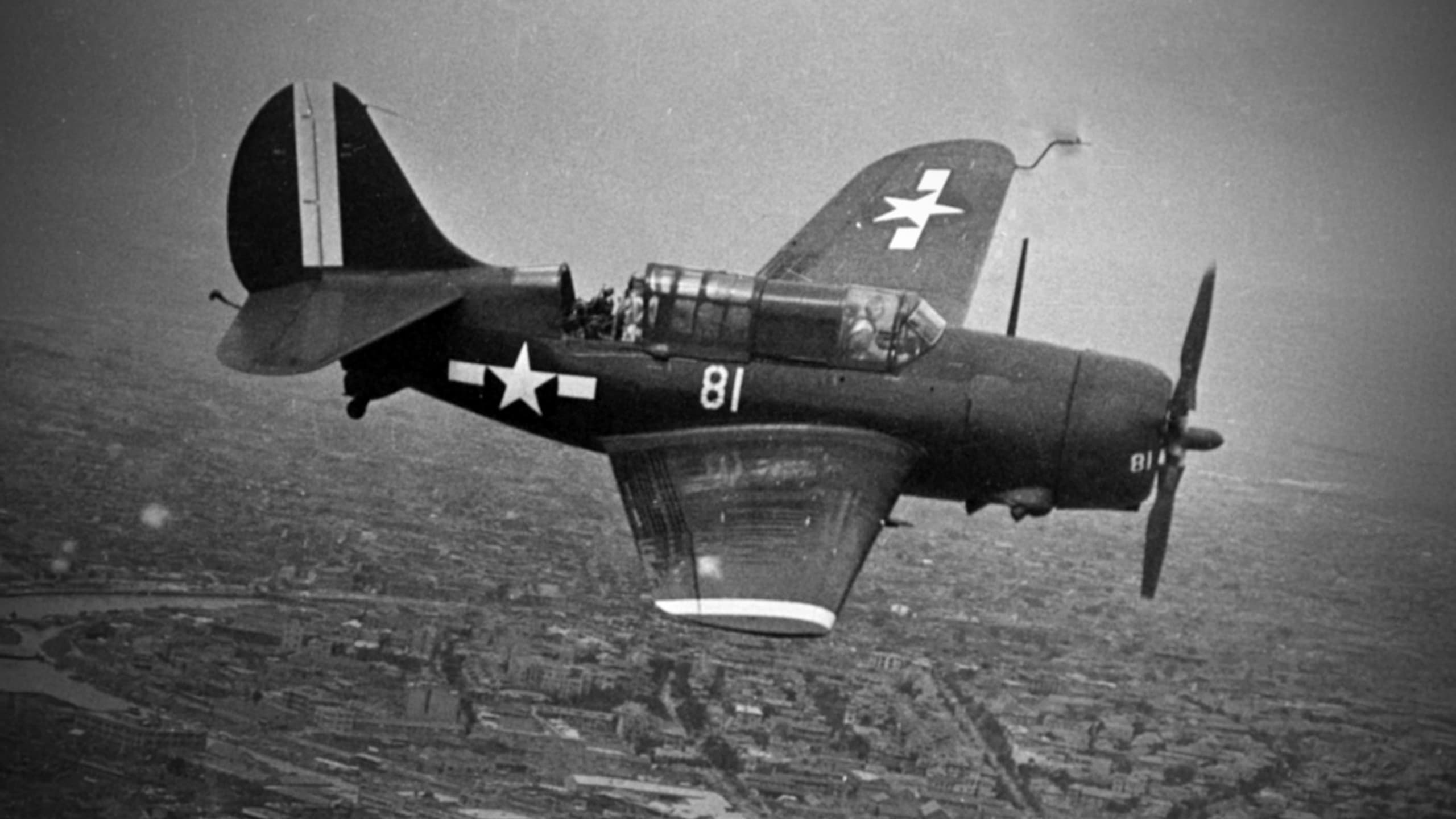
In 1937, the Curtiss SBC Helldiver entered service, but even at that point, the carrier-based two-seat scout/dive bomber was on the verge of being obsolete. Interestingly, it was also the second aircraft produced by Curtiss-Wright to earn the designation “Helldiver” after the United States Marine Corps’ version of the Curtiss Falcon, operated by the U.S. Navy as the F8C Falcon.
The name was recycled just six years later with the Curtiss SB2C Helldiver 2, a carrier-based dive bomber designed to supplement and replace the Douglas SBD Dauntless.
To suggest it had a rocky start and a less-than-stellar service life would be a severe understatement. Still, it went on to be produced in large numbers and saw extensive service in the Pacific Theater. It initially earned a reputation for poor handling, structural flaws, and unreliability. Yet, it became the primary dive bomber in service at the end of the Second World War, with its success attributed as much to the skill and bravery of the pilots as to the aircraft.

It took time for the Helldiver to be proven in action, and it went on to become an effective carrier-launched dive and torpedo-bomber in the war against the Imperial Japanese Navy (IJN). Its troubled development and aforementioned issues led to the aircraft earning the unfortunate moniker “The Beast,” while some pilots suggested the designation SB2C meant “Son of a bitch, second class.”
The Helldiver’s failures also contributed in a small part to the decline of Curtiss-Wright, which failed to adjust to the post-war aircraft designs and sold its assets to North American Aviation in 1948.
Hard Act to Follow
Aviation historians have argued that the core of the SB2C Helldiver’s troubles began with the SBD Dauntless. Although that aircraft was antiquated when America entered WWII and was very much in need of a replacement, it also meant there were huge shoes to be filled. The Dauntless wasn’t the right plane needed to win the war, but it was an aircraft that kept America in the fight.

Being the designated successor to the Dauntless left very little room for error, of which there was no shortage with the Helldiver.
Part of the problem was that the United States Navy also needed a war-winning aircraft, and it needed it quickly.
Development of the Helldiver began before America entered the Second World War, where it followed a series of increasingly capable (and sometimes less capable) aircraft that quickly came and went.
Curtiss SB2C Helldiver: The Last Dive Bomber
From the late 1920’s, the U.S. Navy and USMC saw a need for a dive bomber, which led to the development of the Curtis F8C Falcon and subsequently the aforementioned Curtiss SBC Helldiver. Dive bombers would be antiquated by the end of the Second World War, but in the 1930’s, numerous military planners saw their capabilities.

Even as Curtiss was working on the P-40 Warhawk and P-36 Hawk, it began to design the Helldiver in early 1939.
The early prototype was problem-plagued, resulting in stalls that led to a crash just months after it made its first flight. The project was led by a group under aviation designer Raymond C. Blaylock, but many of its issues shouldn’t be attributed to Blaylock or his team.
Instead, it was the U.S. Navy’s call for an aircraft that could serve as a scout bomber from aircraft carriers. The specifications were extremely comprehensive and left little room for maneuver. Among the U.S. Navy’s designs was that the aircraft was to be a stressed-skin cantilever monoplane with an internal weapons bay that could hold a 1,000-pound bomb and a wide range of other stores. That bomb bay was closed by hydraulically operated doors. The airframe was to be stressed for dive-bombing as well as carrier-capable with folding wings, catapult hooks, and arrester hooks.

In addition, the aircraft was to be operated by a crew of two, able to carry a large amount of fuel, as well as comprehensive radio and other equipment. The specified engine was the Wright R-2600 14-cylinder Cyclone.
Due to the strict specifications, the prototype closely resembled the rival aircraft considered by the U.S. Navy, the Brewster XSMA-1 Buccaneer. It would be fair to suggest that the offering was an even poorer design. Instead of seeing any problems, the U.S. Navy placed an order for the SB2C before the prototype took flight. Had it waited and witnessed the crash, the service may have gone in another direction.

Live The Armory Life. The latest content straight to your inbox plus an automatic entry to each of our monthly gun giveaways!
Then again, it wasn’t like there were other options. The Navy wanted a dive bomber, and the Helldiver was the only option it really had.
Addressing the Problems
The fact that the prototype crashed didn’t end the program, of course, but it did cause them to address some issues with the design. In what could be described as a “too big to fail” moment for the company and the U.S. Navy, it pressed on. A second revised prototype aircraft was built with a lengthened fuselage of about a foot and other improvements, including a larger tail area. It was also outfitted with an autopilot to address some of the stability issues.

The design team was also able to improve the aircraft based on combat reports from Europe. It resulted in the use of self-sealing fuel tanks in the fuselage and inner wings, while additional armor was added. The forward-firing .50-caliber machine guns were changed from two about the cowling to four guns placed in the wings. The rear cockpit was further redesigned with a collapsible decking that was meant to improve the field of fire from the observer’s single .50-caliber machine gun. That weapon was later changed to twin .30-caliber (7.62mm) guns.
The second prototype crashed during a test dive on December 21, 1941, just two weeks after the Japanese attack on Pearl Harbor. Were the United States not at war, that crash might have been the end for the Helldiver. Instead, the U.S. Navy called for additional changes, with some sources suggesting more than 800 alterations were made to satisfy military planners. Those included further modifications to the armament and fuselage to address the handling, but it raised the empty weight of the aircraft by as much as 42%.

So enormous was the production scheme for the SB2C Helldiver at that point that it fell seriously behind schedule. Curtiss was contracted to begin deliveries in December 1941, but no production aircraft were even being assembled. The added changes and modifications only led to further delays.
Prototypes and Production Models
With the United States having to massively gear up for the war in Europe and the Pacific, efforts were made to speed up the program. But then an additional order for 900 Helldivers came from the United States Army Air Forces, to be designated the A-25 Shrike and serve as a land-based dive bomber. That required that the carrier gear be deleted, which further caused delays.

Even as the prototype SB2C Helldivers were undergoing testing, the demand for combat aircraft was so great that production began. Six production aircraft rolled off the assembly line, and they were in most respects worse than the prototypes, incorporating untested or unrefined features. The significant increase in weight meant it was sluggish and hard to maneuver.
With production models piling up and a need for combat aircraft, the SB2C Helldiver was delivered and used to equip U.S. Navy Scouting Squadron 9 (VS-9) in December 1942. It wasn’t deemed “suitable for combat,” and it would be nearly a year later, until November 11, 1943, that the Helldiver was judged to be operationally effective and would finally take part in a combat mission.

Trying to build a “multi-role” fighter in wartime that could be used by the U.S. Navy, the U.S. Army Air Forces, and the U.S. Marine Corps was already a daunting task. It was made worse as there was literally no time to perfect the aircraft, and it was left to the U.S. Navy aviators, the first to receive the Helldiver, to sort out the teething problems.
Helldiver Goes to War
It was in late 1943 that VB-17 finally carried out the first operational sortie that saw the SCB2 dive into action, operating from the Essex-class carrier USS Bunker Hill (CV-17), with the bombing of Rabaul, New Britain, which had been occupied by Japan nearly two years earlier.

A total of three fleet carriers, two light carriers, 282 carrier-based aircraft, and an additional 349 land-based aircraft took part in the operations. The battle saw the first combat operations of the Helldiver, but also its first loss. One plane, piloted by an Ensign Thompson, was shot down, while reports cite that another may have been lost on takeoff and another to anti-aircraft fire. One Helldiver also crashed upon landing and was later pushed into the sea due to the battle damage.
Beyond the losses, the raid on the Japanese positions revealed significant shortcomings with the aircraft.
Naval aviators noted that the performance was lacking compared to the SBD Dauntless, and there were complaints that it was challenging to handle, particularly at slower speeds. More ominously, multiple aircraft suffered from structural problems, including tailwheel and hook failures. The biggest issue was that the Helldiver’s complex hydraulic and electrical systems demanded intense and extensive maintenance.

In all, even after delays in sending the dive bomber into service, the Helldiver failed to live up to lowered expectations when it finally arrived.
Still, the SBC2 Helldiver was the aircraft the U.S. Navy had to serve in the dive bombing role, and it was used in every significant surface action as an integral part of the carrier strike groups. Between late 1943 and the end of the war, the SCB2 Helldiver served in a total of 30 U.S. Navy carrier-based bombing squadrons, which by that point had been merged with the scouting squadrons.
Those included VB-1 to VB-20, VB-80 through VB-88, and VB-94.
As the war continued, the Helldiver was steadily improved, leading to multiple variants. That included a cannon that was fitted to the SB2C-1C, while one of the most effective changes was employed with the SB2C-4, which received the distinctive “cheese grater” split flaps that aided stability during a dive. In June 1944, the U.S. Navy also changed the color schemes of all of its aircraft to the now famous gloss dark blue, and that included its squadrons of Helldivers.
The various modifications resulted in a better and even more respected aircraft.

During the First Battle of the Philippine Sea on June 19, 1944, the SB2C claimed more than 350 Japanese aircraft destroyed in what has become known as the “Marianas Turkey Shoot.” The next day, 51 Helldivers and 54 Grumman TBF Avengers launched an attack on the retreating Japanese fleet. Although the American forces destroyed 600 carrier and land-based aircraft, all but eight Helldivers were lost — many of the aircraft forced to ditch into the sea as they were low on fuel and darkness fell. Others crashed as the pilots were not qualified for night-time deck landings.
Moreover, in the fall of 1944, even as the SB2C-3 was in service, numerous problems continued with the aircraft, so much so that Vice-Admiral Marc Mitscher, commander of Task Force 58 in the Philippine Sea, at one point even considered replacing the plane with the Dauntless. However, production had ended on it, and his forces, stuck with the “Dash-3” version, made do.
A combination of determination and gradual improvements on the Helldiver enabled the job to be completed. It was among the U.S. Navy aircraft at the Battle of Leyte Gulf, where four Japanese carriers were sunk. SB2C-3s went on to carry out strikes against land targets on Formosa and the Philippine Islands.
Even as the role of dive bombing began to diminish, in April 1945, the Helldiver was among the aircraft that carried out the last major attack on Japanese warships in the open sea. The dive bomber took part in the pursuit and then sinking of the famed IJNS Yamato.
A-25 Shrike — Strike and a Miss
As previously mentioned, the United States Army Air Forces had also ordered 900 of the aircraft, and the first 10 aircraft were produced with folding wings. It was a feature not required, and thus dropped with the remainder of the production.

By the time it was introduced in significant numbers, however, the USAAF determined that it had no role for dive bombers, and instead employed fighter aircraft, including the Republic P-47 Thunderbolt, in a tactical air support role. The USAAF then transferred the 410 completed aircraft to the United States Marine Corps, which were converted to the Marine’s variant, the SB2C-1A.
The USMC Helldivers supported U.S. Army operations in the Philippines and later in the Marshall Islands. However, there were limited options for the Marines to carry out dive bombing runs, and by VJ-Day, there were just five USMC Helldiver squadrons stationed west of Hawaii.
Curtiss Helldiver Foreign Service
Beyond the U.S. military, the UK’s Royal Navy ordered 450, but only 26 were delivered, designated as the Helldiver I. The Royal Navy’s Fleet Arm carried out tests of the aircraft, which reports described it as having “appalling handling,” and none were employed in combat.

Australia also ordered 150 Curtiss A-25 Shrikes, which were to be paid for by Washington as part of the Lend-Lease aid. The first 10 were delivered, but the Royal Australian Air Force (RAAF) followed the lead of the U.S. Army Air Forces in determining that dive bombing was an outmoded tactic and cancelled the remaining order. The remaining aircraft were subsequently transferred to USAAF units.
After World War II, the Royal Hellenic Air Force received 48 SB2C-5 Helldivers from the U.S. Navy, and along with other surplus aircraft, the Helldivers were employed in combat operations during the Greek Civil War (1946-49), and then were later used as photographic aircraft until the late 1950s.

The French Aeronavale (Naval Aviation) operated approximately 110 SB2C-5 Helldivers in the 1950s, and it was among the aircraft used to support the French military during the infamous Battle of Dien Bien Phu in 1954 in what is now Vietnam. That marked the final use of the dive bomber in combat.
Surviving SB2C Aircraft
Today, only a small handful of SB2C Helldivers survive, including one in the Hellenic Air Force Museum in Greece, while another is in the Royal Thai Air Force Museum, having been in French service.
In the United States, the National Museum of World War II Aviation in Colorado Springs, Colorado, maintains an airworthy example. Likewise, the Commemorative Air Force’s West Texas Wing in Houston, Texas, has a late-production Helldiver that had previously made the rounds at air shows until it experienced a hard landing in 1982. It has been restored to flying condition, but makes fewer appearances.

A Helldiver is now on display at the Fagen Fighters WWII Museum in Granite Falls, Minnesota, while another is at the Steven F. Udvar-Hazy Center of the National Air and Space Museum in Chantilly, Virginia.
A few other Helldivers are in various states of restoration, and could end up on display soon.
The legacy of the SCB2 Helldiver can be summed up in a June 1945 United States Naval report that stated, “When we needed the SB2C, neither we nor it was ready.” The Navy made do, and it was an aircraft that proved it was better than nothing and perhaps just a bit more.
Editor’s Note: Please be sure to check out The Armory Life Forum, where you can comment about our daily articles, as well as just talk guns and gear. Click the “Go To Forum Thread” link below to jump in and discuss this article and much more!