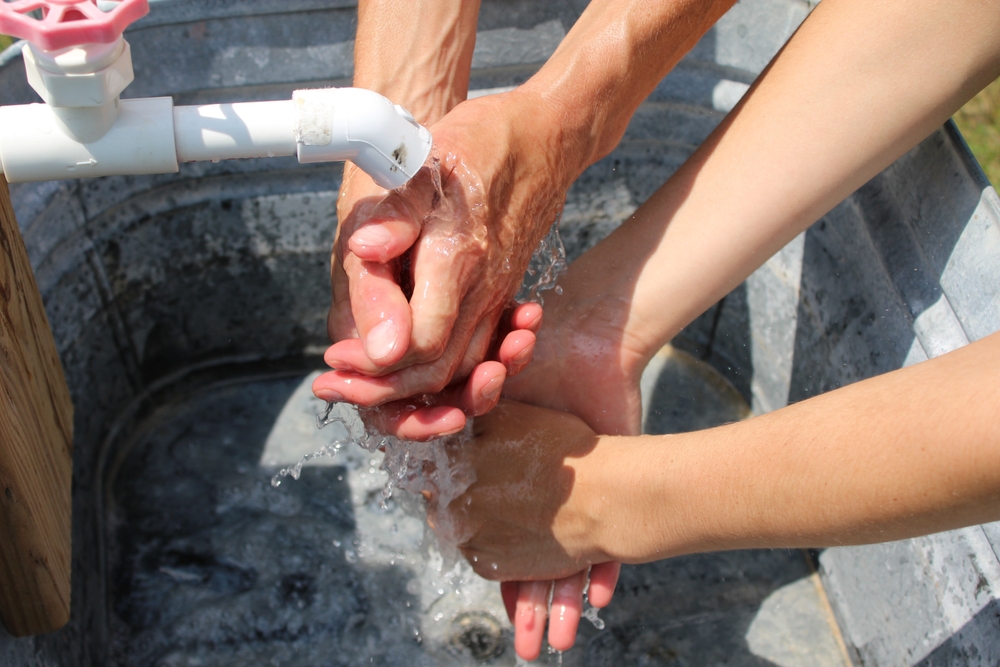
Virtually every culture practices routines of hygiene to prevent illness. Homesteaders and survivalists must implement procedures for washing hands, showering or bathing, laundering clothing and washing dishes with minimal water in order to prevent illness off grid.
I grew up backpacking in the deserts of Arizona and Southern Utah and never stopped. Where possible, travel is planned based on the few dependable water sources, which sometimes are nothing more than dripping springs. When this isn’t possible, we have to carry every drop of water we use, and water weighs approximately eight pounds per gallon, so desert backpackers learn to use this most precious of resources sparingly.
Most families have limited water storage, especially if they have limited storage space. They read recommendations on the subject, and store one or two gallons of water per person per day. That may sound like a good plan, but if you have to resort to using your water storage, the average family uses between 80 and 90 gallons of water per day, and there is a learning curve involved in cutting that down to one or two gallons per day per family member.
How do you do it? Practice, practice, practice. I am a fan of preparedness drills. The timed bugout, the grid-down weekend, and the home invader roleplay are some of my favorites. Low water use practice can be part of a grid down weekend drill, or you can do it separately if you want, but take my word for it, it’s not as easy as it sounds. If you think you can just store water and figure it out on the fly, you are almost guaranteed to burn through much of your water supply by the time you figure it out.
Whether you are planning to garden, pick a lock, start a fire with a bow drill or live on a gallon of water per day, these are all learned skills that should be learned before you need them. If you wait until you are in the middle of survival ordeal to try to learn these skills, your chances of failure increase astronomically.
In the many dozens of survival manual I have read, much attention is paid to water treatment, and hardly any attention is paid to hand washing and hygiene, even though people are statistically just as likely to be infected with giardiasis because they don’t wash their hands as from drinking contaminated drinking water.
In survival situations your hands are the main hygiene-related disease vectors. Washing your hands before meals, food preparation, and administering first aid will prevent most hygiene-related infections.
Learn to Wash Your Hands Properly
If you didn’t learn to wash your hands properly during the COVID-19 pandemic, it is worth doing because it is something that we do many times a day, so it is worth learning to do it right. There are some good videos online by surgeons, who take the subject seriously because it is an important part of their sterile technique.
Learning to wash your hands effectively helps you use less water by focusing on the parts of your hands that need washing and wasting as little motion and water as possible as you wash your hands.
Low Water Hand-Washing
- If your hands are very dirty, brush them off. Wipe them on grass or scrub them with a handful of clean sand. If you have a lot of dirt under your fingernails, scrape and clip them with nail clippers. If you skip this step, you can end up wasting a lot of water trying to get dirt out from under your fingernails.
- Use a little water to wet your hands. Catch the water in your cupped palms and then be sure to turn off the water. When people wash their hands in a sink with running water, they often adjust the water temperature and then let the water run throughout the entire procedure. This is where most of the water is wasted.
- Soap up your wet hands using the water cupped in your palms. Scrub the fingertips of each hand in the palm of the opposite hand as this is where the most dirt and microbes are concentrated.
- Use water to rinse the soap off your hands.
- Dry your hands on a clean towel.
In situations where you are unable to wash your hands before eating, food preparation or first aid, use alcohol-based hand sanitizer. Products with around 60% alcohol content are most effective.
I don’t know why some folks forgo hygiene anytime they go camping or backpacking, but it seems to be a trend since Europeans first set foot in the new world. To me, poor hygiene is a sign that someone is not well adapted to their environment, whether they are in the wilderness or in a city.
Low Water Showering
- If you are able, heat the water to a comfortable temperature. Hot water cuts through grease and grime better than cold water.
- Just as in the hand-washing example, use a little water to wet your hair and body and then turn the water off! Don’t let the water run the whole time you shower.
- Soap up your wet hair and body, starting with your hair. This conserves soap as it will runs down your body. Using a multi-use, biodegradable liquid soap instead of separate soap and shampoo simplifies the operation as you don’t need to grope around with your eyes closed trying to find different products. I carry the soap in a bottle that hands upside down from a lanyard so I can loop it around my wrist, over a showerhead, or hand it from a hook, nail or branch. Be sure to scrub your face, ears, neck, and hot spots.
- Use water to rinse your hair and body.
- Dry off with a clean towel.
Using this method, it is possible to shower with surprisingly little water, but it takes practice. Don’t expect to start showering with one gallon of water right off the bat.
The Off Grid Shower
Constructing a shower makes showering easier, more comfortable and improves privacy. Showering in the cold with high winds will make your teeth chatter, so keep that in mind when you choose the location. If you plan well and use biodegradable soap, graywater can be repurposed for
I’m not a big fan of the little solar shower bladders. In my experience using them with surface water sources, they clog up pretty fast and conditions need to be idea for them to warm water even ten or fifteen degrees, and conditions are almost never ideal. I prefer heating water using a copper coil and a stove or campfire.
You can read about my favorite off grid shower design here.
The Sponge Bath
If you are unable to shower, take a sponge bath. Just washing your face, hands, and feet, wetting and combing your hair and washing your hot spots and you’ll feel like a new person, especially if you change your socks and underwear. In the 90’s, I experimented with sponge baths with baby wipes, and they will make you feel human again after a day on the trail, but I ended up switching to washcloths, soap and water. I carry water and soap anyway and I feel that soap and water is more multiuse and eliminates disposable wipes.
Urban Hygiene
Sometimes you may have access to a restroom with a sink or a water spigot. This is common in rest stops, parks, restrooms and campgrounds. Here are a few tools that can help in these situations:
- Sillcock Key – Commercial buildings often use sillcocks to prevent unauthorized water use. Most are accessible with common sillcock keys. In fact, I have only needed one size of sillcock key to access water where I live, so I don’t carry a big heavy steel 4-way sillcock key, I just carry a cut down, lightweight version of the one tool that I need.
- Silicone Sink Stopper – This is just a round silicone pad with a little handle used to stopper sinks and tubs so they will hold water.
- Universal Sink Showerhead – This solves the problem of washing your hair in a sink. A flexible universal adapter fits over the faucet on most sinks and is attached to a small showerhead with a short length of hose.
Clothing must be kept clean to keep you warm and dry. At a minimum, you should carry extra socks and underwear and launder soiled clothing when you camp or sleep.
The Dry Bag Laundry Machine
Backpackers and river rafters long ago learned to wash clothes in a dry back with very little hot water and soap, but who knows, our ancestors probably laundered clothing in waterproof bags made from animal bladders or stomachs.
The dry bag laundry machine is simple. You just take a dry bag add clothes, water and a washboard surface. For the washboard, I have used a plastic travel washboard I found on Muji or clean pair of flip flops, Teva sandals or any other clean rubber or plastic object with a tread or washboard surface that won’t be damaged and will clean clothing without damaging the clothing.
You put water in the dry bag, add your clothing, add laundry soap, evacuate most of the air, close the bag, and rub the clothes against the washboard surface in the bag for a few minutes. Then open the bag, rinse the clothing, and hang it to dry. You can do this on the trail, in a bathroom sink, in a river, or pretty much anywhere.
For soap, I use Dr Bronner’s unscented castile liquid soap because it is biodegradable and works as soap, shampoo, dish soap, and laundry soap, simplifying logistics.
This method is so successful that you can now buy drybags that have a washboard surface molded into them for washing clothing such as the Scrubba Wash Bag.
Drying Clothing
Choosing quick dry clothing greatly simplifies the task of drying laundry. In most cases, you can wash in a dry bag, sink or wash basin at night, wring it out by hand, and hang it to dry.
My wife taught me a trick her family uses to dry clothing on humid, rainy days in Brazil. They pull the refrigerator away from the wall and hang clothes to dry on the coils on the back of the fridge.
The 3-bucket system minimizes dishes pots as a disease vector, but the main thing is still washing your hands!
- Scrape Your Plates – Remove everything you can before washing.
- Compost Green Waste – Save money and eliminate 25% of what most household sent to the dump by turning into better compost that you can buy.
- Use Biodegradable Soap
- Use the 3-Bucket System – Wash in hot, soapy water. Rinse in clean cold water. Sanitize with diluted bleach.
- 200’ Rule – Strained gray water should be repurposed or scattered at least 200’ from surface water sources, campsites and trails. In bear country keep at least 100 yards between your kitchen, where you use the bathroom, and where you sleep.
Summary
Following practical low water routines for washing hands, bodies, and laundry, and the 3-bucket system for dishes, will prevent illness off grid while using minimal water.