


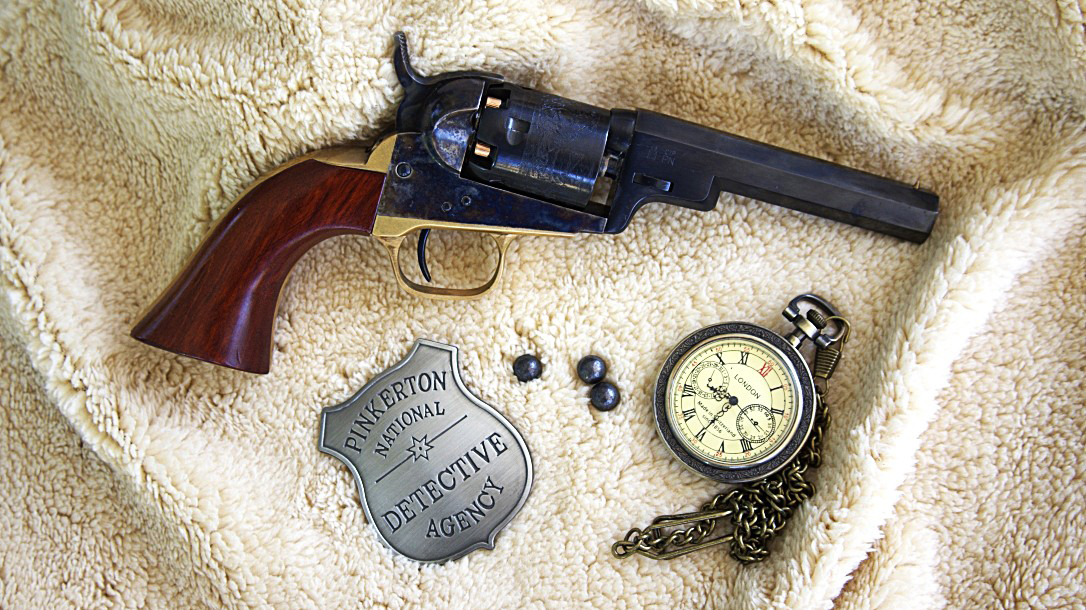
Despite their deficiencies in power and ease of use, pocket pistols sell in the best and worst of times. The answer: convenience. Only the most dedicated gun owners are willing to alter their lifestyle, wardrobe, and mindset enough to change their hardware. Humans are busy creatures, and many of us who want to be armed go with something convenient to carry. Otherwise, we might just go unarmed. Nineteenth-century gun owners were little different. The case in point is the Colt 1849 Pocket revolver, a pioneer in the concealed carry revolution.
The Colt 1849 Wells Fargo – Old School EDC
Handguns in the early 19th century were a largely useless arm that cost the same as a rifle but did not put food on the table. Those with the means resorted to pocket guns. Men like Henry Deringer made a living producing single-shot muff-sized handguns that could fit in a glove or a pocket.
Advertisement — Continue Reading Below
But the times, they were a-changin’. The convenience of carrying a handgun inconspicuously while dealing with potentially dangerous people was not lost on the thousands who packed up their lives and headed West in the years following the Mexican War.
As it happened, the war made Samuel Colt, and the peace gave him a new opportunity. Colt patented the revolver in 1835, but his first design had few takers in a time of peace. His Patent Arms Company went bankrupt in 1842. But his fortunes were restored with the success of the Walker Revolver used by the US Mounted Rifles in Mexico.
Advertisement — Continue Reading Below
Changes
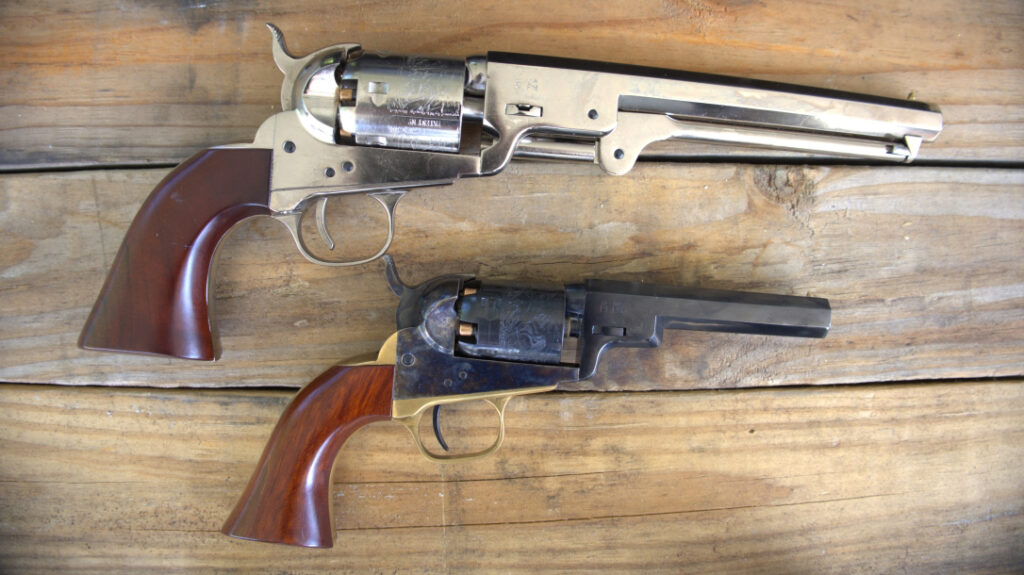
The Walker was an impractical five-pound horse pistol that suffered some defects. Colt remedied them with his .44 caliber Dragoon revolver in 1848. It was paired with a miniaturized .31 caliber version called the Baby Dragoon. The Baby Dragoon provided five shots of firepower in a package that can be shoved into a pocket. It was the most advanced carry handgun available, and it proved popular with gold miners and city folk alike.
In 1850, Colt finally evolved its lock work to its final form and debuted the 3rd Model Dragoon .44, the .36 caliber Colt Navy, and the .31 caliber Colt Pocket Model.
The Pocket Model would continue in production until 1873, and nearly 350,000 were sold. It outsold the Colt Army and Navy revolvers of Civil War fame. It would not be until the 20th century that its record was broken.
Advertisement — Continue Reading Below
The Colt 1849 Today
Black powder revolver enthusiasts today flock to Italian replicas of either the Remington or Colt revolvers in the Army or Navy size. .31 caliber pocket pistols have become the niche, rather than the everyman’s gun. These small guns are less alluring than what we envision on a belt. The combination of a small bullet and a small powder charge makes them less useful and, for some, less fun. I took the inverse approach.
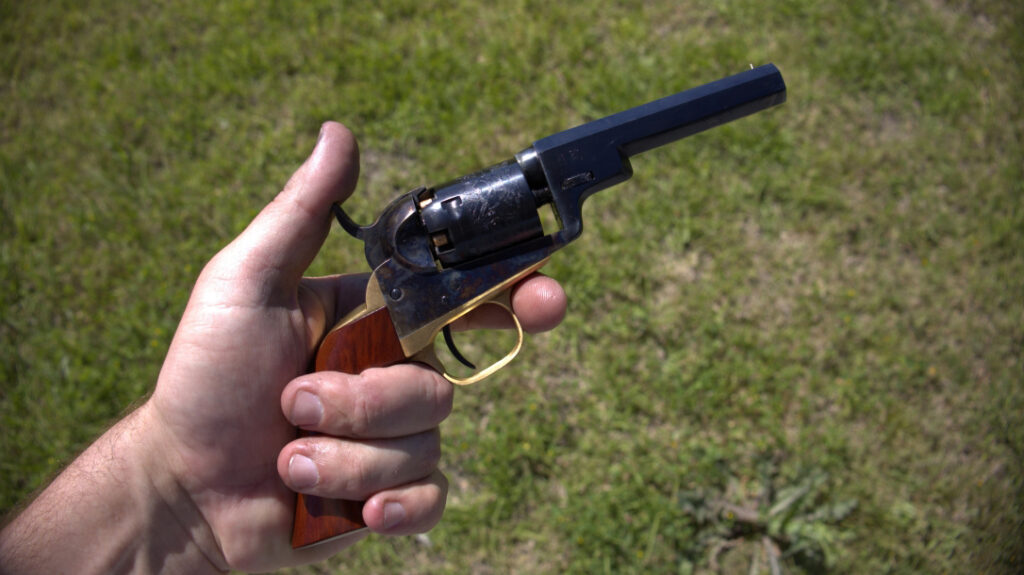
For some years, I owned a Remington Pocket model, which I enjoyed shooting and employed as a trap line gun. Later, I went over to the Colt Pocket Model. Uberti produces several variants, including the Baby Dragoon, Colt Pocket, and Colt Pocket Wells Fargo models. The Colt Pocket was offered with or without a loading lever. Today, the Wells Fargo model stands in as the one that goes without.
Advertisement — Continue Reading Below
The Wells Fargo Colt from Cimarron
Cimarron Firearms of Fredericksburg, Texas, imports the Wells Fargo Colt Pocket Model from Uberti. This model loses a few ounces and has a smaller footprint as it comes without a loading lever. This feature endeared it to Wells Fargo and Pony Express agents who needed to pack light for speed. Today, it represents the handiest Pocket Model you can get, although not the easiest to load.
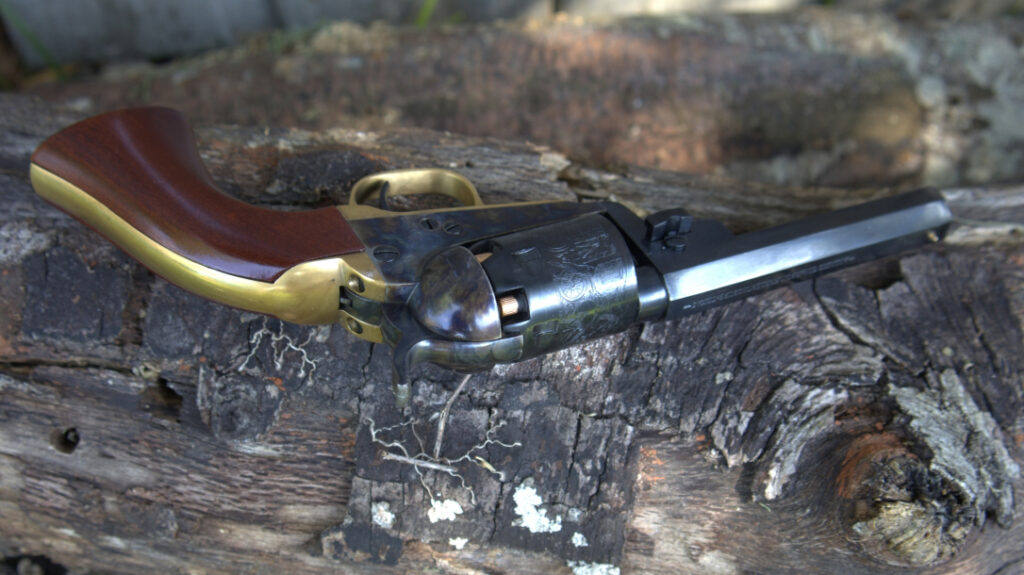
Otherwise, the Wells Fargo Colt has the same features as any other Pocket Model. This includes a one-piece varnished walnut grip, brass grip frame, color case-hardened steel frame, and four-inch octagonal barrel. The five-shot cylinder is unfluted and laser-engraved with a stagecoach scene. The top barrel flat wears Cimarron’s smart address branding and a cone-shaped brass front sight. The rear sight, like other Colts, is a V-notch ground into the hammer nose.
Advertisement — Continue Reading Below
It is a five-shot .31 caliber single-action revolver. Peculiar to modern eyes is its open-top design. The revolver is held in place via a captive wedge secured through the cylinder arbor, where the cylinder rides.
Loading the Hard Way
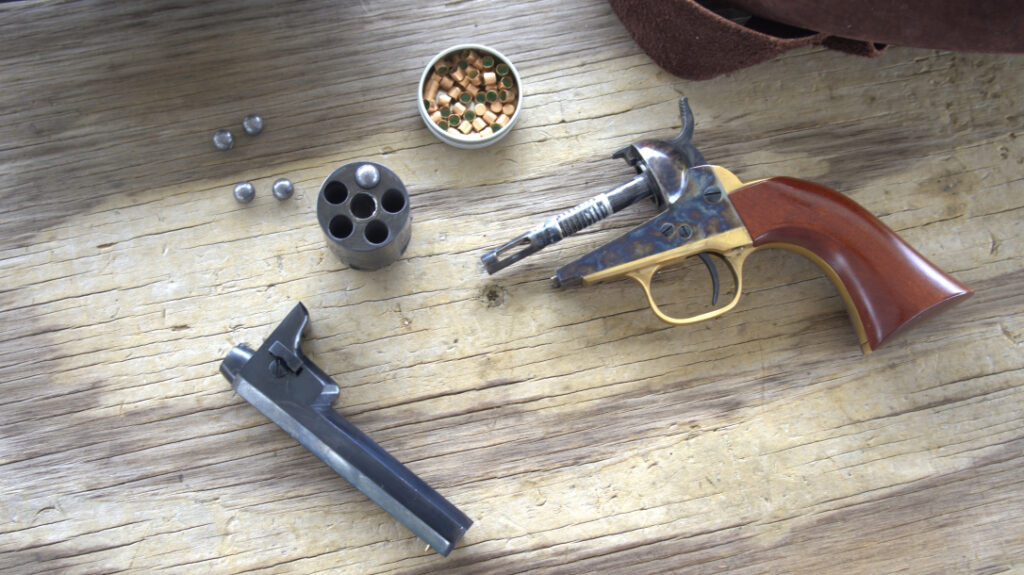
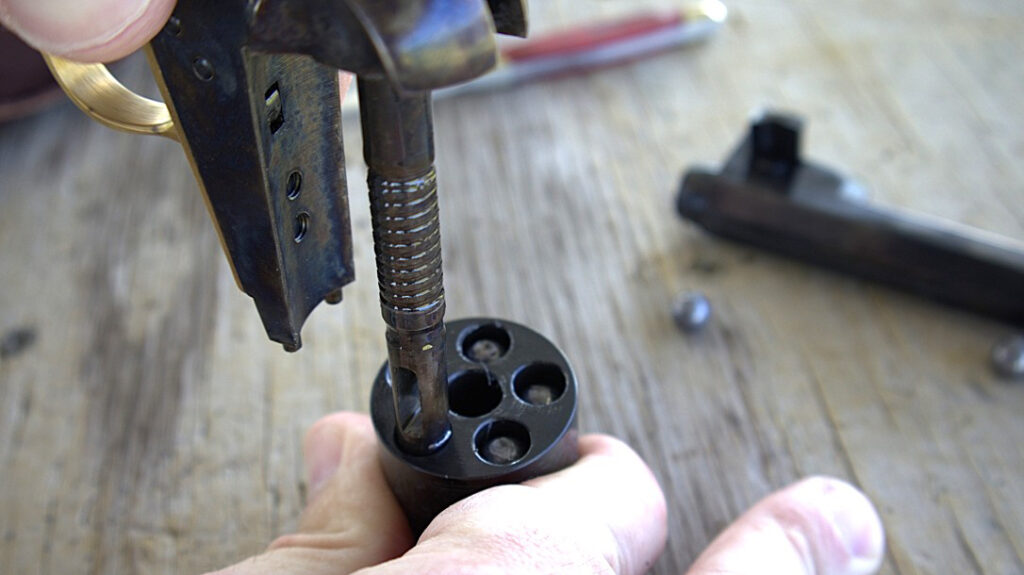
The Wells Fargo Colt is a true fire-and-forget pocket pistol. It is a cap and ball revolver that requires loading from the front of the cylinder. Since there is no loading lever, the cylinder must be removed for loading the gun. A loading lever also helps with disassembly. With Wells Fargo, the wedge is tapped out of the barrel. Then the barrel is tapped off the arbor. I used a brass hammer for this process.
Advertisement — Continue Reading Below
The chambers can comfortably hold fifteen grains of powder and a 50-grain ball. With powder poured, a ball is placed on top and shoved home with the end of the arbor. I used .323-inch diameter cast round balls for a tight fit, but some shooters use cheap 00 buckshot for ammunition.
With the cylinder loaded, you can elect to grease the chamber mouths for lubrication before reassembling the pistol. The Wells Fargo Colt is not so closed off that you can’t cap the gun when it is assembled. With the hammer on half-cock, it is easy to drop Remington No. 10 percussion caps onto each nipple. From there, you can lower the hammer into the single safety pin between chambers or drop the hammer on an empty chamber for safety. At long last, you can shoot.

Five Laborious Rounds
Although the Wells Fargo Colt Pocket Model is a little more laborious to load, the fun factor is the same as any other cap and ball revolver.
The revolver is fairly light, and the slim grip tends to result in more finger on the trigger than needed. But it shares the same grip profile and balance of the legendary Navy pistol, and it points as naturally as a finger. That helps to compensate for the fact that the sights are terrible by our modern standards. The front sight is small and easy to pick up, but tends to get washed out with the tiny v-notch rear. But for a pocket pistol, this arrangement is more passable, where it is not on Colt’s larger open-top pistols.
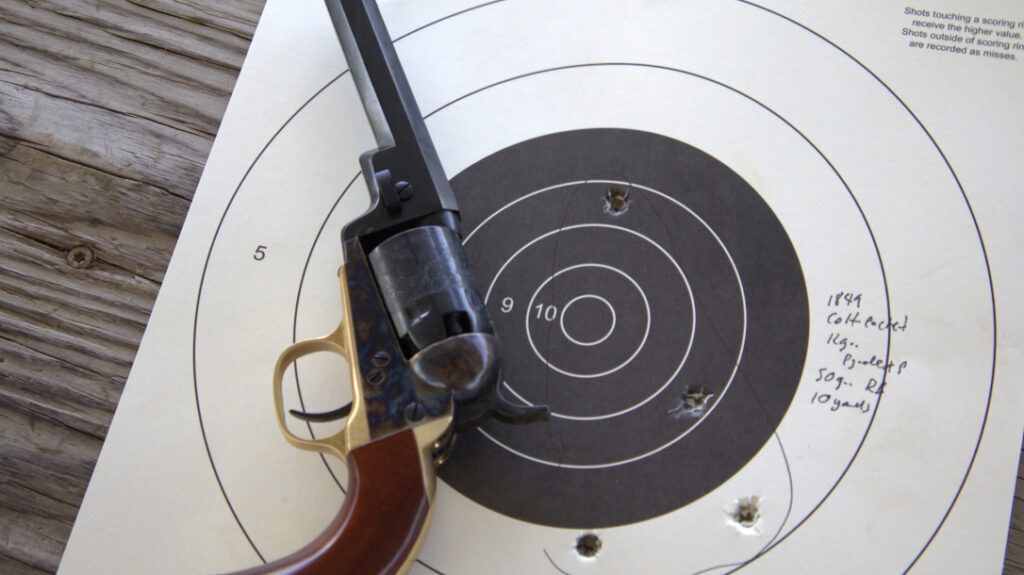
Like other Colt revolvers, the sights are regulated for seventy-five yards and will print high at close range. I did most of my shooting at ten yards, and I could reliably place five rounds into a palm-sized group. But the group favored three to four inches higher than the point of aim.
Recoil
Recoil is more nonexistent than the smoke and flame that belch from the baby Colt would suggest. The loads I used consisted of fifteen grains of either Scheutzen FFFg black powder or Pyrodex P paired with a 50-grain round ball. The Pyrodex load was a little more powerful, but the recoil barely disturbed the sights.
Power is not the strongest suit of the .31. On a standard Colt ’49, I could compress 20 grains of powder followed by a ball with the loading lever. 15 grains of powder is about as good as it gets when loading by hand with the Wells Fargo. 15 grains of Pyrodex gave me an average velocity of 750 feet per second for 63 foot pounds of energy. The Scheutzen load dropped to 691 feet per second.
Taken together, we are talking .25 ACP power. But that is more than enough for small critters and plinking around. With a bit of Kentucky windage, it wasn’t hard to hit and run through two-liter bottles out to fifteen yards with the Wells Fargo Colt. But once you’ve had your five, it’s time to retire to the bench to press some more rounds in.
The Usual Fixings
Black powder revolver replicas are a beast in themselves. Some require no modifications once or ever to run. Others require some spit and polish. The Colt Pocket Models fall into the latter category.
On the inside, the Wells Fargo Colt is the best finished I have seen coming from Uberti. There is hardly a burr or machine mark on it. But the hammer spring was on the weak side. This makes the revolver easy to cock. But that works against you on the firing line when blowback from firing pushes the caps into the slot of the hammer face and brings the hammer back a touch. When you cock the hammer for the next shot, the spent cap falls into the action, preventing you from firing the next shot.
Cap jams are a problem with Colt replicas, and my normal fix is to stone the hammer face and slot. In addition, I added a second hammer spring on top of the first. This increased the pressure on the hammer and kept the caps where they should be. This ensured that I could get five for sure every time.
Cimarron’s Wells Fargo Colt: A Testament to a Little Legend
We live in an era where every passing year promises a game-changer. Cimarron’s 1849 Colt Pocket Model is a testament to a time when the cliché was true. Largely forgotten today, the Colt Pocket Model was light-years ahead of anything else when it debuted. Today, it stands as a historical footnote and a testament to the people who carry it and the Colt engineers who perfected the repeating handgun.
The Wells Fargo Colt loses a bit on ease of loading but makes up for it with sleek class and enough pasta to do what you would with a rimfire handgun today. As the adage goes, “big things do come in small packages.”
For more information, visit Cimarron.
WHY OUR ARTICLES/REVIEWS DO NOT HAVE AFFILIATE LINKS
Affiliate links create a financial incentive for writers to promote certain products, which can lead to biased recommendations. This blurs the line between genuine advice and marketing, reducing trust in the content.