


United States forces have targeted ISIS strongholds across Africa’s Sahel in recent days, in operations coordinated with the Nigerian government. But a longer-term strategic question remains as to whether the U.S. military retains the capacity to thwart potential terror attacks emanating from the continent, given its shrinking regional footprint.
U.S. Air Force Gen. Dagvin Anderson, head of U.S. Africa Command, seemed concerned that the answer might be “no” when he testified to Congress last week.
Anderson said that Africa is the epicenter of global terrorism, but warned that a 75% U.S. force reduction over the past decade – coupled with a parallel drawdown of allied troops – has created “an intelligence black hole” on the continent.
“AFRICOM’s lack of expeditionary capabilities and diminished force posture compromise our crisis response,” Anderson testified before the Senate Armed Services Committee, noting the command is operating with “minimum necessary resources.”
“Our reduced presence on the continent also allows disruptive actors to drive the agenda, undercutting American interests,” he said. “ISIS leadership is [in] Africa. Al-Qaeda’s economic engine is in Africa. Both of these groups share the will and intent to strike our homeland.”
Asked whether his command is capable of disrupting such threats, Anderson gave a circumspect response.
“That is very difficult for us to ascertain in the Sahel right now given our limited posture,” he cautioned.
The implicitly critical remarks came just before President Donald Trump ordered a strike that killed the Islamic State’s second-in-command in Lake Chad Basin. Additional armed actions in northeastern Nigeria followed soon after.
“At my direction, brave American forces and the Armed Forces of Nigeria flawlessly executed a meticulously planned and very complex mission to eliminate the most active terrorist in the world from the battlefield,” Trump wrote in a Truth Social post on Friday night. “He will no longer terrorize the people of Africa, or help plan operations to target Americans.”
Trump identified the target as Abu-Bilal al-Minuki, a top figure in ISIS who was labeled a “Specially Designated Global Terrorist” by the State Department in 2023 during former President Joe Biden’s administration.
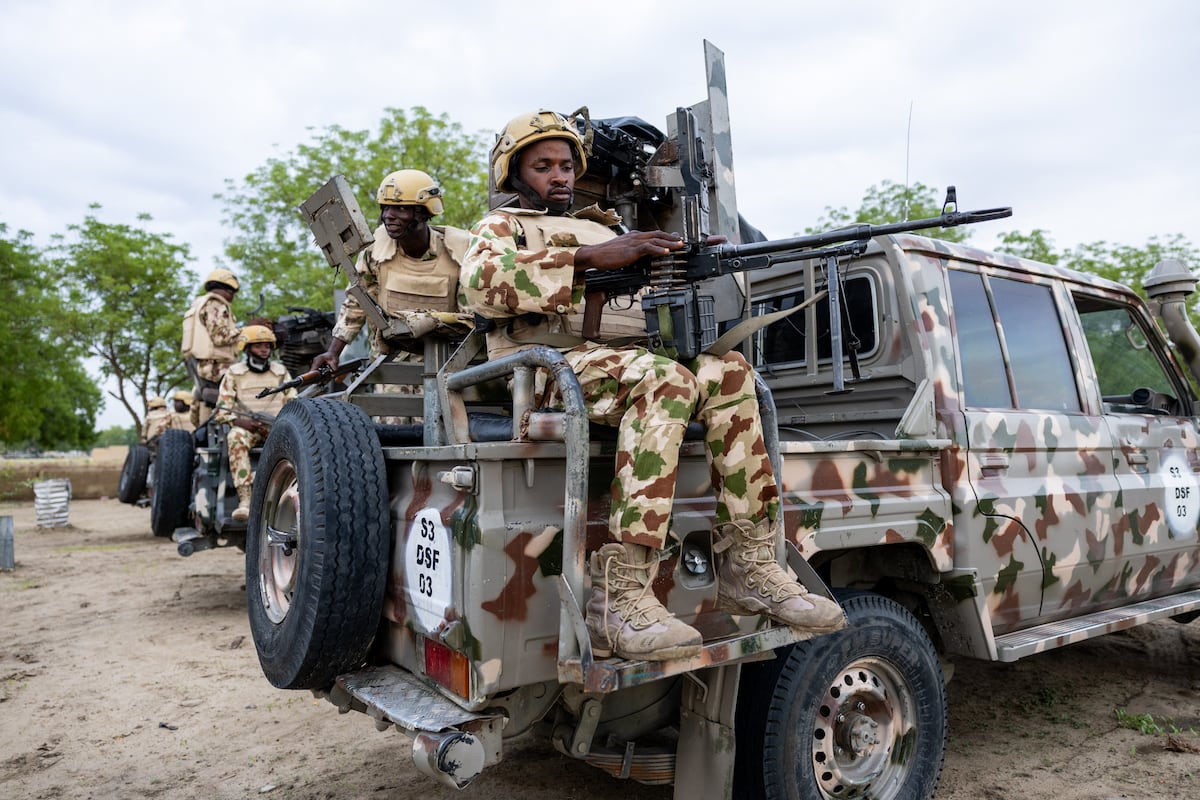
The joint commando raid was the result of extensive intelligence sharing and reconnaissance between the U.S. and Nigeria, according to the Nigerian Army.
The assault on al-Minuki’s fortified enclave in Metele, Borno State, commenced shortly after midnight and culminated in airstrikes on the site following a three-hour clash.
Several of the ISIS leader’s lieutenants were also killed in the firefight.
There were no American or Nigerian military injuries reported as of Monday, a U.S. official told Military Times.
AFRICOM, in a statement, said al-Minuki provided “strategic guidance to the ISIS global network on media and financial operations as well as the development and manufacturing of weapons, explosives, and drones.”
It added that he had a “significant history of involvement in planning attacks and directing hostage taking.”
Officials in Washington and Lagos announced on Sunday that the two countries conducted further strikes against ISIS in Metele in the ensuing days, resulting in the deaths of at least 20 militants.
The Islamic State has transformed the Sahel into a breeding ground for some of its most lethal affiliates, notably ISIS-West Africa, also known as ISIS-WA, and its rival, Boko Haram.
Both groups are especially active in the Lake Chad Basin, which spans Cameroon, Chad, Niger and Nigeria.
Myriad factors — including violent extremism, poverty, food insecurity, climate change and weak governance — have converged to make the theater the locus of one of the world’s most intractable humanitarian crises.
The operation that killed al-Minuki was the most dramatic moment so far in the ongoing effort by the Pentagon to aid the Nigerian government in its quest to beat back insurgents.
On Christmas night, American and Nigerian forces carried out joint missile strikes in the Sokoto State. Trump said “ISIS Terrorist Scum” were the targets.
Soon after, the Pentagon deployed roughly 200 troops to the West African nation to assist in training the country’s armed forces as they battle an Islamist insurgency.
Dr. Oman Mohammed, a senior research fellow within the program on extremism at George Washington University, told Military Times that Africa has emerged as a focal point of terrorist activity since the collapse of the Islamic State’s territorial caliphate in 2017.
He said jihadist movements have expanded rapidly across the Sahel, in part through the recruitment of child soldiers who become more susceptible to radical recruitment amid destitution.
“Poverty is the reason that leads to child soldiers,” Mohammed asserted, adding that the Islamic State has infiltrated schools to create conditions in which indoctrinations begin early. “When there is no access to regular schools, imagine: Their teacher is an imam with the Islamic State teaching them how to be terrorists, promising them money. It makes it very concerning.”
According to the United Nations, violence has forced more than 1,827 schools across the Lake Chad Basin to close, depriving thousands of children access to education. Today, Sub-Saharan Africa remains one of the least educated regions on earth.
Mohammed argued that the U.S. must bolster efforts to confront the rise of terrorism in Africa, not scale back.
“Without continued pressure, terrorists will always find a way to plot against the United States, the West and American interests around the world,” he said. “It is their ideology that goes against everything civil and everything democratic.”
Tanya Noury is a reporter for Military Times and Defense News, with coverage focusing on the White House and Pentagon.