


Editor’s Note: Especially adapted for The Armory Life from The Matchless Enfield .303 No. 4 Mk I (T) Sniper and Britain’s Elite Scout/Snipers Who Dominated WWII Battlefields Book No. 2 Mk II revised and expanded by Jeff John. Available at Amazon.com.
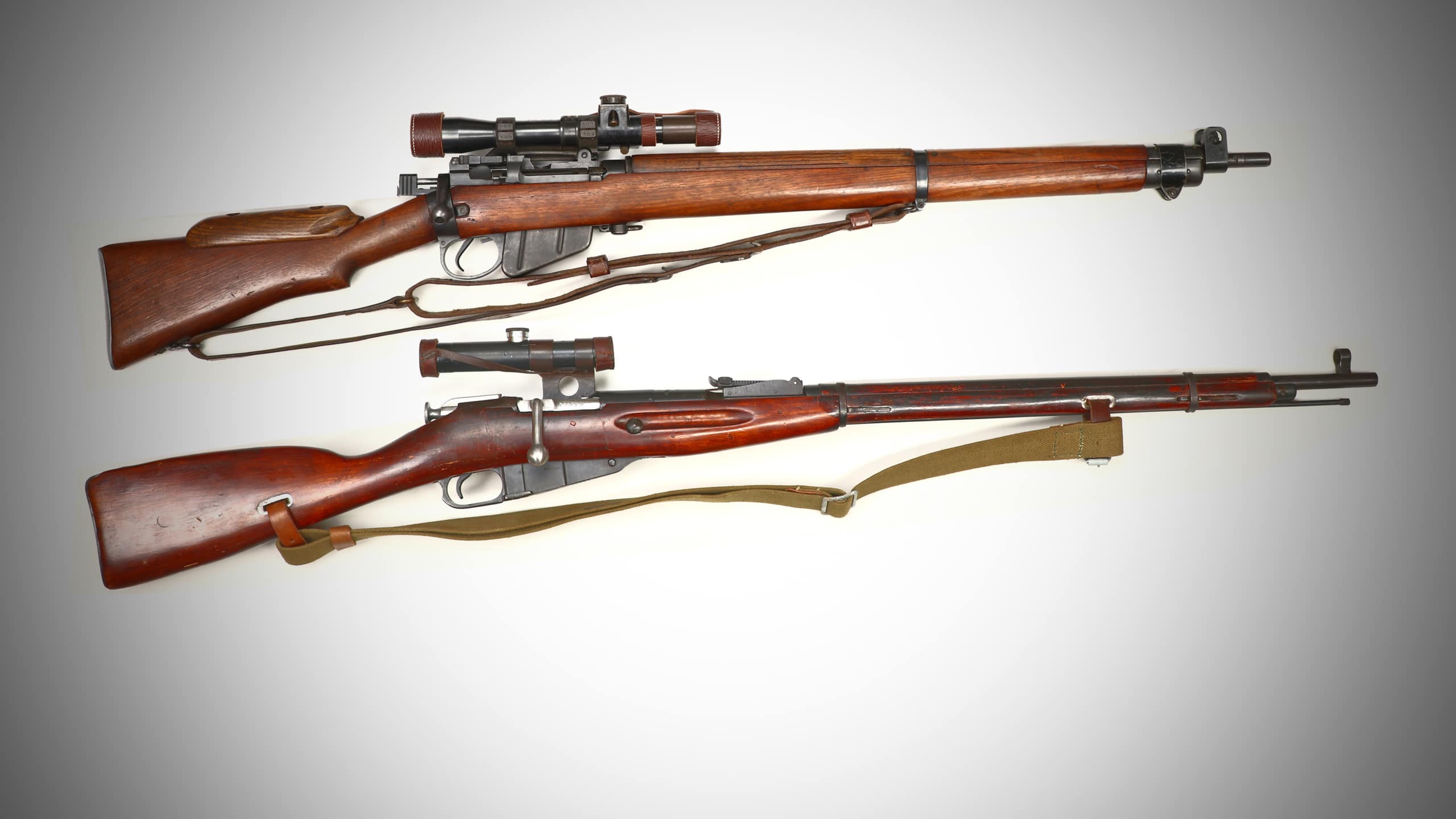
I’ve long believed the Enfield No. 4 (T) was the best sniper rifle in WWII, and here’s why. The No. 4’s slab-sided receiver was amenable to scope bases, and the bolt and safety required no further modifications to mount the scope close to the boreline. All were selected for inherent accuracy, smoothed, tuned, had the bedding adjusted, given a comb riser and fitted with a sturdy military-grade optic and the work done by highly skilled men (Holland & Holland principally). Importantly, a 20X telescope was issued and was critical for intelligence gathering and more precise target identification. Snipers received 50 rounds of the ammo shooting best in their rifles. No other country went to these lengths.
The Communist Choice
In my opinion, the Soviet Mosin-Nagant in 7.62x54R was the second-best sniper rifle. These M91/30 rifles were selected for accuracy, modified with a turned-down bolt and the normally execrable trigger lightened. The quick-detach 3X scope was mounted high making a good cheekweld impossible. When scopes are mounted high, minor rifle cant will throw the shot off as range increases. Impact shifts also occur when the rifleman can’t put his face reliably onto the same spot on the stock each time.

Peak production of Soviet sniper rifles hit more than 53,000 in 1942 and makes one wonder how many of those could be “selected for accuracy” under that kind of pressure. In all, the Soviets made some 187,000 sniper rifles by 1945 with production finally ending in 1947. The Soviets added an optic to the Tokarev SVT-40 self-loading rifle, but it never achieved the success of the M91/30.
Teutonic Take
German optic companies had been making quality telescopic sights before WWI for the sporting community, and their lenses have always been the gold standard. This quality meant WWII Germany should have had the best sniper rifles and optics. Although German snipers were a fearsome bunch, Germany’s curious lack of a dedicated rifle is puzzling.
Many different models of telescopic sights were mounted very high off the bore of the Kar 98k so that no modifications to the bolt or safety were necessary. None had provisions for a cheek riser or other method of ensuring the shooter’s face was in the same place for each shot. Inexplicably, most of the scopes were mechanically zeroed for windage at the factory and only had an elevation turret. The various scopes were mounted in five different systems atop or alongside the receiver, all designed for quick mounting and dismounting.

More puzzling, the rifles were not tested for accuracy beforehand. The barrels were examined for smoothness and quality. If they failed the accuracy test, then they had the barrel replaced. Later, as war pressures mounted, some factories involved in the conversion process sensibly selected the rifles for accuracy beforehand.
Much German optic design and innovation was never quite perfected. The first scout scope called the Zf-41 was mounted over the K98k barrel sight for sharpshooting — not sniping. The low-powered 1.5X scope featured small, dim optics, and was just a good idea poorly executed.

The Germans took the optic-sighted rifle idea further by adding quick-detachable optics such as the ZF4 4X to the K43 and FG42. An optic aided quicker shots, but neither rifle was sufficiently accurate for sniping.
American Precision
Despite a history of sniping and sharpshooting dating back to the Revolutionary War, the U.S. Army was totally unprepared for the need in WWII. The Marines fared better. They kept their WWI sniper rifles still topped with the Winchester A5 and used them to fill the gap until a new one was developed.

The Marine WWI-era M1903 Springfield snipers had the optic mounted high and its external adjustments raised the profile even higher. They were prone to damage if handled roughly, but the combination appears throughout the war exhibiting how well the individual sniper took care of his equipment.
In a smart move, Marines pulled out rifles accurized for National Match shooting for their new sniper rifle topped with the 8X Unertl. Commercial Unertl scopes had a recoil spring that returned the scope to firing position after a shot. The Marines eschewed this spring, and the scopes had to be manually retracted after a shot, thus the rifles required no modification to the bolt or safety. The combination served from mid-WWII to Korea and even in the early days of Vietnam.
Between wars, the American Army scrapped all its WWI sniper optics and had to scramble for a sniper rifle. The biggest problem was there weren’t any military-grade telescopic sights. The most suitable commercial ones had tubes only ⅞-inch in diameter with small lenses.

Nonetheless, Remington was steadily building M1903 rifles, and the sniper problem solved by using the commercially available Weaver 330C (named the M73B1) installed in commercial mounts. Although the Lyman Alaskan scopes (called the M73) were the first choice, Lyman was already running at capacity filling orders for other military equipment and couldn’t provide them in enough quantity.
Worse, M1903 rifles weren’t specially chosen, either. Like the Germans, Remington selected barrels having tolerances that “should” provide the best accuracy, but had to modify the bolt for use with the optic. The receiver legend “U.S. Remington M1903A3” was offset to the left side of the receiver since the rear of the scope base would be on the 12 o’clock position and cover the original marking. The serial number remains on the right side and is visible. It is the one telltale indication that at least the receiver began life as an official M1903A4 sniper. No iron sights were provided.
Semi-Auto Sniping
The Garand was a gargantuan problem. An optic was never planned to be in its future and no thought given to mounting one. Because it had to be loaded straight down from the top with its eight-shot en-bloc clip, the scope could only be installed offset to the side.

After much experimentation, two systems were accepted. The M1C sniper rifle used a commercial system designed by Griffin & Howe of New York — one of America’s top custom gunmakers — and the M1D designed by John C. Garand. Although Garand’s simpler system was preferred by Springfield Armory, for reasons unknown his system was eschewed by higher-ups (probably because of politics) and G&H’s system adopted. Problems arose immediately.
Springfield Armory couldn’t select the rifles for accuracy destined to become the M1C because the receivers had to first go to G&H for drilling of three screw holes and two pin holes for the mount prior to heat treating. If the rifles didn’t meet accuracy specs, Springfield Armory worked hard to make them do so. Springfield Armory had to blueprint the G&H system to ensure the parts were interchangeable in the field. All this slowed delivery of the M1 snipers to a crawl, and they didn’t arrive until 1944.
Because the optic was offset, a leather cheekpiece was laced and screwed to the stock so the sniper’s eye would align with the optic, but the iron sights couldn’t be used if the optic failed. A detachable cone-style flash hider was attached via the bayonet lug. While the cheekpiece worked great with its width adjustable for thickness, the M2 Flashhider either enhanced accuracy if it fit tightly, or degraded accuracy if loose. The M1C was fitted with the Lyman 2.5X Alaskan optic.

The biggest problem was the sightline and bullet path converge only at the range the rifle is zeroed to hit. The rifleman has to be skilled in range estimation and do some mental math in holding off to one side or another depending where the rifle is zeroed. American snipers were quite capable, however, and made all this work.
However, America never ensured their snipers received quality ammo the way Britain did. American snipers were stuck with the standard M2 ball round in their Garands. It wasn’t until Vietnam that American snipers finally received a dedicated, accurate sniper rifle paired with match-grade ammo.
The Setting Sun
The prize for the least thought-out rifle goes to the Japanese. Their sniper rifle had a scope lacking windage or elevation adjustments, and were mechanically zeroed at the arsenal with the scope offset to the bore. The bolt was turned down to ease cycling, but no cheekpiece provided to align the shooter’s eye with the scope. The sniper was aided only by a reticle with tic marks to gauge elevation and windage.

Sniper rifles were built on the 31.5-inch-barreled Type 38 in 6.5×50 and the 25-inch Type 99 in 7.7×58, both with a 2.5X scope. The close jungle conditions meant few long-range shots and mitigated the lack of scope adjustments.
Conclusion
As we see, few countries took the elaborate time or care building an accurate telescopic-sighted rifle for their snipers other than the British and Soviets, and Britain’s No. 4 Mk I (T) was clearly superior to all.

Editor’s Note: Especially adapted for The Armory Life from The Matchless Enfield .303 No. 4 Mk I (T) Sniper and Britain’s Elite Scout/Snipers Who Dominated WWII Battlefields Book No. 2 Mk II revised and expanded by Jeff John. Available at Amazon.com.
Please be sure to check out The Armory Life Forum, where you can comment about our daily articles, as well as just talk guns and gear. Click the “Go To Forum Thread” link below to jump in and discuss this article and much more!
