


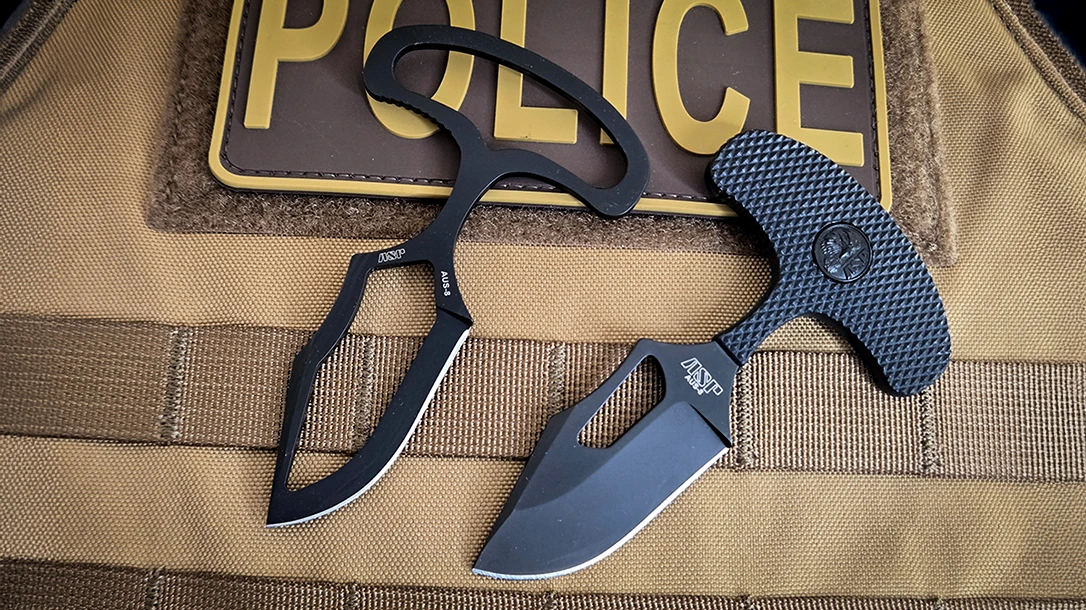
Many officers and security personnel carry a knife of some sort or another. It’s a good idea both from a utility standpoint and as a weapon of last resort. There’s nothing that says I would like to retain my duty weapon and go home alive like a few puncture wounds from a couple of inches of steel. For this reason, ASP recently released its new PDK (Police Duty Knife) Push Knife.
The ASP PDK (Police Duty Knife) Push Knife
In 2009, an off-duty Pittsburgh Police Officer was working a security detail at a downtown Pittsburgh store. While being arrested for shoplifting, the suspect broke free with one hand still cuffed. He used the loose cuff as an improvised metal knuckle and began to assault the officer.
In the ensuing fight, the suspect attempted to grab the officer’s duty weapon. Faced with the armed attack and the suspect attempting to get his service weapon, the officer pulled out what was described as a 2-inch bladed knife from his duty belt and used it to fend off the suspect until backup arrived.
Advertisement — Continue Reading Below
The suspect survived the encounter, and luckily so did the officer. This is exactly the type of situation that the ASP Police Duty Knife Push knife was designed for.
Why a Push Knife
I was working as a County Police officer at the time, and I learned that the city officer did indeed use a push-type knife in that encounter. The reports mentioned that it was a personally owned knife, not issued by the department. The knife was within policy, though, and the officers’ actions were a justified force option based upon the circumstances.
Advertisement — Continue Reading Below
Folding knives are probably the most commonly carried type of knife. However, there’s an argument to be made for fixed blades in general, and ones that don’t require gross motor skills.
I recall talking with the late John Benner of the Tactical Defense Institute (TDI) about this years ago. He would have students bring their carry knife to class and do tests under simulated stress. They were required to draw their knife from wherever they typically carried it, deploy it, and pop a balloon on a target, if I recall correctly.
Advertisement — Continue Reading Below
He found that folding knives, regardless of opening mechanism, tended to be much slower to deploy than a fixed-blade knife. Under stress, people tend to lose fine motor skills. That slowed down the deployment of the knife. An easily grabbed fixed blade that you could snatch with gross motor skills proved much faster.
If you’re familiar with TDI, you know Benner’s answer to that was his TDI knife. It is an excellent example of the style. However, the ASP PDK Push Knife follows the same principles.
The PDK In Detail
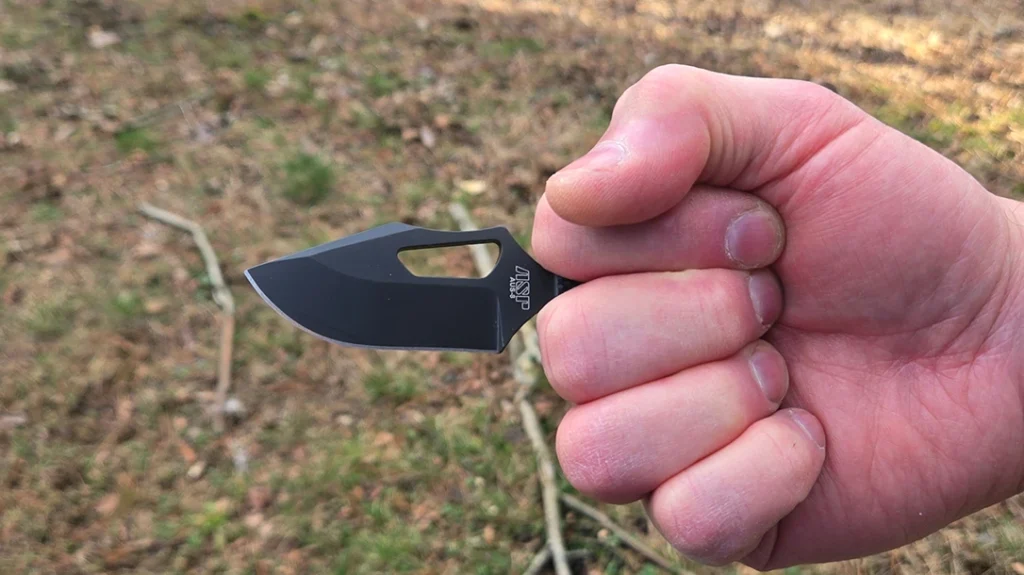
ASP’s PDK Push Knife features a 2.25-inch single-edge blade. It’s made from AUS-8 stainless steel with what they refer to as a Shark Fin spine contour. The single edge should make it legal in most jurisdictions. It’s finished in a non-reflective black PVD finish.
Advertisement — Continue Reading Below
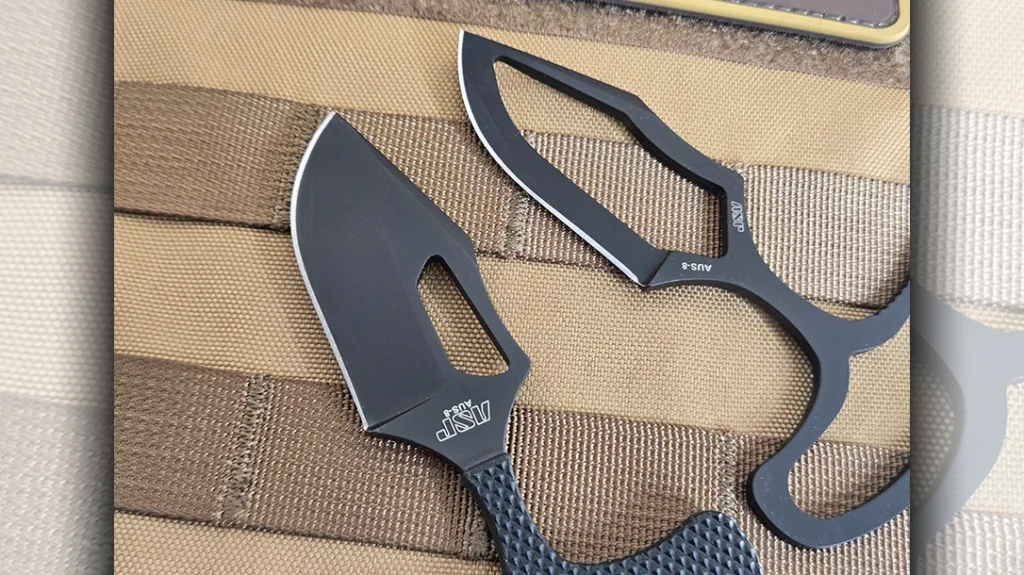
The T-handle is designed to provide a secure grip and gross motor control. It has a grooved underside on one wing serving as a tactile spine-side indicator. If you feel that the grooves are up, you know that the edge is down.
ASP has two variants of the Push Knife. The G model has a textured polymer overmolding that fully encapsulates the handle for enhanced grip. The S model uses a skeletonized handle to minimize bulk and weight.
Advertisement — Continue Reading Below
Both models come with a custom polymer sheath with molded retention and a removable spring steel clip for belts/web gear up to 2 inches wide. There are also 1.25-inch slots for thinner straps, as well as four grommet holes for lanyard use or direct lacing to gear. MSRP is an extremely affordable $37.00 for the G model and $35.00 for the S model.
Carry and Deployment
It doesn’t really matter how or where you carry a utility knife. There’s no pressing need to draw it effectively under stress. The same can’t be said of something like the ASP Push Knife. To fulfill its purpose as a last-ditch defense item, it must be readily accessible.
Since your sidearm is always going to be your primary lethal tool, it makes sense to position the knife where you can access it with your offhand. Your primary hand is likely going to be engaged in a weapons retention struggle if you’re reaching for your knife.
Advertisement — Continue Reading Below
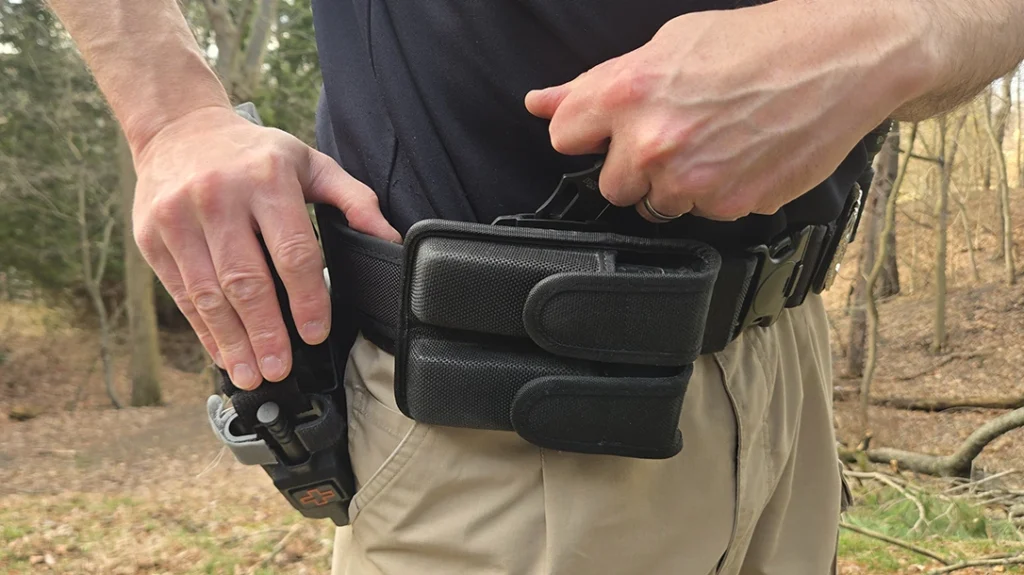
Probably the most common place to carry a fixed blade is on a trouser or duty belt. Often, officers will mount it behind their magazine pouch. It doesn’t take up belt real estate that way, which is tight with all the gear that cops carry these days.
It also conceals the knife to some degree, or at least makes it less obvious. That helps maintain an aspect of surprise if the officer needs to use it. It also keeps others from noticing/accessing it themselves in a fight. You do need to be aware that it’s another tool you need to keep track of, just like your gun, baton, Taser, or pepper spray.
Behind the mag pouch, whether you carry your mags just forward of your sidearm, or on the opposite side of the belt, position the knife so it can be accessed by the off hand. In the case of the Push Knife, the T handle makes it easy to grab and hold on target when your adrenaline is flowing.
Alternatively, you can clip the knife to your trouser belt in the same position before you put on your duty belt. There are benefits to this that I’ll talk about shortly.
Alternative Carry
Another carry option is on a breakaway neck chain underneath your uniform shirt. Some uniforms have snap-type buttons that make it easy to pop open when you need to grab the knife. I’ve also seen officers modify shirts to allow fast access.
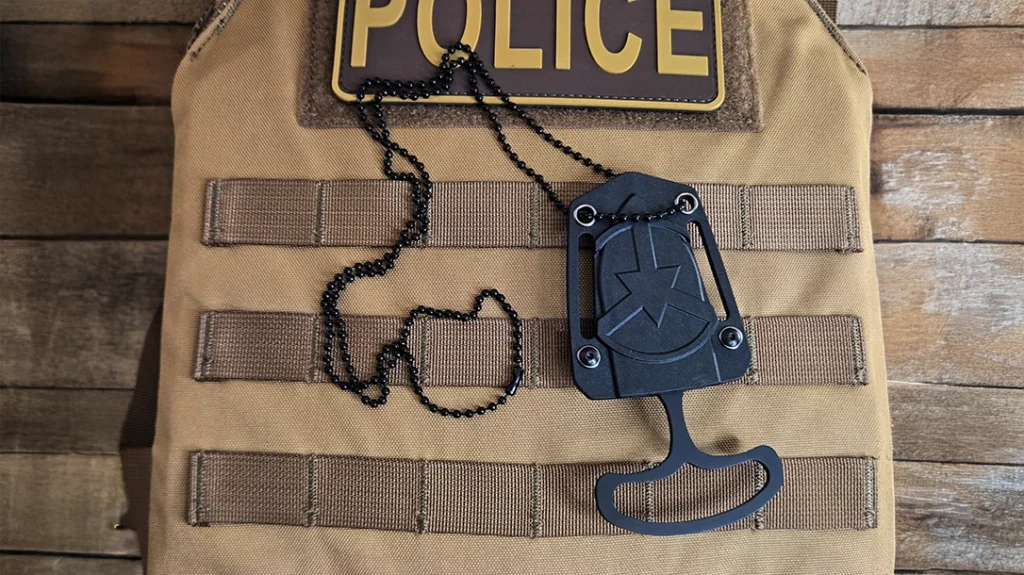
Along the same lines, you can clip the knife to the trauma plate of your soft armor or under your uniform shirt. Both methods are less conspicuous than wearing the Push Knife directly on the belt, but they are a bit slower to access.
If you wear an outer vest carrier for your armor, attaching the knife there is another good option. It can again be clipped behind a mag pouch or other piece of gear. If you’re using a MOLLE carrier, you can use the grommets on the ASP knife to zip-tie or paracord it in place, pretty much anywhere on the vest where you can access it conveniently.
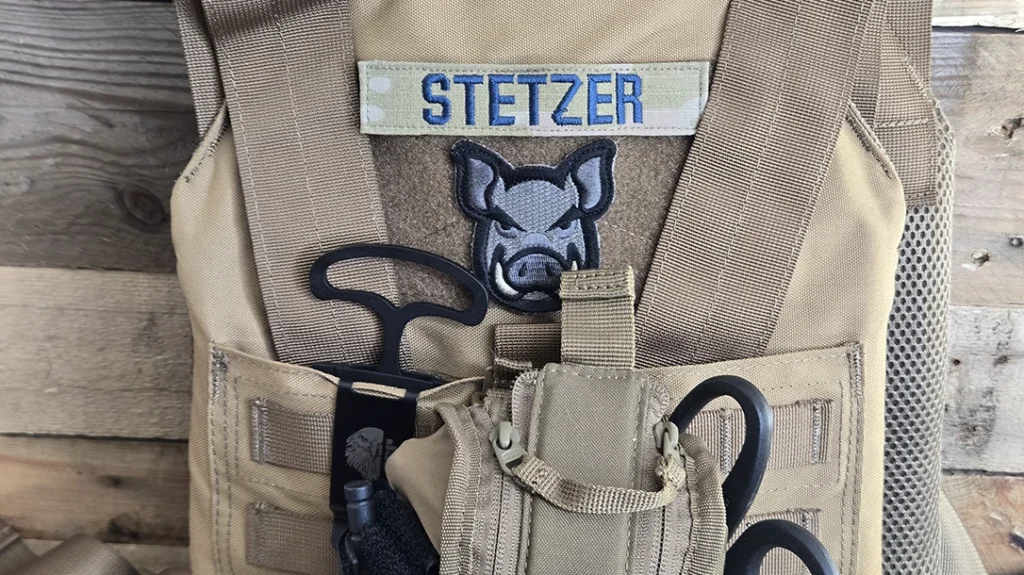
For off-duty or plainclothes carry, the sheath’s clip allows it to be clipped either to the trouser belt or tucked inside the waistband for a more discreet carry option. Again, the key is that it be accessible when your primary hand is occupied. So, you’re probably looking at carrying it on your non-dominant side or on the front of the belt, where it can be accessed with either hand.
Testing the PDK Push Knife
While you can certainly use the Push Knife for general EDC, that’s not really its role. ASP’s PDK comes with a decent edge, and AUS-8 is good, but not amazing steel. This isn’t likely something you’re doing a ton of cutting with, though, so its edge should hold up just fine. It has plenty of toughness and is highly corrosion resistant, which are probably more important for its purposes.
I did some basic cutting just to get a feel for the knife, and did some punches into a stacked cardboard target. It’s easy to use, and I could sink the 2-inch blade all the way in on most hits, even with the target covered in old blue jean denim.
On-the-Job Carry
I tested the PDK on my armor carrier as well as on my duty belt. In my current role as a school police officer, our uniform shirts are Polo-type. So, I did not try neck carry with them. Armor carry works well, but my vest is a rifle plate carrier that I don’t wear all of the time. So, I mostly carried it on the duty belt.
The one thing I found when attaching it directly to the duty belt was that my belt was thick and wide. So, the clip tended to pull free when I went to draw the knife. I found that zip-tying it in place was the way to go if you plan to leave it attached to your duty belt.
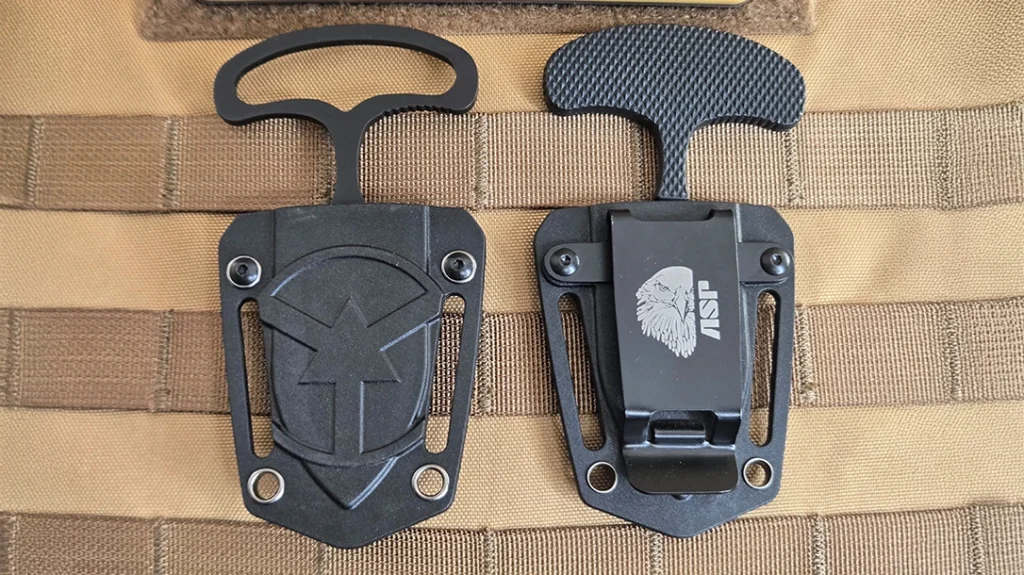
The other carry method I mentioned was to clip the Push Knife to your trouser belt, then put your duty belt over it. This is a minor extra step when putting on your uniform. However, it did hold the knife more securely if you don’t want to semi-permanently attach it to the duty belt.
I also tried one of the Push Knives on my offside near my cuff case. This worked out okay, but it did take up some belt space. Likewise, it was much more obvious that I was carrying it.
When I was off duty, I carried the Push Knife on occasion as well, just to get a feel for it. I’d generally wear it clipped inside the waistband of my jeans. It worked well in this mode too. It was very discreet and easy to carry.
The ASP PDK Push Knife is a Specialized Tool
A Push Knife, like the ASP PDK, is a specialized tool. It’s designed for law enforcement, but can fulfill the same role for security officers and armed civilians just as well. The knives are affordable enough that even if I have an EDC utility knife, I don’t mind having a second quick-access knife as a backup if things ever go severely south.
The Push Knife isn’t the be-all, end-all solution to a weapons retention struggle. However, it is another tool you can have in your tool kit. With its 2-inch blade, it’s small enough to be discreet and doesn’t get in the way when you’re bending, sitting, or moving about.
Some folks may doubt the utility of it, but I suspect the Pittsburgh officer who used his to fend off a gun grab isn’t one of those guys.
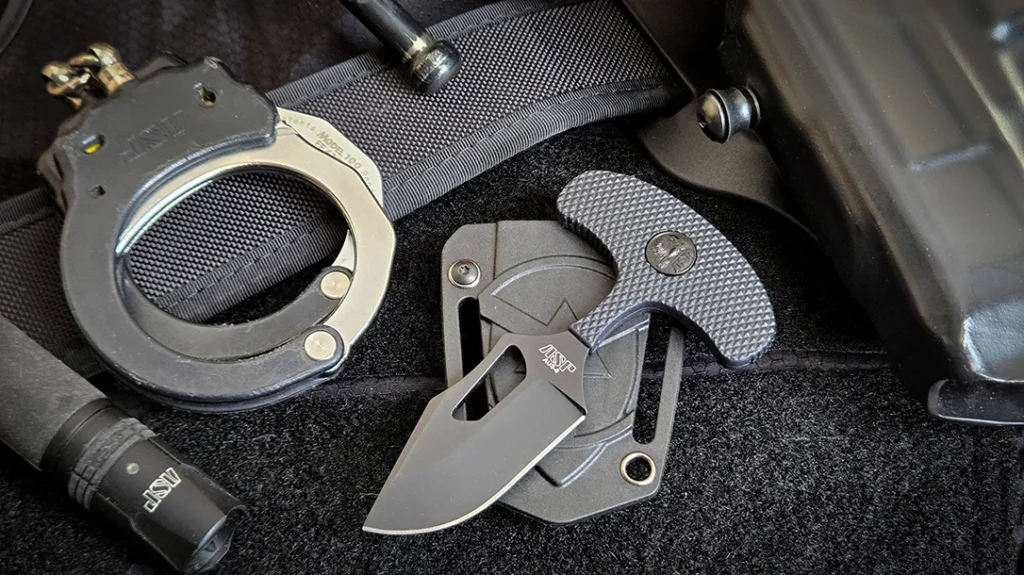
ASP PDK Push Knife Specs
| Overall Length | 4.55 inches |
| Width | 2.6 inches |
| Depth | 0.37 inch |
| Weight | 2.3 ounces |
| Blade Material | AUS-8 stainless steel |
| Blade Profile | 2.25-inch drop point |
| Blade Finish | Black BVD finish |
| Grip Material | Overmolded polymer grip |
| Sheath | Ambidextrous sheath |
| MSRP | $37.00 |
WHY OUR ARTICLES/REVIEWS DO NOT HAVE AFFILIATE LINKS
Affiliate links create a financial incentive for writers to promote certain products, which can lead to biased recommendations. This blurs the line between genuine advice and marketing, reducing trust in the content.