


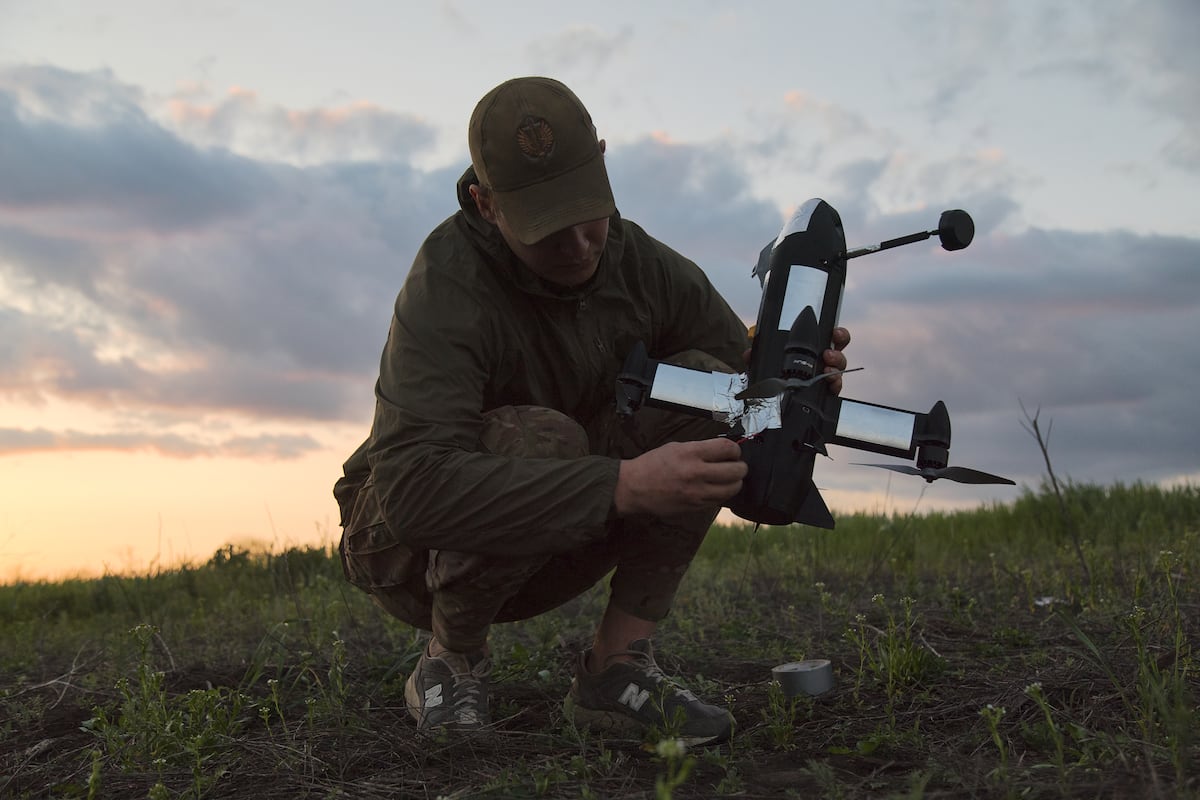
KYIV, Ukraine — The U.S. State Department and Ukraine’s ambassador in Washington have outlined a memorandum that would route Ukrainian drone technology into joint ventures on American soil in an attempt to inject Kyiv’s combat experience into the military’s equipment supply chains.
The draft agreement would open a legal channel for Kyiv to sell its weapons to the U.S. for the first time since it effectively banned arms exports to maintain its own forces at the start of Russia’s full-scale invasion in 2022, CBS News first reported.
The memorandum, drawn between the State Department and Ukrainian Ambassador Olha Stefanishyna, would integrate Ukrainian producers into joint ventures and tech-transfer arrangements with American firms.
The development caps two weeks in which Kyiv adopted an export framework dubbed “Drone Deals,” launched a procurement coalition with multiple European partners and watched Washington lift a 1997 import ban – all while signing four bilateral export contracts and pursuing roughly 20 more across the Middle East and partner countries, President Volodymyr Zelenskyy said this week.
Zelenskyy touted the new framework at a May 13 summit in Bucharest, Romania, with delegates from NATO’s nine eastern-flank members and their Nordic allies, as seen in a clip of the event posted on X.
“I believe all of us need bilateral Drone Deals,” he said, “using Europe’s production capabilities and Ukrainian expertise proven in real defense during a real war.”
Over four years into Russia’s full-scale invasion, Ukraine has built an arms industry that manufactures much of the hardware seen on the battlefield today, but that has struggled to scale up while capped by export bans, funding limitations and manufacturing challenges caused by the ongoing war.
“The Ukrainian military will always have the right to priority and sufficient supply – they will take what is needed, and the volume beyond that will go to export,” Zelenskyy said in a April 28 Telegram post announcing the new policies.
After years of struggling to arm its one million active-duty soldiers, Kyiv has been wary of allowing its domestic producers to sell their weapons abroad at a markup in case they may choose profit over supplying their own military.
But times have changed. Foreign defense funding to Ukraine hit $6.1 billion in 2025, marking a tenfold increase over the roughly $600 million the year before, according to the Ministry of Defense, and the world is turning to Kyiv as the leader in modern warfare and defense tech.
Fears over remaining empty-handed at home appear to have subsided.
“In some production areas, we currently have up to 50% surplus capacity,” Zelenskyy said last month.
Ukraine’s defense production capacity has grown 35 times since the invasion began, from $1 billion to $35 billion, but domestic contracts covered only about a third of that last year – a gap Kyiv’s National Security and Defense Council projects will widen, with capacity expected to hit $55 billion in 2026.
Western contracts pay multiples of what the domestic procurement budget can offer, and those funds are the only capital large enough to fund the scale Ukraine needs to sustain both its front line and its surging arms industry.
Stefanishyna told the Philadelphia Inquirer in April that more than 100 U.S. investors have already expressed interest in Ukrainian defense-tech companies, and the U.S. government bought an initial 1,000 P1SUN drones from Ukraine that month.
Business lost?
Ukrainian producers have been pressing for new and improved export laws for years, but especially since demand from foreign buyers for Ukraine’s drones began surging after the war in the Middle East kicked off earlier this year.
Ihor Matviyuk has spent months turning down orders he cannot legally fill. He heads Aero Center Drones, a Kyiv-based manufacturer building FPV strike platforms and interceptor drones.
Until now, the only legal route has run through state arms-trade companies like Ukrspecexport, Progress and SpetsTechnoExport that take the contract on the producer’s behalf, he said.
“No Ukrainian company can export military goods independently. Companies can manufacture, but they cannot ship,” Matviyuk told Military Times in March.
He said a Western government asked Aero Center for 1,500 interceptor drones earlier this year, a request he’s now received several times over as the Iran war demonstrates how quickly a state can exhaust conventional interceptor stocks defending against mass-drone attacks.
But Matviyuk said he had to turn down the request despite having the manufacturing capacity to do it within weeks without affecting his current contracts.
“We cannot currently export large quantities,” he said at the time. “It’s only possible at the state level.”
The new framework permits five export categories – drones, missiles, ammunition, software and integration services – drawn from Defense Ministry-certified surplus. The Foreign Ministry and intelligence services have naturally blacklisted Russia and its cooperators from buying Ukrainian.
“The National Security and Defense Council of Ukraine, based on intergovernmental agreements with partners, will define the framework for cooperation – just to ensure that Ukrainian technologies and Ukrainian weapons do not end up in Russian hands,” Zelenskyy said.
It opens three legal channels for producers – independent licensing through the State Export Control Service, routing via specialized state arms-trade companies, and a 15-day “Defense City” preliminary permit that skips Cabinet designation, though the interagency commission still reviews every application under all three routes.
Defense City is a special legal regime for defense manufacturers, launched in January, that grants qualifying firms tax exemptions, simplified customs and the fast-track 15-day export permit regardless of where they operate in Ukraine. Approved firms will also be able to sell through the ten European hubs Zelenskyy announced in February, according to Euronews.
Every signed contract will now move through a 90-day clock at the State Export Control Service and a 17-member interagency commission under the National Security and Defense Council, replacing a licensing regime that set no fixed timelines and left approvals to bureaucratic discretion.
The NSDC commission had sat dormant for eight months until Zelenskyy reactivated it in December. It has made roughly 80 decisions since then, according to Ukrinform.
The new framework is intended to break the bottleneck that turned Matviyuk’s prospective 1,500-interceptor order into a loss, and Zelenskyy said the new timelines should close the room for graft that the old system created.
“We also need automatic export authorizations with a clear and predictable timeframe for approval, so that there is no ground for corruption,” he said.
Kyiv officials have pledged to continue advancing anti-corruption enforcement in parallel – a difficult process that has seen several successes but still has significant work ahead, according to a 2026 analysis by the global watchdog group Transparency International.
Procurement orchestrations
For Kyiv, things are moving forward elsewhere, too, when it comes to fresh approaches to defense purchases with European partners.
Ukraine and five European nations – Finland, Italy, Norway, Sweden and the United Kingdom – signed the CORPUS Memorandum on April 30 in a Kyiv hotel garage-turned-bunker, launching a defense-procurement coalition that links the countries’ national procurement agencies to coordinate buying, share supply-chain intelligence and open a path to joint contracts.
Ukraine’s CORPUS chair, Arsen Zhumadilov, also heads the country’s Defense Procurement Agency, set up in 2023 to take over arms buying after scandals over inflated food contracts and substandard winter jackets cost then-Defense Minister Oleksii Reznikov his job.
One of the DPA’s biggest moves against corruption and approval delays cut out the intermediaries – middleman firms that had been a required layer between state buyers and private manufacturers. Their share of arms procurement has fallen from 81% to 12%.
Zhumadilov’s role in CORPUS places Ukraine’s own procurement agency inside a multinational coalition, rather than leaving it only on the buyer’s side.
“We are starting with the exchange of experience and best practices to build coordination mechanisms, mutual trust, and plan for the future,” Zhumadilov said at the CORPUS post-signing press conference.
Denmark, France and the Netherlands have already registered interest in joining the group, he added.
More bilateral defense procurement partnerships are in the works, too. Kyiv and Berlin announced six new joint ventures over the last month, and Norway inked a parallel cooperation declaration to mass-produce Ukraine’s mid-range strike drones. Zelenskyy has announced plans to open ten export hubs across Europe in 2026, with production lines already running in the United Kingdom.
European leaders increasingly see Ukrainian weapons production as key to allied defense.
“Instead of us thinking that Ukraine needs Europe, perhaps we should think that we in Europe need Ukraine more,” Finland’s president, Alexander Stubb, said on May 4.