


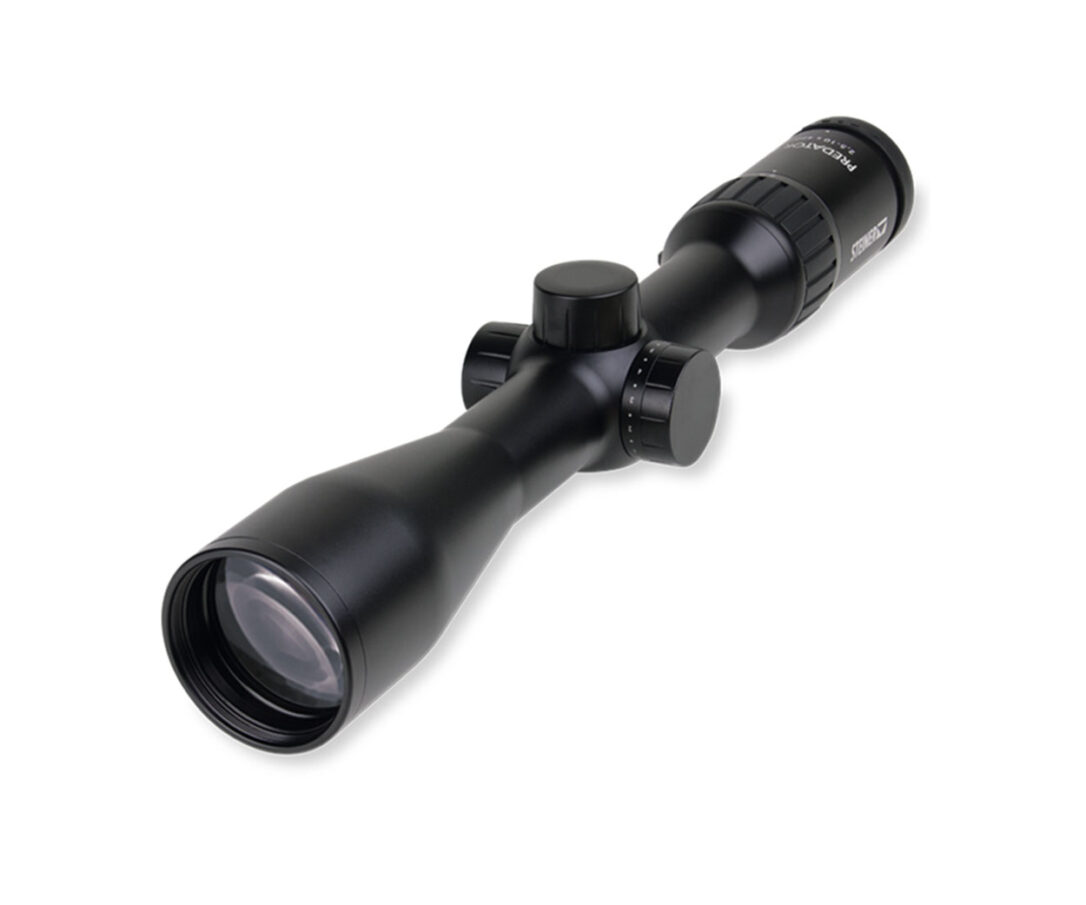
Riflescopes are simple things, right? After all, you look through one end, see your target far closer than it actually is because of the magnification, put the crosshairs right where you want them, and then squeeze the trigger. Boom! Big buck down!!
While new shooters might think that’s all they need to know, when they start shopping for their first scope, they’ll quickly realize riflescopes have a language all their own. Let’s take a look at a handful of the more important optical terms new shooters need to understand when considering a riflescope.
Some Important Terms To Know
Magnification: The extent to which an object appears enlarged is called magnification. For instance, with a 3-9x riflescope, you can magnify the target from 3x to 9x its normal size. Keep in mind that increasing the power reduces the brightness of the image.
Advertisement — Continue Reading Below
Objective Lens: The objective lens is the front lens on the riflescope, usually measured in millimeters. For a 3-9×42 scope, the objective lens is 42mm, and the magnification ranges from 3 to 9x. A larger objective lens allows more light to pass through, resulting in clearer images, while a smaller one transmits less light.
Ocular Lens: Also known as the eyepiece lens, this is the lens closest to the shooter’s eye. It is smaller than the objective lens and adjustable for focus to an individual user’s eyesight. The exit pupil is emitted from this lens.
Tube Diameter: This, of course, is the diameter of the scope’s main tube. Common sizes are 1 inch, 30mm, and 34mm. A larger tube diameter provides a greater elevation adjustment range, which is essential for long-range shooting.
Advertisement — Continue Reading Below
Reticle: The reticle is the crosshairs or aiming point in the riflescope that you align with the target when pulling the trigger. A few decades ago, most were simple crosshairs. However, today they range from basic crosshairs to tactical reticles, precision reticles, and everything in between.
Eye Relief: This is the distance from the rear lens of a riflescope to the point at which the user’s eye can see the full field of view. More eye relief means less chance of whacking yourself in the forehead with the scope during recoil.
A Few More Of Note
Coatings: The optical elements within a scope are coated to alleviate internal light loss and glare. That ensures even light transmission, resulting in sharper images, greater brightness, better color fidelity, and higher contrast. From least effective to best, they are coated, fully coated, multicoated, and fully multicoated.
Advertisement — Continue Reading Below
Light Transmission: A scope’s ability to transmit light is crucial for how well a distant object can be seen through the scope. Several factors can affect light transmission and, as a result, image quality, including lens glass quality, coatings used, and the lens diameter.
Field of View: FOV is the size of the area that can be seen when looking through a riflescope. It is typically measured in the number of feet that can be viewed at 100 yards. The higher the magnification, the smaller the field of view.
Exit Pupil: This is the diameter of the beam of light that leaves the eyepiece of a riflescope, measured in millimeters. The larger the exit pupil, the brighter the image will be—an important factor for low-light shooting.
Advertisement — Continue Reading Below
Turret: The turrets are the knobs located at the center of the scope tube. The one on the right adjusts the windage (left and right), while the top one adjusts the shot’s elevation (up and down). These are used during sighting to ensure the rifle shoots exactly where the reticle is aimed.
Resolution: This is a measurement of the scope’s ability to distinguish fine detail and produce sharp images. Resolution is closely linked to the size of the objective lens, as larger lenses allow more light, resulting in a clearer sight picture. Higher resolution also benefits from better glass and coatings.